BPM’s structured approach to managing business processes improves the quality of work and operational efficiency — the two primary reasons companies adopt it. A well-executed BPM program can eliminate waste, cut errors, save time, improve compliance, increase agility, support digital transformation and ultimately help deliver better products and services to customers.
“BPM allows organizations to streamline workflows by automating tedious tasks, such as data management, data flows, date entry approval processes and report generation,” said Isaac Gould, research manager at Nucleus Research.
BPM can also be an effective management tool for the following reasons:
BPM’s focus on standardizing processes reduces the risk of human error.
Embedded analytics gives managers more visibility into process performance and helps them identify bottlenecks.
Automation tools increase efficiency and let employees focus on tasks that require human expertise and interventions.
All of the above give employees more time to identify other process enhancements and automations for continuous improvement of business processes.
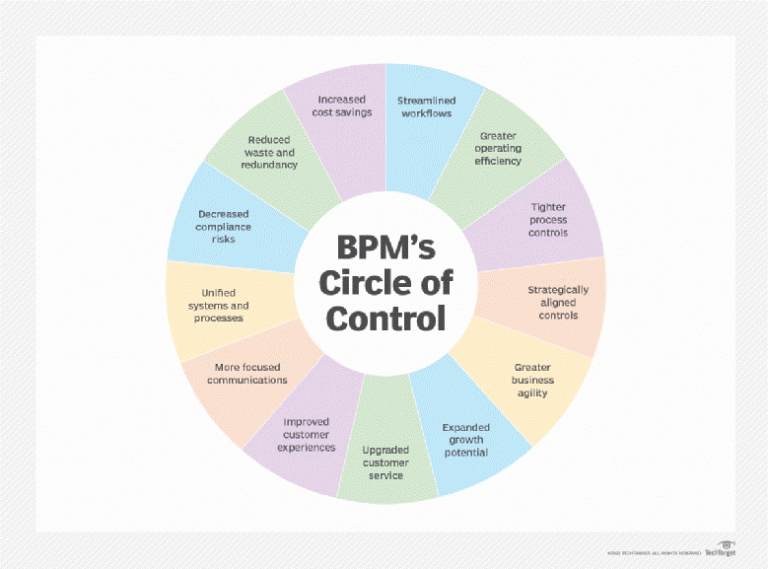
Done well, the benefits of BPM permeate practically every aspect of operations, as illustrated in the chart below.”
BPM benefits
The benefits of BPM permeate business operations.
What are the challenges of business process management?
Challenges abound in any business initiative that involves changing the status quo. That is especially true of BPM,
To maximize the benefits of BPM, organizations must be prepared for the challenges they might encounter and have a plan for addressing them, as explained in an article by technology reporter George Lawton, who covers technology-enabled business transformation.
The following obstacles are the most common reasons for BPM failures, according to the experts Lawton interviewed:
- lack of executive buy-in and support;
- unclear business goals and objectives;
- inadequate testing infrastructures;
- confusion about the right tool for the job;
- hidden processes vulnerable to breakdowns;
- poor process visibility and traceability; and
- inflexible third-party contracts and incentives.
- Different categories of business process management
BPM is so broad and typically involves the use of various tools, some BPM experts talk about the discipline in terms of the following categories:
System-centric. This type of BPM focuses on processes involving workflows in business systems that operate without much human intervention and are integrated into enterprise applications. Automated processes in customer relationship management and enterprise resource planning systems are two examples.
Human-centric. BPM can also focus on processes that people handle. These processes include ones in business applications that have features designed for human interaction, such as a well-designed user interface, alerts and notifications.
Document-centric. This approach centers on documents, such as the process of formatting, signing and verifying contracts. Often, business process management tools specialize in a specific document-centric task, such as signing documents.
‘Levels of concern’ in BPM
In Business Process Change, Harmon argued that it’s useful to distinguish between the various “levels of concern” in BPM initiatives, which he identified as the enterprise level, business process level and implementation or resource level. “Projects or activities at different levels require different participants, different methodologies, and different types of support,” he wrote.
Harmon offered the example of a BPM project focused on a company’s supply chain management process. The project might be triggered by an enterprise-level BPM group that decides the company’s supply chain is not operating efficiently, initiating a redesign of the process. The redesign team undertakes a study and recommends certain changes, which must be approved by senior management. In this example, the redesign involves the acquisition of a new ERP system, which brings in the IT department. It also creates new job roles that require training courses, bringing in HR.
Harmon’s three levels of concern in BPM
Graphic depicting Paul Harmon’s levels of concern in BPM
– PAUL HARMON
BPM examples and applications
BPM applications are used in many departments within an organization. Examples of how it is used to achieve business objectives include the following:
Human resources. BPM software can make HR departments more efficient by, for example, simplifying the review of timesheets. Onboarding new hires is another HR area where BPM can improve and speed up the many steps of the process. When document-centric HR tasks are automated, it cuts the use of paper forms throughout a company.
Finance. Finance departments receive a variety of documentation from both system-centric and human-centric processes. They receive a large volume of emails and paper forms about the company’s internal and external financial processes. For example, a BPM platform enables finance departments to process employee travel requests faster. It can also streamline purchasing processes.
Sales. Sales teams also deal with a mix of human- and system-centric processes. BPM tools can coordinate the exchange of sales quotes and invoices and ultimately shorten sales cycle workflows.
Different types of BPM technologies
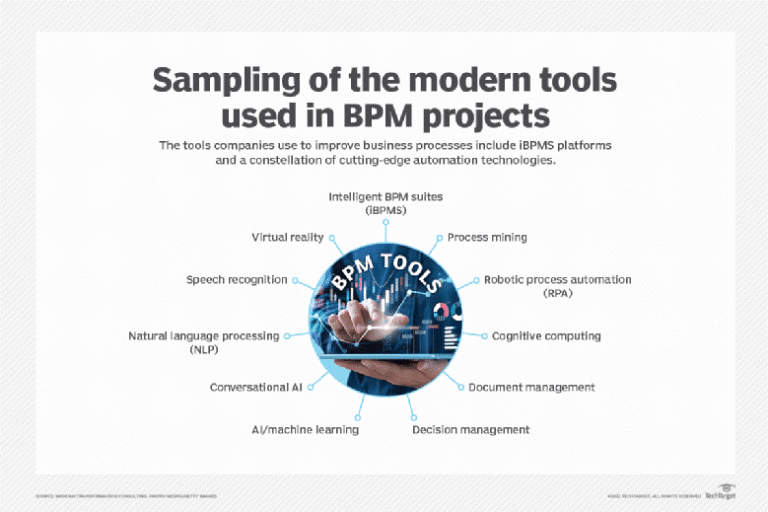
Business process management software (BPMS) is designed to automate the improvement of business processes. Sometimes referred to as BPM systems or suites, BPMS is a collection of different types of technologies that include the following:
process mining tools for the discovery, representation and analysis of the tasks that drive business processes;
BPMN tools for diagramming business processes;
workflow engines to automate the flow of tasks that complete a business process and support workflow management;
business rules engines (BREs) to enable end users to change business rules without having to ask a programmer for help; and
simulation and testing tools for observing how processes behave without having to code first.
Our newly expanded definition of business process management software explains in detail what this software is, why it’s used and the standard features you can expect. Here is an overview of some of the new developments in BPMS:
IBPMS. The term intelligent BPMS (iBPMS) was introduced by research firm Gartner Inc. It is now widely used by BPM vendors to underscore how the use of advanced technologies — such as real-time analytics, machine learning, complex event processing, business activity monitoring and other systems — have made process automation more data-driven and dynamic. These iBPMS products also come with advanced social and collaboration capabilities.
LCNC. BPM’s increasing use of low-code/no-code (LCNC) technology means that businesses no longer need to depend solely on professional coders to optimize their business processes. Business analysts and even business users can work together with developers to model new business processes. For a detailed list of standard BPM modeling techniques, read “Top 9 business process modeling techniques with examples.”
RPA vs. BPM. Robotic process automation (RPA) and BPM, considered by some to be competitors or at best frenemies, today function as complementary partners.
RPA programmable software tools, or bots, automate manual, repetitive, rules-based tasks by mimicking the way humans click and type in the business applications they use to do their jobs. This relatively user-friendly software can also automate access to legacy software applications that lack modern application programming interfaces, or APIs — another selling point. RPA is best suited for automating discrete tasks rather than complex business processes, but this limitation is diminishing as the software evolves.
BPM, as explained in this guide, is a discipline, not a technology. It aims to improve processes using a set of principles and techniques derived from methodologies such as Six Sigma, total quality management and lean management. BPM may or may not involve automation and, as proponents stress, it is as much a mindset as it is a technical discipline: Companies that adopt BPM must see the value of taking a process approach to fulfilling business goals and the value of continuous process improvement. As noted, BPM’s collection of enabling technologies — BPMS — has evolved to better address the business need for continuous improvement and agile transformation at scale.
Bottom line: RPA products are becoming better at scaling process automation, and BPM software platforms increasingly offer RPA as part of their toolkit. Read more about how BPM and RPA work together in “RPA vs. BPM: How are they different.”