Informational

Software Development Outsourcing In The Netherlands

July 22, 2026
Software development outsourcing in Netherlands
Business development manager - Bangladesh Software Solution
Share:

A practical 2026 guide to costs, vendor selection, AVG/GDPR compliance, time-zone collaboration and delivery control

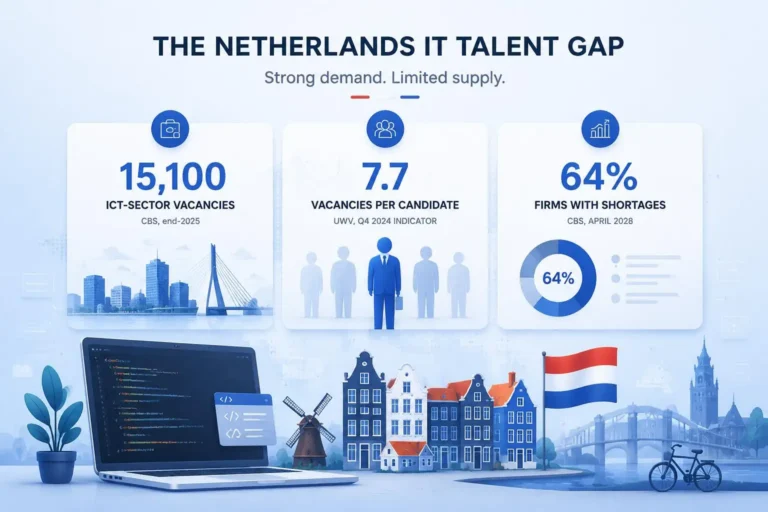
Software development outsourcing is increasingly relevant to Dutch companies not because local talent has disappeared, but because recruiting a complete, resilient engineering capability remains slow, expensive and difficult to scale. UWV still describes the ICT labour market as very tight, while CBS reported 15,100 vacancies in the Dutch ICT sector at the end of 2025. Across the wider economy, 64% of firms reported staff shortages in April 2026. [1] [3] [4]

A sound outsourcing decision therefore starts with capacity planning, not price shopping. Dutch buyers should define the business outcome, decide which responsibilities stay internal, choose the right engagement model, verify the actual delivery team, run a paid pilot, and put governance, intellectual-property ownership, security and exit arrangements into the contract before scaling.

The most important compliance question is whether the external team will process or access personal data. If it will, the Dutch company should map controller and processor roles, put an Article 28 processing agreement (verwerkersovereenkomst) in place, and assess any transfer outside the European Economic Area. Bangladesh is not on the European Commission’s current adequacy list, so an appropriate transfer mechanism—commonly Standard Contractual Clauses—plus a transfer assessment and supplementary safeguards may be required. [11] [12] [13] [14] [31]

Figure 1. Current Dutch capacity signals Source: UWV and CBS; see sources [1], [3] and [4].

Decision rule

Outsource when the business has a clear owner, measurable outcomes and a governance model—but needs faster access to capacity or specialist skills. Do not outsource an undefined product strategy and expect the vendor to create accountability that the client has not assigned internally.

The Dutch Development Hiring Problem

A company rarely needs “a developer” in isolation. A reliable product function typically needs product ownership, architecture, frontend and backend engineering, quality assurance, cloud or DevOps capability, security awareness, documentation, release management and ongoing maintenance. Hiring these roles one by one creates dependencies: the first engineer may wait for product decisions, the QA hire may arrive after architecture choices have hardened, and the technical lead may spend months recruiting instead of shipping.

  • Competition for experienced specialists. Senior cloud, DevOps, cybersecurity, data and enterprise engineers are recruited by banks, consultancies, platforms, public organisations and scale-ups at the same time.
  • A long time-to-capacity. Advertising, agency search, interviews, notice periods and onboarding can consume a meaningful part of a product roadmap.
  • A salary is not the full commitment. Employers also budget for holiday allowance, payroll and pension-related costs, equipment, licences, training, leave, management and replacement risk.
  • Retention becomes a delivery risk. When knowledge is concentrated in one or two local hires, resignation or long-term absence can disrupt a roadmap.
  • Fixed headcount reduces flexibility. Permanent hiring is valuable for core capability, but it is difficult to reverse when a temporary migration, launch or regulatory deadline ends.
  • A local agency can be faster—but costly. A Dutch software agency may supply a complete team, yet its blended rate includes local salary levels, bench, management, sales and overhead.

Why an in-house team still matters

Outsourcing is not a reason to remove internal technical ownership. Dutch companies normally obtain better results when they retain product strategy, final prioritisation, compliance accountability, access approval, architecture direction and acceptance authority. The external team supplies execution capacity and specialist experience; it should not become the only place where the product’s business logic is understood.

Robert Half’s 2026 Netherlands guide places the national monthly gross starting-salary range for a software developer at €4,351 to €5,912, or roughly €52,200 to €70,900 annually before holiday allowance and other employer costs. Its IT Manager range is €6,276 to €8,251 a month. These are salary benchmarks—not total employer cost and not contractor or agency rates. [5] [6]

Salary is only the first line of the budget

Dutch employers generally need to account for at least 8% holiday allowance as well as other personnel costs that can include employer contributions, pension arrangements, travel or home-working support, equipment, licences, training, recruitment and management. Statutory annual leave also reduces the number of productive delivery hours available from a full-time salary. The exact cost depends on the CAO, pension scheme, employment terms and organisational structure. [8] [9] [10]

Role Illustrative gross salary Illustrative annual employer cost

Junior software developer

€52k–€60k

€68k–€83k

Mid-level software developer

€59k–€72k

€77k–€99k

Senior software developer

€71k–€90k

€93k–€125k

QA engineer / test lead

€49k–€75k

€64k–€104k

DevOps / cloud engineer

€65k–€90k

€85k–€125k

Technical lead / IT manager

€75k–€99k

€98k–€138k

Salary anchors use Robert Half 2026; employer-cost ranges are BSS editorial scenarios adding holiday allowance and explicit cost assumptions—not quotes or statutory percentages.

Table 1. Illustrative Dutch development employment costs

How the employer-cost scenario was built

The model adds the statutory 8% holiday allowance, then uses an illustrative 18%–25% provision for employer contributions, pension and benefits, plus €4,000–€12,000 for recruitment, equipment, licences, training and management. Organisations should replace these assumptions with payroll, pension, CAO and procurement data from their own business. [8] [9]

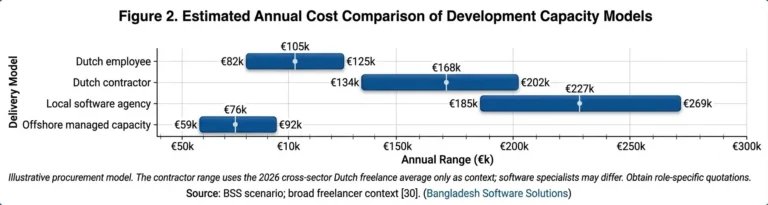
Estimated annual cost of development capacit

Estimated annual cost of one unit of development capacity

A small product team: local versus outsourced

Factor Illustrative Dutch in-house team Illustrative Outsourced Team

Team shape

2 developers, 1 QA engineer, 0.5 DevOps, 0.5 product/project management

2 developers, 1 QA engineer, 0.5 DevOps, shared delivery lead

Annual cost scenario

€390k–€550k

€250k–€360k

Time to assemble

Often several sequential recruitment cycles

Can be formed from an existing delivery organisation after due diligence

Direct control

Highest; all employment and daily management are internal

High if client retains product ownership and has direct team access

Scalability

Slow; adding or reducing headcount has employment consequences

Faster through contractual ramp-up/ramp-down terms

Continuity risk

Knowledge can concentrate in a few employees

Vendor must provide documented handover, replacement and retention controls

Compliance

Internal policies still apply

Requires contractual, technical and cross-border data controls

Cost ranges are scenario-based and must be replaced with actual compensation, procurement and BSS quotation data before a business case is approved.

Table 2. Small-team capacity comparison

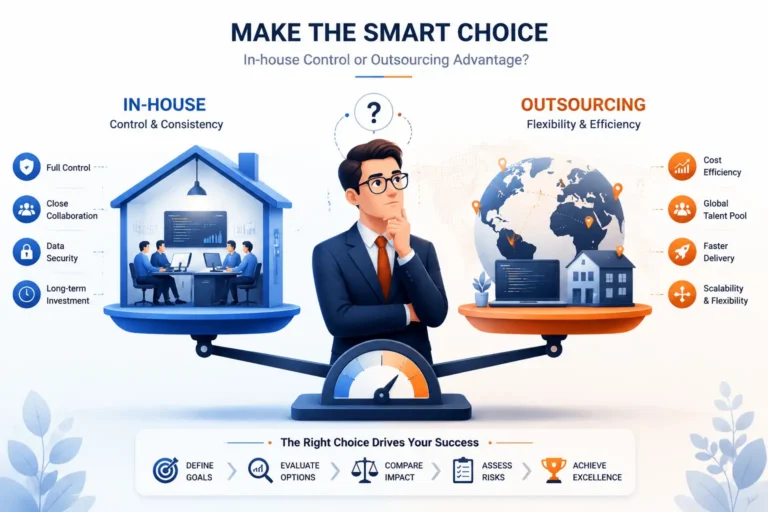
Figure 2.5. Making the smart choice.

Outsourcing Is the Right Choice

Outsourcing works best when a company can define the outcome and govern the relationship, but cannot—or should not—build every delivery capability locally. The deciding factor is usually the shape and duration of the capacity need, not whether one country is universally “better” than another.

Good use cases for Software Outsourcing in the Netherlands

  • MVP or product launch. A defined product owner needs a cross-functional team quickly and wants to validate demand before committing to a large permanent organisation.
  • Legacy modernisation. The company needs temporary specialists for re-platforming, cloud migration, API development, automated testing or data conversion.
  • Capacity extension. An internal engineering team owns the product but needs additional developers to meet a release or regulatory deadline.
  • Specialised capability. Skills such as AI/ML, DevOps, mobile, QA automation, BIM/CAD integration or ecommerce platforms are needed intermittently or are hard to recruit locally.
  • Long-term dedicated team. A stable external team can work as an extension of the Dutch organisation under one backlog, architecture and quality standard.
  • Maintenance and support. A documented product needs predictable enhancements, testing, incident response and release support.

When Software Outsourcing May Not Be the Right Option

  • No accountable product owner. A vendor cannot resolve conflicting stakeholder priorities without a client decision-maker.
  • The business problem is undefined. Outsourcing an unclear strategy typically turns ambiguity into change requests and rework.
  • Sensitive access cannot be controlled. Projects involving production data or critical systems should not start until legal, security and least-privilege controls are ready.
  • Physical presence is continuous. Some hardware, laboratory, industrial or on-site operational work may require a local team or hybrid model.
  • The buyer wants only the lowest rate. A procurement process that ignores continuity, communication, quality and exit costs creates false economy.

Choosing the Right Software Outsourcing Model

The same vendor can perform very differently under different commercial models. Select the model that matches scope certainty, required control, duration and the maturity of the client’s product organisation.

Model Best use case Client control Vendor responsibility Flexibility Typical duration Cost predictability Main risk

Dedicated team

Ongoing product development

High

Team capacity, people and delivery support

High

12+ months

Medium–high

Team becomes a black box

Staff augmentation

Specific skill gaps

Very high

Named individual contributors

High

3-18 months

Medium

Client lacks management capacity

Project-based

Well-defined build or migration

Medium

Scope, schedule and deliverables

Low-medium

3-12 months

High when scope is stable

Change-request disputes

Managed product delivery

Outcome-based product stream

Medium-high

Cross-functional team and delivery management

High

6–24+ months

Medium

Weak product ownership

Build-operate-transfer

Create a long-term capability to internalise

High over time

Recruit, operate and transfer team/process

Medium

18–36 months

Medium

Transfer terms are vague

Local recruitment

Permanent core capability

Highest

Employment only

Low

Long-term

Low after hire

Slow capacity and fixed cost

Compliance

Short, senior or specialist need

Highest

Individual expertise

High

1–12 months

Low-medium

Dependency on one person

Table 3. Development sourcing model comparison

How to Outsource Software Development: Step-by-Step Guide

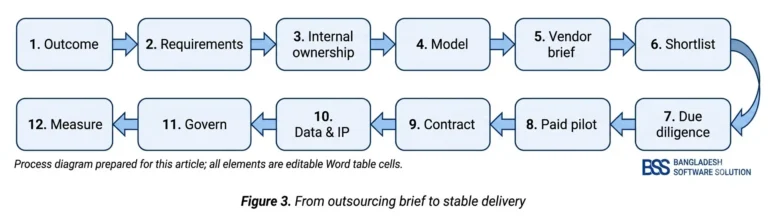
Successful outsourcing is a managed sequence of business definition, vendor due diligence, controlled onboarding and measurable delivery. The process below is intentionally more rigorous than sending a feature list to several vendors and comparing day rates.

Step 1: Define the business outcome

Begin with the business result, not the technology stack. Write down the user or operational problem, the measurable outcome, the target date, budget boundaries and the person authorised to make trade-offs. A “new customer portal” is a solution label; “reduce service calls by giving customers secure self-service for the five most common requests” is a usable outcome.

Project Definition AreaWhat to define or verify
Business objectiveWhat commercial, operational or regulatory result must change?
UsersWho will use the product and what problem do they have?
Success metricsAdoption, conversion, processing time, defect rate, cost or compliance evidence.
Decision ownerName the product owner with authority over scope and acceptance.
ConstraintsBudget, launch date, procurement, data, technology and integration boundaries.

Checklist: 1: Define the business outcome

Step 2: Define the technical requirements

Convert the outcome into a technical brief without pretending every design decision is already known. Describe current systems, integrations, hosting, security classification, performance, availability, browser/device support, accessibility, testing, documentation, deployment and maintenance. Mark assumptions and unresolved questions so vendors can price discovery instead of hiding uncertainty inside a fixed bid.

Engineering ConsiderationWhat to define or verify
ScopeFeatures in scope, out of scope and future assumptions.
ArchitectureCurrent landscape, preferred patterns and technical constraints.
DataCategories, residency, environments, retention and permitted test data.
QualityDefinition of done, test levels, code review and non-functional requirements.
OperationsMonitoring, support hours, release process and handover expectations.

Checklist: 2: Define the technical requirements

Step 3: Decide what should remain internal

A company in Netherlands should usually retain product strategy, business priority, compliance ownership, final access approval, acceptance authority and a clear architecture decision path. The vendor can provide engineering leadership and delivery management, but the client should not outsource accountability for why the product exists or whether the organisation is legally permitted to process data.

Ownership CategoryWhat to define or verify
Keep internalProduct ownership, final prioritisation, compliance decisions, access approval, budget and acceptance.
Can be sharedArchitecture, release planning, risk management, quality standards and roadmap refinement.
Can be externalEngineering execution, QA, DevOps implementation, documentation and managed delivery—subject to controls.

Checklist: 3: Decide what should remain internal

Step 4: Select the engagement model

Use scope certainty and desired control to select dedicated team, staff augmentation, managed product delivery or project-based outsourcing. A fixed-price project can be appropriate for a stable specification; it is usually the wrong tool for a discovery-heavy product where the backlog will change. For ongoing products, capacity-based models often make trade-offs more transparent.

Engagement ScenarioWhat to define or verify
Stable scopeProject-based or milestone contract.
Changing roadmapDedicated team or managed product delivery.
One missing skillStaff augmentation.
Future internalisationBuild-operate-transfer or structured knowledge transfer.

Checklist: 4: Select the engagement model

Step 5: Create an RFP or vendor brief

A strong brief lets vendors respond to the same problem, which makes proposals comparable. It should state business outcomes, users, scope, technology, data classification, target team, governance, security expectations, commercial model, evaluation criteria and the evidence required.

Evaluation AreaWhat to define or verify
Outcome and scopeBusiness objective, users, inclusions, exclusions and target date.
TeamRequired roles, seniority, location, overlap hours and named-person expectation.
DeliveryAgile cadence, reporting, tools, documentation and acceptance.
Security and privacyData categories, access, hosting, DPA, SCC/TIA, incident response and audit evidence.
CommercialPricing model, assumptions, change control, invoice rules and exit support.
EvaluationWeighted criteria and paid-pilot decision gate.

Checklist: 5: Create an RFP or vendor brief

Step 6: Build a vendor shortlist

Shortlist companies that can prove relevant delivery, not simply list every technology logo. Ask for comparable case studies, client references, named engineers, retention data, security practices, Netherlands or EU experience, subcontractor use, financial stability and a clear escalation route. Verify company registration and office claims independently.

Evaluation AreaWhat to define or verify
EvidenceComparable work, references and team CVs.
Operating modelWho manages delivery, who owns architecture and how status is reported.
ContinuityRetention, replacement, backup roles and knowledge transfer.
ComplianceDPA/SCC readiness, security controls, subprocessors and audit trail.
Commercial transparencyRate card, assumptions, exclusions and exit costs.

Checklist: 6: Build a vendor shortlist

Step 7: Conduct technical due diligence

Interview the actual engineers and delivery lead proposed for the work. Use a realistic architecture discussion, code sample, debugging exercise or design review. Review coding standards, pull-request controls, automated testing, CI/CD, secrets management, incident handling, dependency management, documentation and business continuity. The goal is not a puzzle contest; it is evidence that the team can reason about the buyer’s real system.

Review AreaWhat to define or verify
PeopleInterview the named team, not only the sales engineer.
Code qualityReview structure, tests, error handling, observability and maintainability.
DeliveryInspect backlog, estimation, review, release and reporting practices.
SecurityAccess, environments, credentials, logging, vulnerabilities and incidents.
ContinuityBackup staff, documentation, repository ownership and recovery plan.

Checklist: 7: Conduct technical due diligence


Step 8: Run a paid pilot

A paid pilot should be real enough to reveal delivery behaviour but limited enough to contain risk. Select one thin vertical slice or low-risk integration. Define acceptance criteria, code ownership, security boundaries, time box, team, communication rhythm and a retrospective. Evaluate the quality of questions, predictability, transparency and handover—not only whether a demo appeared on time.

Evaluation AreaWhat to define or verify
ScopeOne useful, bounded slice with limited production risk.
DurationUsually one or two sprints, depending on complexity.
EvidenceWorking code, tests, documentation, review history and demo.
DecisionGo, adjust, replace team or stop—using pre-agreed criteria.

Checklist: 8: Run a paid pilot


Step 9: Finalise the commercial agreement

The contract should translate sales promises into enforceable operating terms. Use a master services agreement for relationship terms, a statement of work for scope/team/pricing, service levels where operational support is included, and a data-processing agreement when personal data is processed. Cover acceptance, changes, invoicing, intellectual property, confidentiality, subcontractors, security, incidents, insurance, termination, knowledge transfer and return or deletion of assets.

Contract ComponentWhat to define or verify
MSALiability, confidentiality, IP framework, disputes, term and termination.
SOWTeam, scope, rates, hours, milestones, assumptions and deliverables.
SLAAvailability, response, restoration, support window and exclusions.
DPA / SCCProcessing instructions, security, subprocessors, transfers and deletion.
Exit scheduleRepository, documentation, credentials, data, handover and assistance rates.

Checklist: 9: Finalise the commercial agreement


Step 10: Protect data and intellectual property

State who owns source code, configuration, documentation, designs, test assets and project-specific inventions. Distinguish pre-existing vendor components from work created for the client. Require disclosure and approval rules for open-source dependencies. Keep source repositories and cloud subscriptions under client-controlled accounts where practical, use least privilege, and define return, deletion and certification steps at exit.

Ownership & Governance AreaWhat to define or verify
OwnershipProject deliverables assigned to the client on agreed payment terms.
Background IPVendor identifies reusable components before use.
Open sourceApproved licences, inventory and vulnerability process.
RepositoriesClient-controlled access, branch protection and exportability.
CredentialsNamed accounts, MFA, secrets vault and immediate revocation.
ExitComplete data/code return, deletion and knowledge transfer.

Checklist: 10: Protect data and intellectual property


Step 11: Establish delivery governance

Create a small governance system before the first sprint. Name the product owner, delivery lead, technical lead and security/privacy contacts. Agree ceremonies, reporting, escalation, risk register, architecture decisions, access reviews, release approval and budget tracking. Direct access to the delivery team should be normal; a project manager should facilitate communication, not filter it.

Review cycleWhat to define or verify
Daily/weeklyStand-up, backlog refinement, delivery update and blocker escalation.
Per sprintPlanning, review, retrospective, quality metrics and budget check.
MonthlyRisk, architecture, security, staffing and commercial review.
QuarterlyRoadmap, value delivered, capacity, resilience and contract changes.

Checklist: 11: Establish delivery governance

Step 12: Measure performance

Measure whether the team improves delivery outcomes. Useful indicators include sprint predictability, lead time, cycle time, escaped defects, rework, pull-request age, deployment frequency, availability, mean time to restore, documentation completeness and stakeholder satisfaction. Velocity can help one stable team plan its own work; it should not be used to compare teams or reward inflated estimates.

Performance AreaWhat to define or verify
PredictabilityCommitted versus completed work with reasons for variance.
FlowLead time, cycle time, work in progress and blocked time.
QualityEscaped defects, rework, automated-test reliability and code-review latency.
OperationsDeployment frequency, change failure rate and mean time to restore.
SustainabilityTurnover, documentation, security actions and stakeholder confidence.

Checklist: 12: Measure performance

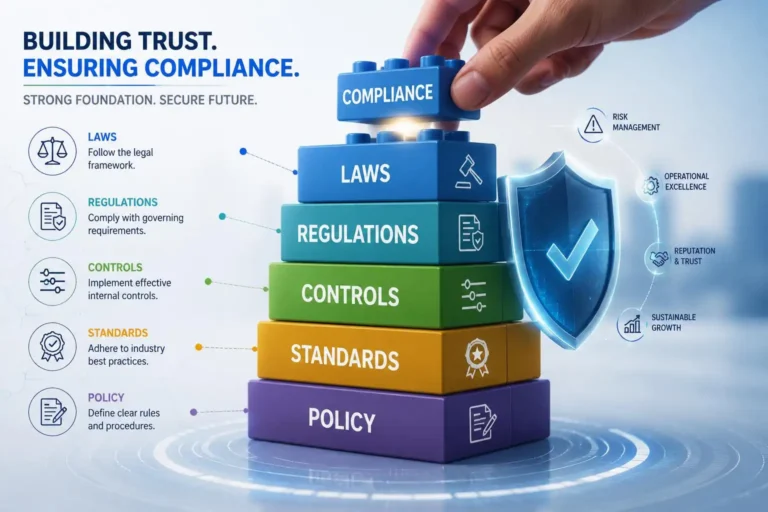
Figure 4: Building Trust

Vendor evaluation scorecard

Criterion Weight Evidence to request

Comparable delivery evidence

15

Case studies, references, product complexity and domain relevance

Named team quality

15

Interviews, seniority mix, communication and problem-solving

Delivery process

15

Backlog, estimation, code review, QA, release and documentation

Security and privacy

20

DPA/SCC readiness, access, environments, incidents, subprocessors and evidence

Continuity and resilience

10

Retention, backup roles, BCP, knowledge transfer and exit

Time-zone collaboration

10

Daily overlap, direct communication, calendars and escalation

Commercial transparency

10

Rates, assumptions, exclusions, invoicing and change control

Cultural and product fit

5

Ability to challenge constructively and work with Dutch stakeholders

Weights are an editable starting point. Adjust them to the project’s risk and business priorities.

Table 4. Vendor evaluation scorecard

Dutch and EU Compliance Requirements

Outsourcing software development is legal, but it does not remove the Dutch company’s obligations. The legal work starts by identifying what the vendor will access, which party determines purposes and means, where data is processed, which sector rules apply, and what evidence must be retained.

Key accountability principle

A Dutch controller remains accountable for selecting and governing processors, giving documented instructions, assessing security, managing international transfers and demonstrating compliance. A vendor can perform controls, but the client cannot contract away its own regulatory role. [11] [31]
Requirement Why it matters Client responsibility Vendor responsibility Evidence to request Review frequency

GDPR / AVG role mapping

Determines controller, processor or joint-controller duties

Document purposes, lawful basis, instructions and decisions

Process only on documented instructions; support rights and evidence

Data map, ROPA, role memo, privacy notices

At design and on material change

Article 28 DPA / verwerkersovereenkomst

Mandatory when a processor handles personal data

Select processor; approve terms and subprocessors

Confidentiality, security, assistance, deletion, audit support

Signed DPA, TOMs, subprocessor list

Before access; annual review

International transfer mechanism

Access from Bangladesh can be a third-country transfer

Choose lawful mechanism and assess the transfer

Follow SCC duties and agreed supplementary measures

SCCs, data-flow map, transfer assessment

Before transfer; on legal or technical change

Transfer impact assessment

Tests whether safeguards work in practice

Assess laws, data, access risk and effective measures

Provide country, hosting and security information
TIA, legal assessment, risk decisions
Before transfer; periodic review

Data minimisation and test data

Reduces exposure and breach impact

Limit fields, environments and retention

Use synthetic/masked data; follow deletion rules

Data dictionary, masking proof, retention schedule

Each release / quarterly

Access and identity

Prevents broad or persistent access

Approve roles, MFA, privileged access and revocation

Use named accounts, least privilege and logs

Access matrix, MFA evidence, review logs

Monthly / quarterly

Encryption and secrets

Protects data and credentials

Set encryption and key-ownership requirements

Encrypt in transit/at rest; use secrets vault

Architecture, key plan, configuration evidence

Each environment / release

Incident and breach handling

Enables timely legal assessment and notification

Set notification path, decision owner and regulator process

Detect, contain, preserve evidence and notify client promptly

Incident plan, contact tree, exercise report

Annual test; after incident

Data-subject requests

Clients may need vendor assistance

Set response process and deadlines

Search, export, correct or delete within instructions

Procedure, ticket evidence, deletion logs

Annual test / per request

Subprocessors

Approve or object; maintain oversight

Hidden chains create transfer and security risk

Disclose subprocessors and flow obligations down

Current list, notices, contracts

Before use / continuous

IP and open source

Protects ownership and licence compliance

Define ownership and approval policy

Assign work product; disclose background IP and licences

IP clauses, SBOM, licence scan

Each release / exit

Secure development

Reduces exploitable defects

Set SDLC and acceptance requirements

Threat model, review, test, patch and document

SDLC, review history, scan results

Each sprint / release

DORA, where applicable

Financial entities retain ICT third-party risk duties

Classify service, contract and monitor resilience

Provide registers, controls, incidents, testing and exit support

DORA clauses, register inputs, resilience evidence

Per contract / ongoing

NIS2 / Dutch Cybersecurity Act

May impose duty of care and incident reporting

Assess scope and prepare governance

Support security controls and reporting evidence

Scope assessment, policies, incident process

Before 15 Aug 2026 and ongoing

EU AI Act, where applicable

AI features may trigger provider/deployer duties

Classify system and assign roles

Provide technical documentation, data and monitoring support

AI inventory, classification, risk file

At design / material change

Accessibility, where applicable

Covered consumer products/services must be accessible

Define applicable standard and acceptance

Implement and test accessibility requirements

Audit, test results, accessibility statement

Design, release and periodic review

General compliance checklist, not legal advice. Sector, role and data-specific legal review is required.

Table 5. Dutch and EU outsourcing compliance checklist  Source: AP, European Commission, EDPB and Business.gov.nl; sources [11]–[18], [31].

International transfers to Bangladesh

The European Commission’s current adequacy list does not include Bangladesh. That does not prohibit outsourcing, but a Dutch organisation should not treat a signed confidentiality agreement as a transfer mechanism. Where personal data is made accessible from Bangladesh, the parties should determine the transfer roles and usually consider the Commission’s Standard Contractual Clauses, a documented transfer assessment and measures such as strong access control, encryption, pseudonymisation, data minimisation and EU-hosted environments. [12][13][14]

The analysis should focus on the real data flow: production access, support logs, database copies, screenshots, telemetry, backups, collaboration tools and source-code repositories can all contain personal data. A project can often reduce risk by keeping production data in the EEA, using masked or synthetic test data, allowing controlled just-in-time access, and logging every privileged action.

Sector rules to test early

  • DORA. Since 17 January 2025, in-scope financial entities must manage ICT third-party risk, maintain contract and provider information, test resilience and prepare exit arrangements. A software vendor may need to supply evidence and contract language even when it is not itself the regulated entity. [15]
  • NIS2 and the Dutch Cybersecurity Act. Business.gov.nl currently states that the Dutch Cybersecurity Act is scheduled to enter into force on 15 August 2026. Organisations should assess scope and prepare duty-of-care and incident-reporting processes; the implementation date and final requirements should be rechecked before publication or contract signature. [16]
  • EU AI Act. The Act is applying in phases and becomes broadly applicable on 2 August 2026, with exceptions and transitional rules. AI-enabled software should be classified by role and risk before development commitments are made. [17]
  • European Accessibility Act. Covered consumer products and services, including certain ecommerce, banking and
    electronic communication services, have accessibility obligations. Requirements should be translated into design,
    development and acceptance testing. [18]

Turning Rules in Netherlands into Engineering Practice

A contract clause does not protect data by itself. The legal requirements must become onboarding, architecture, access permissions, ticket templates, coding standards, test controls, release gates and evidence that can be reviewed later.

Engineering control How to implement it

Compliance onboarding

Explain the client’s sector, data categories, prohibited actions, reporting route and consequences before access is granted.

Written standards

Provide secure coding, data handling, open-source, logging, retention, accessibility and documentation rules in the working language.

Least privilege

Use named accounts, MFA, role-based access, just-in-time privileged access and automatic expiry.

Environment separation

Keep development, test, staging and production separate; restrict production access to approved operational roles.

Safe test data

Use synthetic, anonymised or masked data unless production data is explicitly approved and protected.

Approved tools

Define where code, tickets, files, credentials, chat and recordings may be stored.

Incident reporting

Create one immediate channel and a written threshold for suspected loss, disclosure, malware, credential exposure or access error.

Code-review gates

Require protected branches, peer review, automated checks and security acceptance before release.

Compliance acceptance criteria

Write privacy, security, retention and accessibility conditions into backlog items, not a separate document nobody reads.

Periodic access reviews

Revalidate every user, role, repository, cloud account and support entitlement.

Evidence retention

Keep approvals, logs, test results, training records, architecture decisions and deletion evidence.

Named contacts

Identify product, technical, security, privacy and legal escalation owners on both sides.

Editable operating checklist prepared for this guide.

Table 7. Converting compliance obligations into daily delivery controls

Practical test

Ask a developer what they should do after accidentally receiving a production database export. A mature team should know to stop, preserve evidence, avoid copying or inspecting the data, notify the named channel immediately and follow the client’s containment and deletion instructions.

Managing the Netherlands–Bangladesh Time Difference

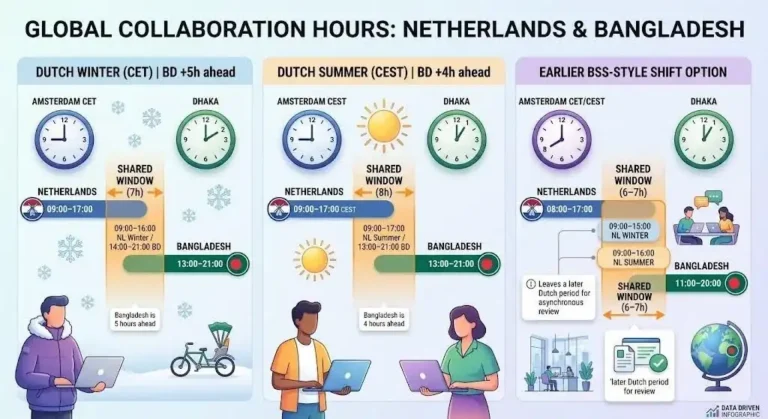
Bangladesh uses UTC+6 throughout the year. The Netherlands uses CET (UTC+1) in winter and CEST (UTC+2) in summer, so the difference is five hours in winter and four hours in summer. The shift is manageable when core overlap and handover rules are designed into the engagement instead of left to personal availability.

Figure 4. Netherlands–Bangladesh working-hours timeline
  • One shared calendar. Show CET/CEST changes and public holidays in both countries. Do not rely on team members to calculate daylight saving manually.
  • A fixed daily overlap. Reserve the overlap for decisions, pairing, review, stand-up and blockers—not routine status reading.
  • Written asynchronous updates. Every developer should leave the ticket, pull request and next action understandable without a meeting.
  • A handover point. Before the Bangladesh shift ends, unresolved blockers, deployment state and decisions needed from the Dutch product owner should be explicit.
  • Urgent escalation. Define one monitored channel, severity levels, response expectations and authorised contacts.
  • Recorded demonstrations. Record sprint demos and architecture walkthroughs for stakeholders who cannot attend, while respecting confidentiality and retention rules.
  • Release windows. Agree when changes may be deployed, who approves them and who remains available for rollback.

Bangladesh Software Solution working-hours claim to confirm

Bangladesh Software Solution publicly positions its services for global collaboration and time-zone alignment. The exact Netherlands-aligned core hours, summer/winter schedule, on-call coverage and holiday handling should be written into the proposal and statement of work rather than assumed. [22] [24]

Two Dutch Outsourcing Success Examples

The examples below use public, vendor-published case studies. They show how recognisable Dutch companies used external technology capability, but they are not independent audits and they do not imply that Bangladesh Software Solution worked with either company.

KLM: embedded engineering for social channels

KLM needed to serve customers across its website, mobile app and rapidly expanding social channels. A TCS case study describes an API- and microservices-based Social Media Hub integrating channels including Facebook Messenger, Twitter, WeChat, WhatsApp and Google Assistant. TCS embedded team members within KLM, which is important: the relationship was not presented as a remote ticket factory but as integrated product delivery. [19]The published outcome emphasises faster time-to-market, scalability, lower operating cost and the ability to add AI-enabled functionality, although it does not provide a precise percentage for those gains. A later 2024 TCS announcement says the wider Air France-KLM relationship had existed for 30 years and described a new cloud-data programme involving more than 100 professionals across France, the Netherlands and India. [19] [20]

Lesson for Dutch buyers

External engineering is most effective when the partner is embedded in product and architecture decisions, works through common APIs and standards, and has a long-term governance model—not when work is thrown over a wall.

Philips: external pricing technology across 20 markets

An Omnia Retail case study describes how Philips expanded a successful UK pricing-automation pilot to 20 markets on three continents. The external platform and partnership automated pricing recommendations, reduced manual work and standardised knowledge transfer across local teams. [21]The vendor-published case reports double-digit growth in direct-to-consumer sales, higher absolute margin, a 75% reduction in price-related complaints and approximately 60,000 price recommendations a day. These results concern an external technology platform and operating partnership rather than a conventional custom-development team, so they should be read as evidence of governed technology outsourcing—not a universal business case. [21]

Lesson for Dutch buyers

Start with a measurable pilot, validate the operating model, and scale market by market. Standardisation, adoption and local stakeholder training are as important as the software itself.

Red Flags When Choosing a Partner

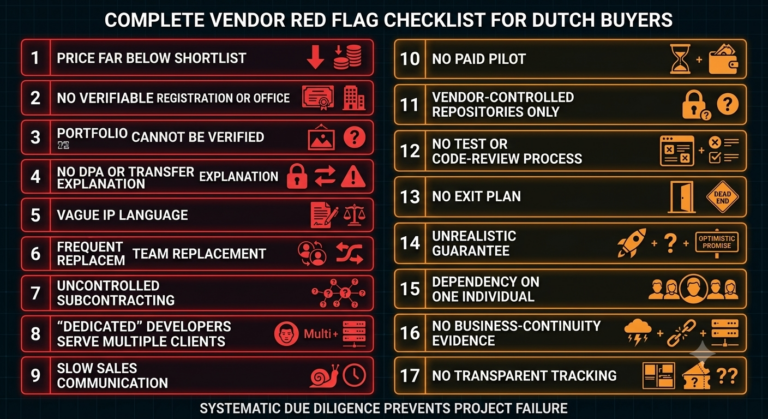
Most outsourcing failures show warning signs before the contract is signed. A single issue may be explainable; several together usually indicate that the buyer is being asked to accept more operational risk than the proposal reveals.

Red flag checklist
Figure 5. Vendor red flag checklist.
Red flag Question the Dutch buyer should ask

Price far below the shortlist

Which seniority, management, QA, security, leave and replacement costs are included?

No verifiable registration or office

Which legal entity signs the contract, invoices us and employs the team?

No named delivery team

Can we interview the exact engineers and delivery lead before signing?

Portfolio cannot be verified

May we speak to a reference and inspect the role you actually performed?

No DPA or transfer explanation

How will you meet Article 28 and manage access from outside the EEA?

Vague IP language

Who owns code, documentation, configurations, designs and improvements?

Uncontrolled subcontracting

Which subprocessors or freelancers will access our systems or data?

“Dedicated” developers serve several clients

How is exclusivity measured, reported and enforced?

Frequent team replacement

What is your twelve-month turnover and replacement/handover process?

Slow sales communication

What response and escalation standards will apply after contract signature?

No paid pilot

Why should we make a long-term commitment before observing delivery?

Vendor-controlled repositories only

Can the client own and export the repository, history and CI/CD configuration?

No test or code-review process

Show a recent anonymised pull request, quality gate and release checklist.

No exit plan

How quickly will code, data, credentials and knowledge be transferred at termination?

Immediate request for production access

Why cannot synthetic data, staging or read-only access meet the initial need?

Unrealistic guarantee

Which assumptions, exclusions and remedies make the promise credible?

Dependency on one individual

Who can support the system when that person is unavailable?

No business-continuity evidence

How will you operate during outage, disaster, cyber incident or office disruption?

No transparent tracking

Will we have direct access to tickets, pull requests, tests, dashboards and risks?

Buyer due-diligence table prepared for this guide.

Table 6. Red flags and practical buyer questions

How to Make the Software Outsourcing Partnership Successful

The contract creates permission to work together; the first 90 days create the actual delivery system. The objective is to make the external team operate as an accountable extension of the Dutch product organisation while preserving clear commercial and compliance boundaries.

Best Practices for Managing an Outsourced Development Team

  • One accountable product owner. Backlog conflict should be resolved by a named Dutch decision-maker.
  • A stable team. Track planned and unplanned changes; require documented handover and client approval for key replacements.
  • A shared definition of done. Code, review, tests, security checks, documentation, deployment and acceptance must be explicit.
  • Transparent tools. The client should see tickets, pull requests, test results, risks, releases and budget consumption.
  • Architecture governance. Record major decisions and ensure short-term delivery does not create avoidable long-term cost.
  • Continuous knowledge transfer. Documentation, pairing and demonstrations should happen throughout the engagement—not only at exit.
  • Early escalation. Red status should be safe to report; hidden delay is more damaging than an early difficult conversation.
  • Periodic legal and security review. Recheck data flows, access, subprocessors, vulnerabilities and sector obligations when the product changes.
Period Primary actions Evidence of progress

First 30 days

Confirm outcomes and architecture; complete DPA/SCC/TIA work; provision least-privilege access; agree working hours; baseline metrics; deliver first thin slice.

Approved onboarding checklist, architecture map, security controls, sprint demo and risk register.

Days 31–60

Increase delivery cadence; automate testing and deployment; close pilot findings; document support and incident flow; validate predictability.

Release pipeline, quality dashboard, operational runbook, access review and revised roadmap.

Days 61–90

Stabilise team and governance; complete resilience and exit tests; agree quarterly capacity; review value, cost and stakeholder confidence.

Quarterly business review, capacity plan, knowledge map, BCP evidence and 90-day decision.

Editable 30/60/90-day onboarding roadmap.

Table 7. First 90 days of an outsourcing partnership

Why Choose Bangladesh Software Solution

Bangladesh Software Solution can be evaluated against the same process and controls described in this guide. Its public website lists offices in Nieuwegein, Utrecht and Dhaka, and presents offshore software development, dedicated teams, staff augmentation and custom software development as core services. [22] [23] [24] [25] [26] [27]

A Netherlands-facing operating context

The publicly listed Netherlands office gives Dutch buyers a local point of contact, while the Bangladesh delivery operation provides access to a broader engineering organisation. Public Bangladesh Software Solution pages also include testimonials attributed to Netherlands-based organisations, including Xinaps and Ace Green B.V. These are company-published references and should be verified through direct reference calls during procurement. [22] [23] [24]

Relevant delivery capabilities

  • Offshore software development. End-to-end development capacity for web, mobile, cloud and enterprise products. View service
  • Dedicated development teams. Stable teams designed to integrate with the client’s backlog and engineering practices. View service
  • Staff augmentation. Named engineers added to an existing client-led team for specific skills or capacity. View service
  • Custom software development. Product discovery, design, engineering, QA and operational support for bespoke systems. View service

Public Netherlands work

Bangladesh Software Solution has published a VERIFI3D case study describing the development of a Netherlands-based construction validation product from proof of concept towards an enterprise solution. It can be used as a starting point for technical and reference questions, but the buyer should still verify current scope, team, outcomes and permission to disclose details. [28]

Company-provided information

Bangladesh Software Solution states that it supports Netherlands-based clients and can align collaboration with European working hours. Before contracting, confirm the exact Netherlands legal entity, core hours, holiday calendar, security controls, certifications, team allocation, pricing and service levels in writing. [22] [23] [24]

Discuss Your Development Needs With Bangladesh Software Solution

Share your product goals, team gaps, compliance constraints and preferred working model.

Contact BSS

Conclusion

For Netherlands-based companies, outsourcing software development is not simply a comparison between a Dutch salary and an offshore day rate. It is a choice about how quickly the business can assemble capability, how clearly it can retain product ownership, and how well it can govern quality, security, personal data, intellectual property and continuity.

The practical path is consistent: define the outcome, keep accountable decisions internal, select the right model, compare vendors using evidence, interview the actual team, run a paid pilot, contract for operations and exit, and measure delivery with quality and flow indicators. For Bangladesh-based delivery, Dutch companies should explicitly address the four-to-five-hour time difference and any international personal-data transfer instead of treating either as an informal working detail.

A well-governed offshore team should gradually feel less like a distant supplier and more like a transparent extension of the engineering organisation. The difference is not geography alone; it is the quality of the operating system created between client and vendor.

Frequently Asked Questions

These answers are concise publishing-ready responses. They provide general business information and should not replace legal, tax, employment or sector-specific advice.

Is software outsourcing legal for Dutch companies?

Yes. Dutch companies can outsource software work, but they remain responsible for their own legal and regulatory duties. Contracts, security, data protection, sector rules and supplier oversight must match the actual service.

Potentially, but access can constitute a transfer outside the EEA. Bangladesh is not on the EU adequacy list, so the parties should identify a lawful transfer mechanism, assess the transfer and implement effective safeguards. [12] [13] [14]

It should reflect GDPR Article 28, including subject matter and duration, processing instructions, confidentiality, security, subprocessor conditions, assistance, deletion or return, and audit information. The contract must match the real service. [11] [31]

Robert Half’s 2026 national gross starting-salary range is €4,351–€5,912 per month for a software developer. Total employer cost is higher once holiday allowance, employer contributions, pension/benefits, equipment, recruitment, leave and management are included. [5] [8] [9]

There is no universal rate. Role, seniority, team composition, management, security, support and contract terms matter. This guide uses an illustrative €35–€55 hourly range for managed offshore capacity, not a Bangladesh Software Solution quote.

Use clear IP assignment, identify background components, control open-source use, keep repositories and cloud accounts client-accessible, define credential ownership, and include handover, export and deletion obligations at exit.

Most product teams benefit from at least three to four reliable hours for decisions and collaboration. A Netherlands–Bangladesh model can provide six or more hours when the Bangladesh shift is deliberately aligned.

Usually yes when the partner is new. A paid, time-boxed pilot reveals code quality, communication, predictability, security behaviour and handover discipline before the buyer scales the commitment.

Legal disclaimer

This article provides general business and technology information as at 16 July 2026. It is not legal, tax, employment, cybersecurity or regulatory advice. Applicability depends on the organisation, data, sector, contracts, technology and processing locations. Obtain qualified advice before relying on it for a specific engagement.

Sources

The article prioritises Dutch public bodies, EU institutions and current recruitment data. Cost models are clearly labelled as editorial scenarios, not quotations. Company examples and Bangladesh Software Solution claims use public vendor or company materials and are identified as such.

  1. [1]
    ICT-beroepen in beeld. UWV. 27 May 2025. Open source. Accessed: 16 July 2026. Used for the ICT labour-market tightness indicator and the 7.7 vacancies per short-term unemployed ICT professional.
  2. [2]
    ICT-beroepen. UWV. Updated 2026.Open source. Accessed: 16 July 2026. Used for the most recent direction of ICT vacancies and unemployment in the Netherlands.
  3. [3]
    Digitalisering en kenniseconomie 2025. Statistics Netherlands (CBS). 10 February 2026.Open source. Accessed: 16 July 2026. Used for the number of vacancies in the Dutch ICT sector at the end of 2025.
  4. [4]
    Staff shortages mean business is turning to automation. Statistics Netherlands (CBS). 3 June 2026.Open source. Accessed: 16 July 2026. Used for the share of Dutch firms reporting staff shortages in April 2026.
  5. [5]
    Software Developer Salary (Updated for 2026). Robert Half Netherlands. 2026. Open source. Accessed: 16 July 2026. Used for national monthly gross starting-salary percentiles for software developers.
  6. [6]
    IT Manager Salary (Updated for 2026). Robert Half Netherlands. 2026. Open source. Accessed: 16 July 2026. Used as a benchmark for senior technology-management salary levels.
  7. [7]
    IT Project Manager Salary (Updated for 2026). Robert Half Netherlands. 2026. Open source. Accessed: 16 July 2026. Used as a benchmark for project-management capacity.
  8. [8]
    Holiday allowance. Business.gov.nl. Accessed 2026. Open source. Accessed: 16 July 2026. Used for the statutory minimum 8% holiday allowance in the Netherlands.
  9. [9]
    Personnel costs. Business.gov.nl. Accessed 2026. Open source. Accessed: 16 July 2026. Used to identify employer-cost categories beyond gross salary.
  10. [10]
    Holiday entitlement. Business.gov.nl. Accessed 2026.Open source. Accessed: 16 July 2026. Used for statutory annual-leave context.
  11. [11]
    Processing agreement. Autoriteit Persoonsgegevens. Updated 17 December 2025.Open source. Accessed: 16 July 2026. Used for processor-contract requirements under GDPR Article 28.
  12. [12]
    Standard Contractual Clauses. European Commission. 4 June 2021; current page accessed 2026. Open source. Accessed: 16 July 2026. Used for safeguards for transfers of personal data outside the EEA.
  13. [13]
    Recommendations 01/2020 on supplementary measures. European Data Protection Board. 18 June 2021.Open source. Accessed: 16 July 2026. Used for transfer impact and supplementary-measure guidance.
  14. [14]
    Data protection adequacy for non-EU countries. European Commission. Current list accessed 16 July 2026.Open source. Accessed: 16 July 2026. Used to confirm which jurisdictions have EU adequacy decisions; Bangladesh is not listed.
  15. [15]
    Digital Operational Resilience Act (DORA). European Commission. Applies from 17 January 2025.Open source. Accessed: 16 July 2026. Used for financial-sector ICT outsourcing and resilience context.
  16. [16]
    Cybersecurity Act: NIS2 in the Netherlands. Business.gov.nl. Current page accessed 16 July 2026.Open source. Accessed: 16 July 2026. Used for the scheduled Dutch implementation date and duties for organisations in scope.
  17. [17]
    AI Act. European Commission. Current page accessed 16 July 2026.Open source. Accessed: 16 July 2026. Used for the phased EU AI Act application timeline.
  18. [18]
    Rules for accessibility of products and services (EAA). Business.gov.nl. Current page accessed 16 July 2026.Open source. Accessed: 16 July 2026. Used for European Accessibility Act applicability to covered products and services.
  19. [19]
    KLM – TCS Social Media Hub. Tata Consultancy Services. Case study accessed 2026.Open source. Accessed: 16 July 2026. Vendor-published case used for the KLM external engineering partnership example.
  20. [20]
    Air France-KLM selects TCS as strategic cloud partner. Tata Consultancy Services. 27 November 2024.Open source. Accessed: 16 July 2026. Used as supporting evidence for the long-running TCS partnership and current operating model.
  21. [21]
    Philips: pricing automation across 20 markets. Omnia Retail. Case study accessed 2026.Open source. Accessed: 16 July 2026. Vendor-published case used for the Philips external technology-partner example.
  22. [22]
    Bangladesh Software Solution homepage. BSS. Company-published information accessed 16 July 2026.Open source. Accessed: 16 July 2026. Used for public service descriptions and public Netherlands client testimonials.
  23. [23]
    Contact BSS. BSS. Company-published information accessed 16 July 2026.Open source. Accessed: 16 July 2026. Used for publicly listed Netherlands and Bangladesh office locations.
  24. [24]
    Offshore software development. BSS. Company-published information accessed 16 July 2026.Open source. Accessed: 16 July 2026. Used for BSS service positioning and public client references.
  25. [25]
    Dedicated development team. BSS.Company-published information accessed 16 July 2026.Open source. Accessed: 16 July 2026. Used for BSS dedicated-team service information.
  26. [26]
    Staff augmentation. BSS. Company-published information accessed 16 July 2026.Open source. Accessed: 16 July 2026. Used for BSS staff-augmentation service information.
  27. [27]
    Custom software development. BSS. Company-published information accessed 16 July 2026.Open source. Accessed: 16 July 2026. Used for BSS custom-development service information.
  28. [28]
    VERIFI3D: From proof of concept to enterprise solution. BSS. Company-published case study accessed 16 July 2026.Open source. Accessed: 16 July 2026. Used as a public example of BSS work associated with a Netherlands-based client.
  29. [29]
    Hire offshore developers from Bangladesh. BSS. Company-published article accessed 16 July 2026.Open source. Accessed: 16 July 2026. Used as a relevant BSS internal-link destination.
  30. [30]
    Average Dutch freelancer hourly rate reaches €83. NL Times, reporting Knab research. 21 March 2026.Open source. Accessed: 16 July 2026. Used only as broad freelance-rate context; it is not a software-specific benchmark.
  31. [31]
    General Data Protection Regulation, Article 28. EUR-Lex. Consolidated text accessed 16 July 2026.Open source. Accessed: 16 July 2026. Used for controller-processor responsibilities and mandatory contract terms.