






European companies can use white-label software development and white-label developers to expand delivery capacity without immediately increasing permanent headcount. Building a large internal team takes time and creates long-term staffing commitments. White-label development provides a more flexible way to add development capacity when it is needed.
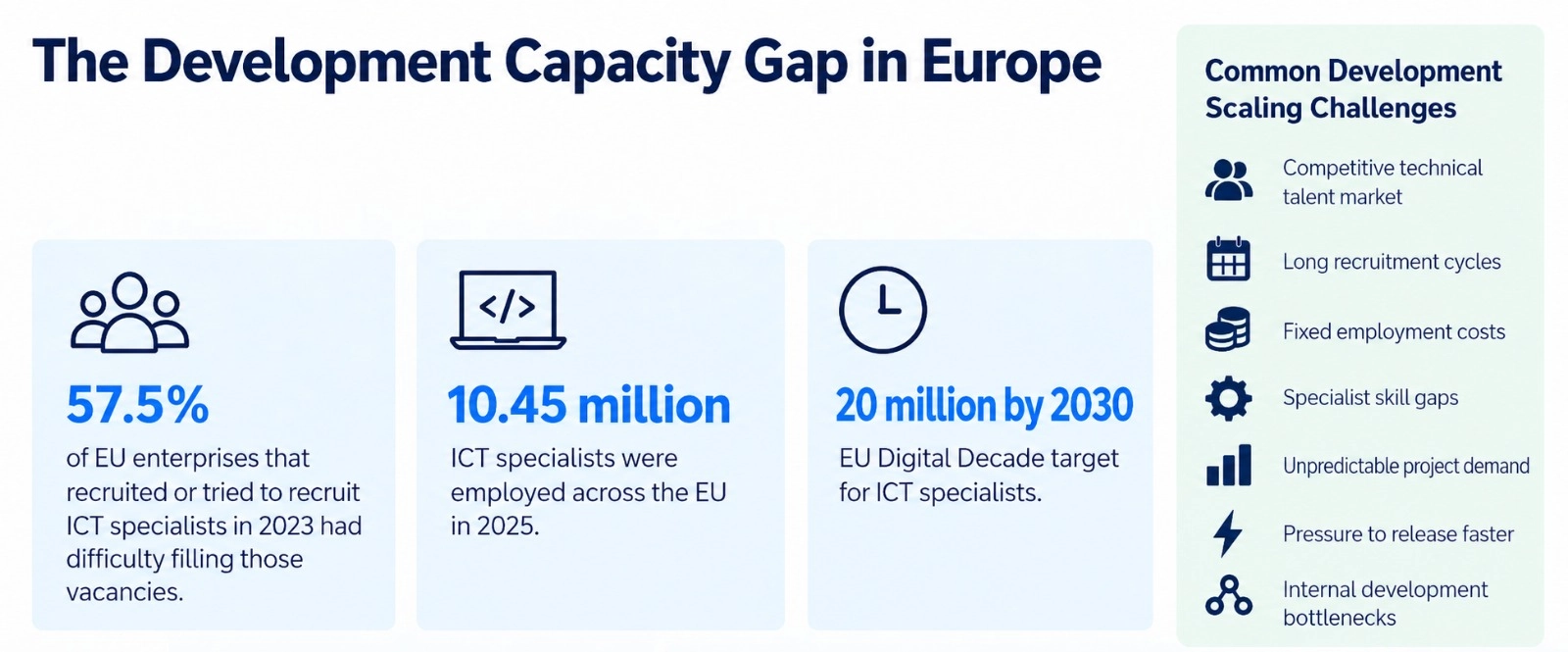
Why Scaling Development Teams in Europe is Difficult
European software companies can face several barriers when trying to expand development capacity quickly.
What Are White-Label Developers?
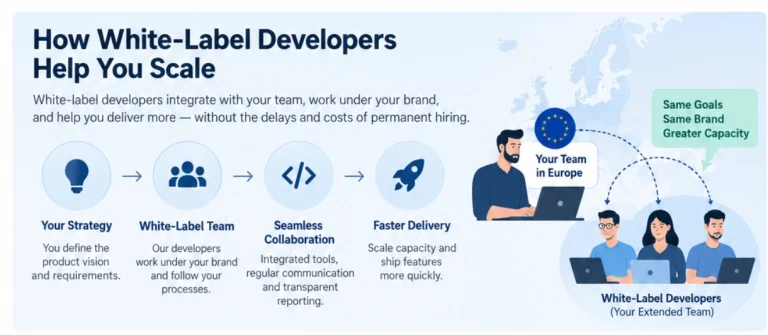
White label developers work behind a company’s own brand, not their own.
The commissioning company keeps customer ownership, strategy and product direction.
The external team extends development capacity while operating under the commissioning company’s brand and delivery processes.
This is a service and team model, not a resold software product.
Companies considering this approach can explore Bangladesh Software Solution structures offshore software development support for external engineering capacity.
How White-Label Developers Help European Companies Scale
This model helps European companies in several concrete ways.
Table 1: Core benefits of white-label development services for growing European teams.
| Benefit | What it means in practice |
|---|---|
Add capacity without permanent hiring | Avoid permanent internal headcount expansion |
Handle overflow projects | Absorb peaks without stretching the team |
Access specialist skills | Niche expertise not held in-house |
Shorten delivery timelines | More workstreams in parallel |
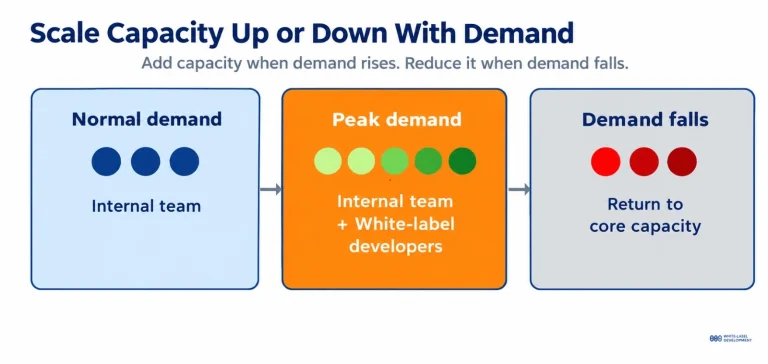
Scale teams up or down | Match capacity to demand |
Expand service offerings | Work outside current specialisms |
Keep internal focus on strategy | Core team stays on product direction |
Improve cost control | Convert part of permanent staffing cost into flexible delivery spend. |
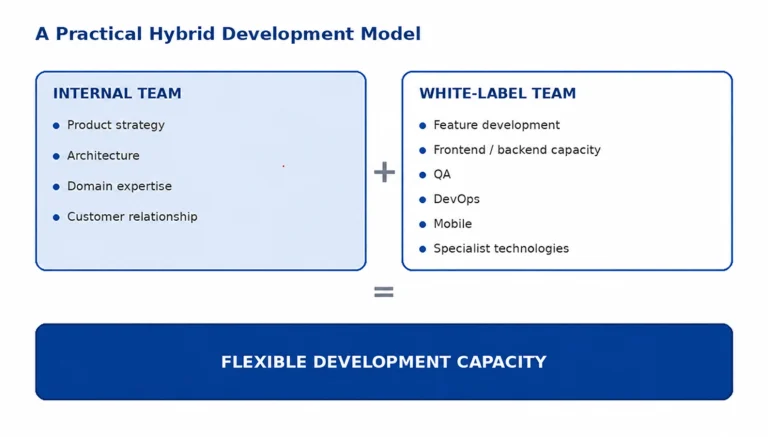
A Practical Hybrid Development Model
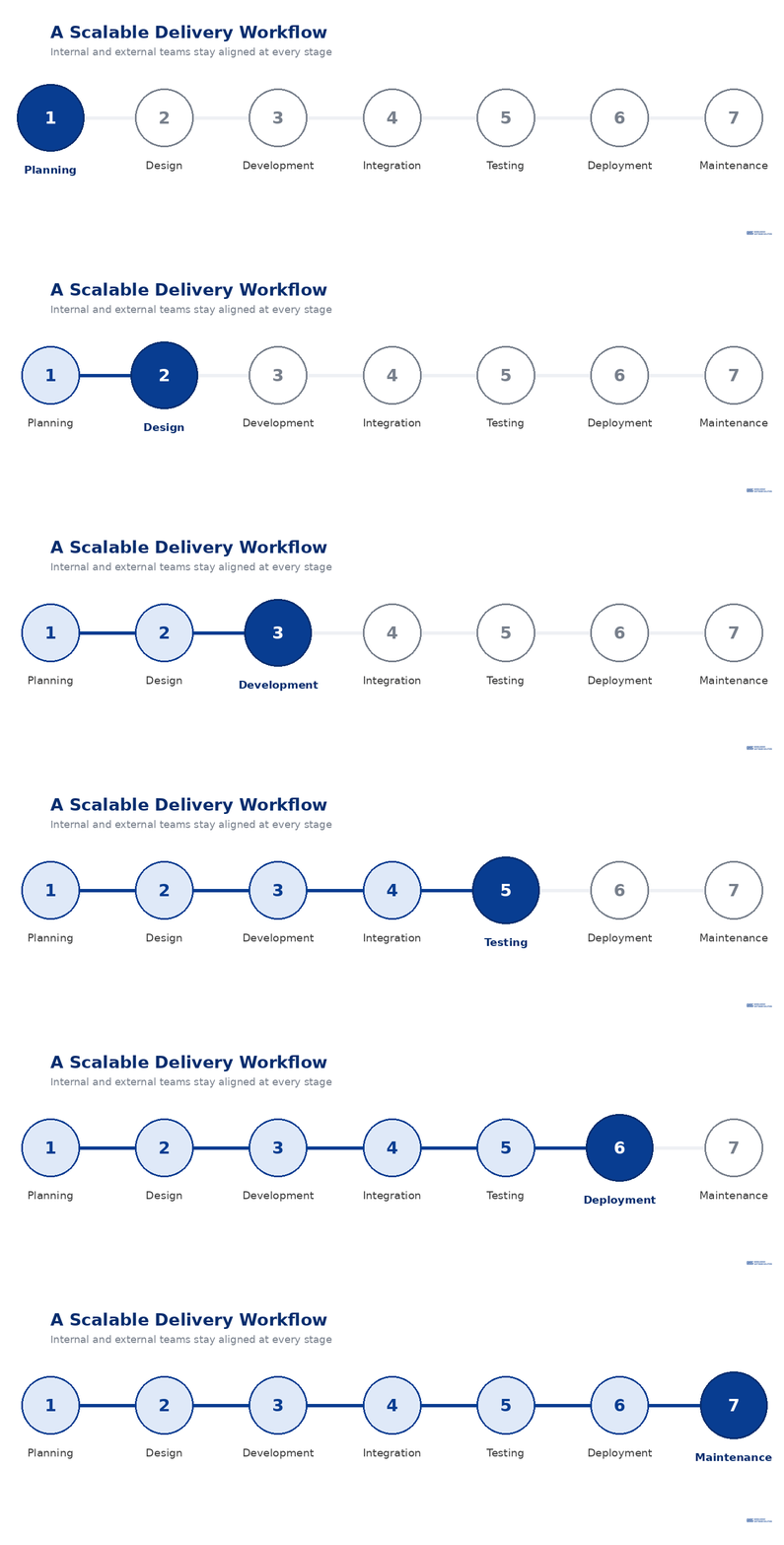
White-label development often works most effectively as an extension of an existing internal team rather than a complete replacement. European teams retain strategy and customer relationships throughout.
The external team focuses on execution: building, testing and shipping features.
The workflow below shows how the two teams stay coordinated end to end.
Where White-Label Development Works Best
Table 2: Typical use cases across different types of European organisation.
| Company type | Where the model helps most |
|---|---|
Digital agencies | Overflow client projects, service expansion |
SaaS companies | Roadmap acceleration, integrations |
Start-ups / scale-ups | MVP delivery, flexible capacity |
Software consultancies | Additional delivery resource |
Enterprises | Modernisation and transformation projects |
For start-ups validating a new product, this often overlaps with MVP development, where speed and flexible capacity matter most.
Things Marketplace Owners Should Consider Before Choosing a Payment Solution
- Payment compliance
- Seller verification
- Refund handling
- Transaction tracking
- Payment provider compatibility
White-Label Developers vs In-House Teams vs Freelancers
Each staffing model has a different profile, summarised below.
Table 3: Comparing white-label development services with hiring and freelance capacity.
| Factor | White-label developers | In-house team | Freelancers |
|---|---|---|---|
Speed to scale | Usually faster | Usually slower | Often fast for individual roles |
Fixed employment cost | None | High | None |
Specialist access | Broad | Limited | Variable |
Team continuity | Usually high with dedicated teams | High | Varies |
Project management | Often available | Internal | Usually self-managed |
QA availability | Often available | Internal | Varies |
Ability to scale down | Usually flexible | Difficult | Usually flexible |
Brand confidentiality | Defined by agreement | Full internal control | Depends on agreement |
How to Integrate White-Label Developers Into Your Workflow
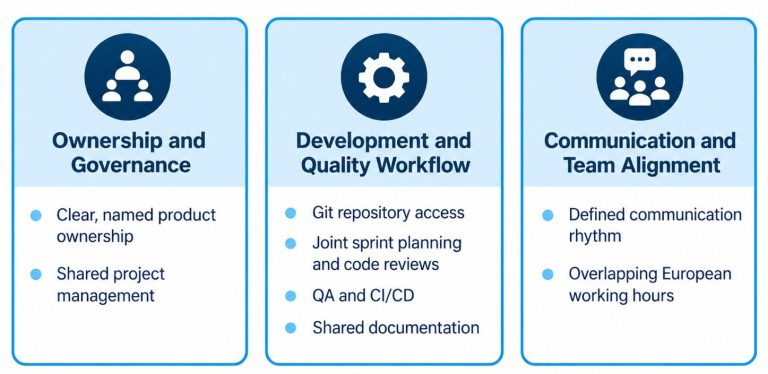
Integration works best when ownership and process are clear from day one. Shared repositories, sprint rhythms and code review keep both teams aligned. Regular working-hour overlap also helps teams resolve questions, review work and coordinate delivery efficiently.
For teams that need a stable, long-term extension rather than a short project, a dedicated development team can offer more continuity than rotating freelance support.
Risks And Controls
No delivery model is risk-free, and this one is no exception.
Table 4: Common risks in white label software development and how to control them.
| Risk | Control |
|---|---|
Quality inconsistency | QA standards and code review |
Scope creep | Clear scope and a formal change process |
Communication gaps | Defined roles and a regular sync |
IP uncertainty | Written ownership terms |
Security / GDPR | Access control and documented data practices |
Partner dependency | Owned repositories and knowledge transfer |
Cost overruns | Clear scope, pricing visibility and change control |
These risks can be reduced through clear agreements, transparent processes and regular oversight.
Good to know
When an external development partner processes personal data on behalf of a European company, GDPR responsibilities should be defined before access is granted.
The European Commission states that a data processor’s duties toward the controller must be set out in a binding contract or other legal act. This should address documented processing instructions, confidentiality, security measures and other data-protection responsibilities.
For transfers of personal data outside the EU/EEA, companies should also assess the appropriate transfer mechanism. The European Commission provides Standard Contractual Clauses for qualifying international data transfers.
How to Choose a White-Label Development Partner
Choosing the right partner determines whether white-label development becomes a scalable advantage or creates additional delivery risk.
Technical and Delivery Capability
- Relevant technical expertise — Confirm that the team has experience with the technologies, frameworks and architecture your projects require.
- Proven delivery experience — Review case studies, previous projects or references that demonstrate successful software delivery.
- Defined code review process — Check how code is reviewed for quality, maintainability, security and adherence to development standards.
- Demonstrated QA capability — Ensure the partner has a structured approach to functional, regression and other required testing.
Communication and Collaboration
- Realistic team availability — Verify when the required developers can start and whether their availability matches your delivery schedule.
- Clear communication — Agree on communication channels, responsibilities, reporting frequency and escalation procedures from the beginning.
- European working-hour overlap — Ensure sufficient working-hour overlap for meetings, reviews and resolving delivery issues quickly.
- Consistent documentation practices — Confirm that technical decisions, architecture, workflows and project knowledge are documented throughout delivery.
Security, Legal and Ownership
- GDPR awareness — Evaluate whether the partner understands appropriate data handling, access controls and GDPR-related responsibilities.
- NDA arrangements — Ensure confidentiality obligations can be formally defined before sensitive business or customer information is shared.
- IP and source-code ownership terms — Specify clearly in the contract who owns the code, documentation and other project deliverables.
- Repository transparency — Keep appropriate access to source-code repositories so development progress and project assets remain visible.
Scalability and Long-Term Fit
- Scaling flexibility — Confirm that the partner can increase or reduce development capacity as project workloads and priorities change.
- Maintenance capability — Confirm that support, bug fixes and ongoing improvements can continue after the initial release.
- Pricing transparency — Confirm how rates, additional work, scaling costs and change requests are calculated before the engagement begins.
- Knowledge transfer — Enquire if the project knowledge will remain accessible if the engagement changes?
Frequently Asked Questions
What is a white-label developer?
A developer or team that delivers software work under a client’s own brand, rather than their own, while the client retains customer ownership.
Is white-label development the same as outsourcing?
It is a form of outsourcing, but delivered discreetly under the client’s brand rather than as a visible third-party vendor relationship.
Can white-label developers work with an existing team?
Yes. White-label developers can work alongside internal teams, often taking responsibility for defined workstreams, specialist tasks or additional delivery capacity.
How does GDPR affect outsourced development teams?
Access controls, data-processing agreements and documented handling practices should be defined before any project data is shared.
Who owns the code in a white-label development project?
Code ownership should be defined explicitly in the contract. In many engagements, the commissioning company receives ownership of the agreed source code and project deliverables.
Conclusion
White-label development is not simply a cost-reduction strategy. Its stronger value lies in flexible capacity, specialist expertise and the ability to adapt delivery resources as business needs change
Looking to scale your development capacity with a flexible white-label model? Discuss your requirements with Bangladesh Software Solution to explore the right approach for your team.