Informational

How to Hire Offshore Developers in 2026: The Complete Guide for Growing Businesses

July 16, 2026
Hire Offshore Developers in 2026: Costs, Process & How to Choose the Right Team
Business development manager - Bangladesh Software Solution
Share:

A practical, step-by-step guide to building a reliable offshore engineering team — without the guesswork.

Introduction

In 2026, hiring is no longer just about who lives closest to the office. Rising salaries in mature tech markets, a persistent shortage of senior engineers, and pressure to ship faster have pushed even cautious, risk-averse companies to look beyond their own borders for talent. What used to be a cost-cutting tactic reserved for large enterprises is now a mainstream growth strategy for startups and mid-sized businesses alike. Offshore development today is less about “cheaper coders” and more about access — to specialized AI, cloud, and mobile engineering skills that are scarce and expensive at home, to teams that can scale up or down as a roadmap shifts, and to the speed that comes from having more hands on deck without months of local recruiting. This guide walks through why businesses are making the shift, exactly how to hire offshore developers the right way, what it actually costs by country, and the warning signs worth watching for before you sign anything.

Why Businesses Are Hiring Offshore Developers in 2026


AI excels at routine tasks like boilerplate generation, debugging suggestions, and documentation. JetBrains found that nearly 90% of AI users report time savings, with a fifth claiming to save a full workday per week. Google’s 2025 DORA report notes that teams heavily relying on AI see enhanced productivity and code quality.

Yet rigorous research paints a more cautious picture:

  • A randomized controlled trial by METR (Model Evaluation & Threat Research) in early 2025 tested experienced open-source developers on familiar repositories. Surprisingly, those using AI tools (primarily Cursor Pro with Claude models) took 19% longer to complete tasks despite perceiving a 20% speedup.
  • Faros AI’s analysis of over 10,000 developers showed high adoption but no clear company-wide productivity gains, with AI often increasing pull request sizes and review burdens.

The disconnect arises because AI boosts individual output volume but requires extra time for review, correction, and integration. Subtle errors in “almost right” code consume debugging time, offsetting generation speed.

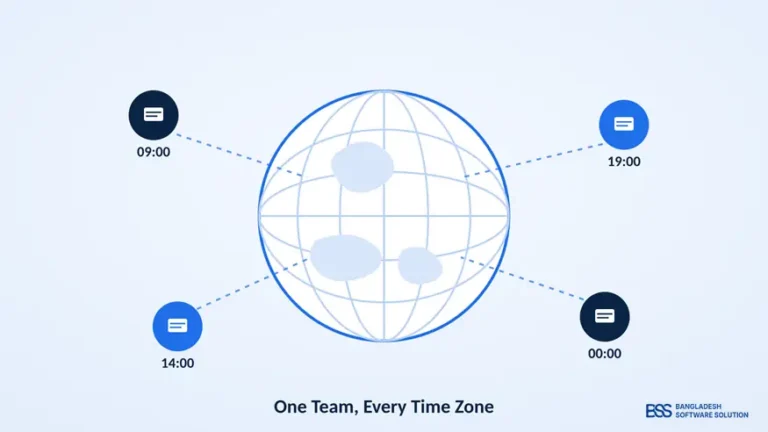
One team, every time zone — offshore collaboration in practice

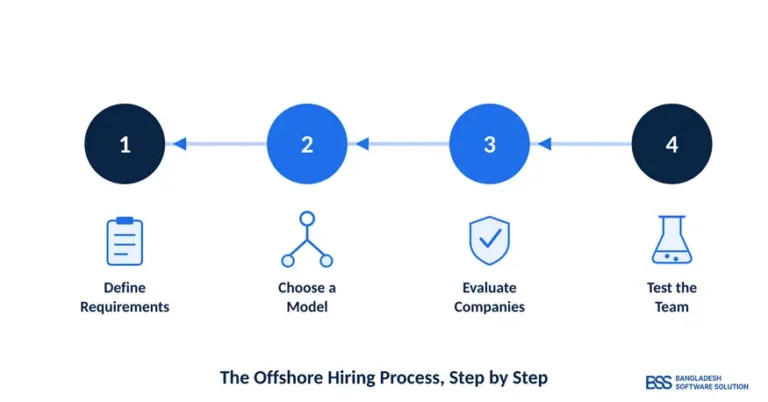
How to Hire Offshore Developers: Step-by-Step Process

Hiring offshore well is a process, not a transaction. The businesses that get the best results treat it with the same rigor as a local hire — just compressed into a faster timeline.

Step 1: Define Your Project Requirements

Before reaching out to any offshore partner, get specific about what you actually need. Vague requirements are the single biggest cause of mismatched engagements. At minimum, identify:

  • The required technology stack (languages, frameworks, cloud platform)
  • The project scope — what’s in, what’s explicitly out
  • The expected timeline and any hard deadlines
  • The specific developer roles needed (frontend, backend, DevOps, QA, PM)
  • Communication requirements — overlap hours, reporting cadence, tools

The clearer this brief is, the more accurate the proposals, timelines, and quotes you’ll receive back will be.

Step 2: Choose the Right Offshore Development Model

There is no single “correct” offshore model — the right one depends on how long you need the team and how much control you want over day-to-day work.

  • Dedicated development team:

    A team that works exclusively on your product, embedded in your processes long-term. Best for ongoing product development and companies that want an extension of their in-house team.

  • Staff augmentation:

    You add individual offshore developers to fill specific skill gaps in an existing team. Best for short-to-medium term needs, tight deadlines, or specialized skills you don’t have in-house.

  • Project-based outsourcing:

    You hand off a defined project with a fixed scope, timeline, and budget to an external team that manages delivery. Best for well-scoped, self-contained builds like an MVP or a discrete feature.

Step 3: Evaluate Offshore Development Companies

Once you know what you need, shortlist and vet potential partners with the same diligence you’d apply to any vendor that will touch your codebase. Check:

  • Portfolio of past and current work
  • Case studies relevant to your industry or technical challenge
  • Industry experience specific to your domain
  • Client reviews and references you can actually contact
  • Technical expertise across the stack you need
  • Communication process — who you’ll talk to, how often, in what tools
  • Security practices — code access, data handling, compliance posture
Step 4: Test the Team Before Long-Term Engagement

Technical skill alone doesn’t guarantee a good working relationship. Before committing to a long-term contract, it’s worth verifying how a team actually operates:

  • Technical interviews with the specific engineers who’d join your project
  • A small, paid trial project scoped to a real (but low-risk) piece of work
  • Reviewing previous code samples for quality and consistency
  • Checking problem-solving ability on an ambiguous or open-ended task
  • Communication tests — how clearly they explain trade-offs and blockers
  • A sprint-based evaluation to see how the team performs against real deadlines

Technical skills alone are not enough. A brilliant developer who can’t communicate blockers, push back on unrealistic scope, or work asynchronously across time zones will slow a project down just as much as a weaker one. Collaboration is the multiplier that makes the technical skill actually usable.

Offshore hiring process

Over-reliance also raises concerns about skill erosion, especially for juniors, and declining trust: Stack Overflow reports positive sentiment dropping to 60% in 2025, with 46% distrusting AI accuracy.

Offshore Developer Cost Comparison by Country (2026)

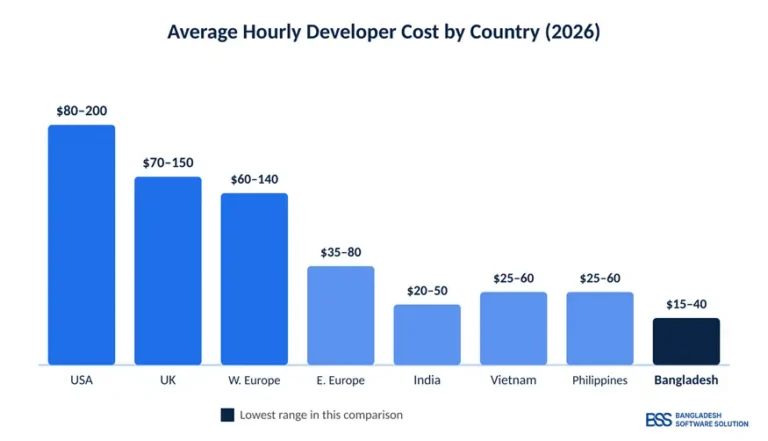
Hourly rates vary significantly by region, and that gap is exactly why offshore development remains attractive. Here’s a general picture of average hourly developer costs in 2026:

CountryRegionAverage Hourly Developer Cost
USANorth America$80–$200/hour
UKEurope$70–$150/hour
Western EuropeEurope$60–$140/hour
Eastern EuropeEurope$35–$80/hour
IndiaSouth Asia$20–$50/hour
VietnamSoutheast Asia$25–$60/hour
PhilippinesSoutheast Asia$25–$60/hour
BangladeshSouth Asia$15–$40/hour

These figures are useful as a starting reference point, but cost should not be the only deciding factor in choosing where — or who — to hire. A lower hourly rate that comes with communication friction, missed deadlines, or high turnover can end up costing more than a slightly higher rate from a team that delivers predictably. Alongside cost, businesses should weigh:

  • Technical capability relative to the complexity of the project
  • Communication quality, in both language fluency and responsiveness
  • Time-zone compatibility with your core working hours
  • Experience with projects similar in scale or industry to yours
  • Long-term reliability — team stability, retention, and delivery track record

Bangladesh has emerged as one of the more competitive options on this list, combining rates at the lower end of the South Asian range with a fast-growing pool of English-speaking engineers and increasing experience serving European and North American clients. It won’t be the right fit for every project — no single country is — but for businesses evaluating where to extend their engineering capacity, it’s a market worth including in the comparison rather than overlooking.

Average hourly developer rates by country, 2026

Red Flags When Hiring Offshore Developers

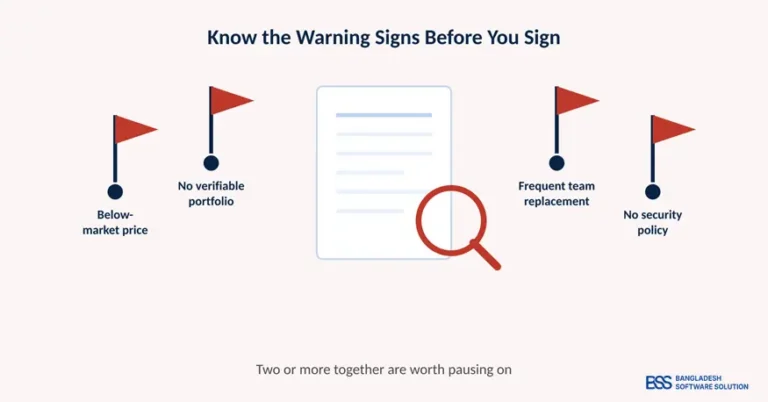
Most offshore engagements that go wrong show warning signs early — they’re just easy to miss when a proposal looks good on paper. When you hire offshore developers in 2026 watch for:

None of these signs is automatically disqualifying on its own, but two or more together are worth pausing on. The businesses that get burned by offshore hiring are rarely the ones who did too much due diligence — they’re almost always the ones who skipped it under time pressure.

Know the warning signs before you sign

Why Choose BSS for Offshore Software Development?

Hiring the right team is only half the job — the other half is how you manage the relationship once work is underway. Offshore partnerships that consistently deliver tend to share the same habits:

  • Clear KPIs. Defined, measurable goals for velocity, quality, and delivery — agreed on up front, not improvised later.
  • Regular sprint meetings. Consistent check-ins keep priorities aligned and surface blockers before they become delays.
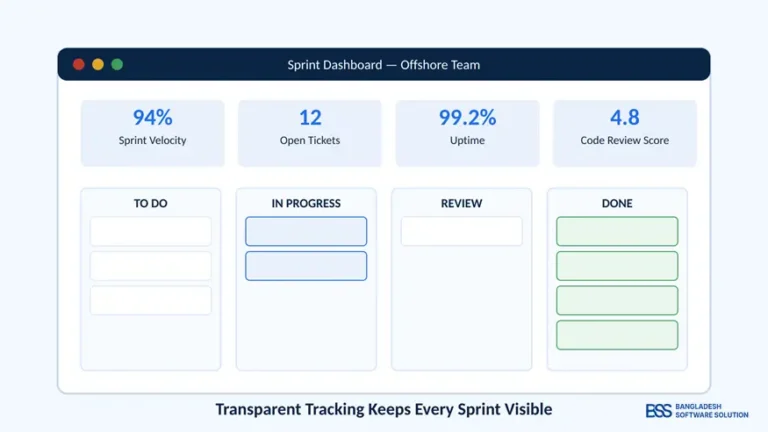
  • Project management tools. Shared visibility into what’s being worked on, by whom, and at what stage — no guessing.
  • Code reviews. A built-in quality gate that catches issues early and keeps standards consistent across the team.
  • Documentation. Decisions, architecture, and processes recorded so knowledge doesn’t live in one person’s head.
  • Transparent communication channels. A direct line to the team — not just a project manager relaying filtered updates.
  • Performance monitoring. Ongoing tracking of how the team is actually performing against the KPIs you set, not just how the project feels.

Done well, an offshore team stops feeling “offshore” at all. It starts functioning like an extension of your internal team — attending the same standups, held to the same standards, and accountable to the same roadmap.

Transparent tracking keeps every sprint visible

How to Ensure Your Offshore Team Delivers Results

Getting the process, the model, and the vetting right — as outlined above — is what separates a good offshore hire from a frustrating one. It’s also, unsurprisingly, how BSS approaches every engagement it takes on.BSS works with companies to build dedicated offshore development teams that plug into existing workflows rather than operating at arm’s length. That means access to skilled developers across frontend, backend, mobile, DevOps, QA, and AI/ML — vetted before they ever join a client project — combined with the transparent communication, sprint-based reporting, and documentation practices this guide has walked through. For businesses trying to reduce the usual hiring friction and get to a scalable, reliable engineering team faster, that combination is the point.Learn more about BSS offshore software development services.