







A traditional online store is simple: one seller, one bank account, and one checkout flow. A multi-vendor marketplace works differently. Instead of a single seller, it connects many independent third-party sellers with the same group of buyers, and every part of the payment process becomes more complex as a result. Think of the online platform where third-party sellers list their products next to thousands of other merchants, and a single order might contain items from three different vendors. Amazon platform is the most familiar example: it connects millions of buyers with third-party sellers, and behind every checkout the platform must sort out customer payments, seller earnings, marketplace commissions, refunds, and payouts, all without the buyer noticing any of it. For marketplace owners, that behind-the-scenes complexity is the real cost of growth. The eCommerce platform has to know exactly how much of each order belongs to the vendor, how much belongs to the marketplace as commission, and how to . This is precisely the problem that split payments were built to solve, and it is worth understanding before choosing any payment gateway for marketplace operations.
The Marketplace Payment Challenge
As a marketplace grows from a handful of vendors to hundreds, manually tracking seller payments, commissions, refunds, and transaction records stops being realistic. Spreadsheets that worked for five vendors break down at fifty. Every new seller adds another bank account, another commission rate, and another set of records to reconcile by hand. Payment delays start to frustrate vendors, disputes become harder to trace, and the marketplace owner spends more time on bookkeeping than on growing the business. This is usually the point where a marketplace payment solution stops being optional and starts being necessary.
Key Fact
Marketplace growth creates a payment challenge:
More sellers → More transactions → More payout complexity
Understanding Split Payments
Split payments solve this in a simple way, without requiring marketplace owners to understand the underlying technology. A customer pays once, at a single checkout, exactly like they would in any online store. Behind the scenes, an automated payout system instantly divides that one payment into two parts: the seller’s share of the sale, and the marketplace’s commission. Both amounts move to the correct destination automatically, on every order, without anyone manually calculating percentages or issuing transfers. It is the same online marketplace payment flow that powers the biggest platforms in the world, made accessible for growing businesses too.
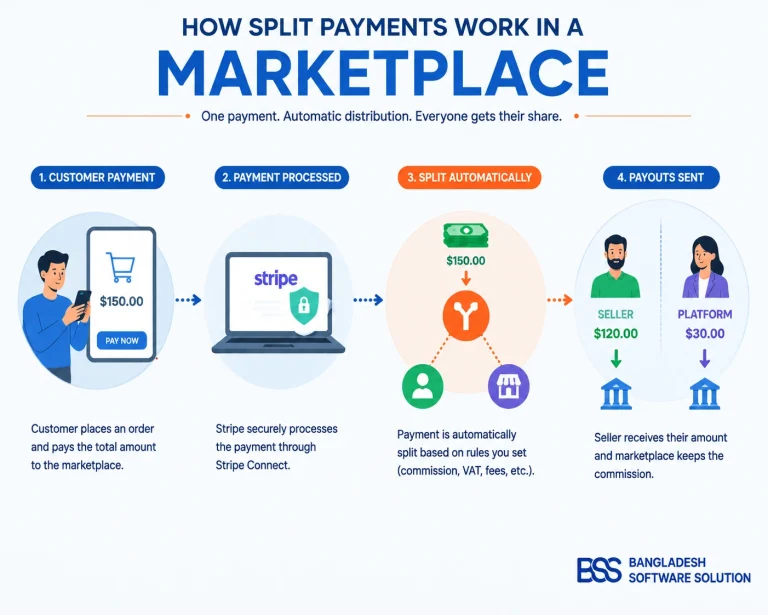
Amazon's Marketplace Model
Amazon’s third-party seller model is the clearest illustration of this idea in action, though the exact internal mechanics of any single company remain private. Broadly speaking, once a marketplace allows multiple sellers to list and sell independently, payment handling can no longer follow a traditional single-store setup. This is the same underlying idea behind an online platform where third-party sellers operate independently, and it is why marketplace commission management cannot be an afterthought once a business moves past its first few vendors. The table below is a simplified comparison of what changes.
Table 1: Traditional Ecommerce vs Multi-Vendor Marketplace Payments
| Traditional Store | Multi-Vendor Marketplace |
|---|---|
One seller | Multiple sellers |
One payment receiver | Multiple payment recipients |
Simple accounting | Commission tracking needed |
Manual reconciliation works fine | Automated payout system becomes essential |
How Stripe Connect Works
Stripe Connect is one of the most widely used tools for handling marketplace payments, and understanding it does not require any coding knowledge. In simple terms, it manages four things for a marketplace: seller onboarding, so vendors can safely receive money; payment distribution, so each sale is divided correctly; commission collection, so the marketplace automatically keeps its share; and automated vendor payouts, so sellers are paid on a predictable schedule. For marketplace owners, this turns payment handling from a manual, error-prone task into a background process that simply works.
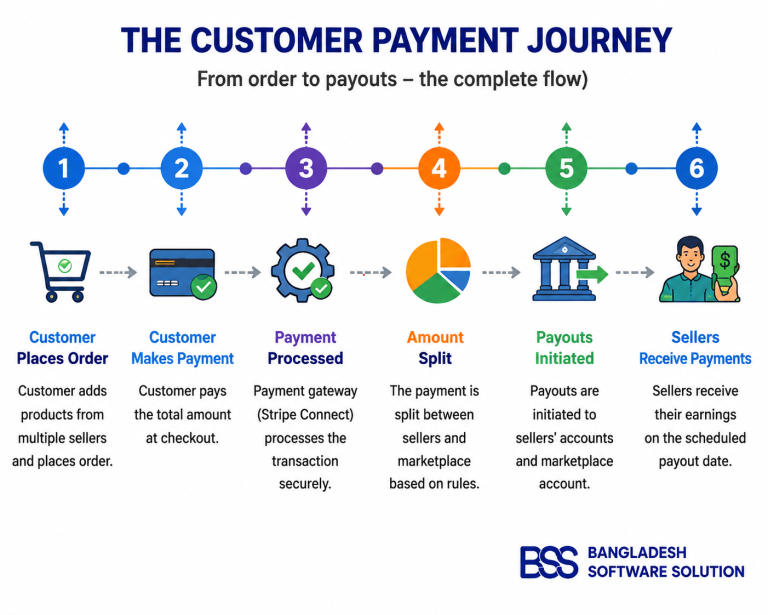
Benefits and Risks
Once split payments are in place, the day-to-day impact shows up quickly. Vendors stop chasing payment status, marketplace owners stop manually calculating commissions, and the entire online marketplace payment flow runs with far less oversight. The benefits generally fall into four areas.
Benefits
Automated Vendor Payouts
Reduces manual payment work for every order.
Better Commission Management
Marketplace owners collect their share automatically.
Improved Seller Experience
Sellers receive clearer, more predictable payment information.
Scalable Marketplace Growth
The system works just as well with 500 vendors as with five.
Split payment systems solve real problems, but they are not automatically simple to set up, and no solution is completely risk-free. Before choosing a marketplace payment solution, owners should think through how it handles regulatory compliance, seller identity verification, and refunds across multiple vendors in a single order. Transaction tracking needs to stay transparent enough for both sellers and the marketplace to trust the numbers. Not every payment provider integrates cleanly with every eCommerce platform, so compatibility is worth checking early, before development starts rather than after.
Things to Consider Before Choosing a Payment Solution
- Payment compliance
- Seller verification
- Refund handling
- Transaction tracking
- Payment provider compatibility
Choosing the Right Solution
For businesses building a marketplace with nopCommerce, payment handling requires proper integration between vendors, commissions, and checkout, since the platform does not handle multi-vendor payment splitting on its own. This is where custom ecommerce development solutions come in, connecting Stripe Connect’s payout logic directly into the storefront.
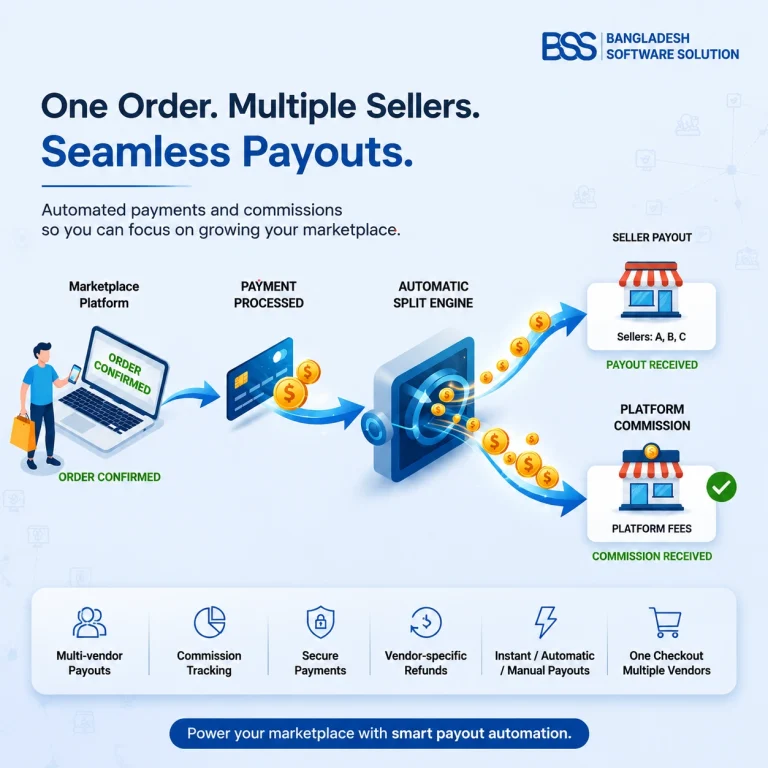
Bangladesh Software Solution offers nopCommerce development services built specifically for marketplace scenarios, including the Stripe Connect Split Payment Plugin for nopCommerce, which automates seller onboarding, commission collection, and vendor payouts inside a standard nopCommerce store. It is designed for marketplace owners who want the split payment model working correctly from day one, without building custom payment logic from scratch.
Multi-vendor marketplaces succeed or struggle based on details buyers never see: how fairly and how quickly sellers get paid. As transaction volume grows, manual payment handling becomes a bottleneck long before most owners expect it to. Split payments, whether through Stripe Connect or another marketplace automation tool, turn that bottleneck into a background process. For marketplace owners evaluating a payment gateway for marketplace operations, the right choice handles seller onboarding, commission tracking, and vendor payment automation without adding technical overhead.
Frequently Asked Questions
What are split payments in a marketplace?
Split payments automatically divide a customer’s payment among the marketplace, vendors, and other recipients based on predefined rules.
Why do multi-vendor marketplaces need split payments?
They simplify vendor payouts, commission collection, refunds, and transaction tracking while reducing manual work and payment errors.
How does Stripe Connect support marketplace payments?
Stripe Connect helps marketplaces onboard sellers, process customer payments, collect platform commissions, and transfer earnings to vendors.
Can one order include products from multiple vendors?
Yes. A split payment system can process one checkout and allocate the correct amount to each vendor after deducting applicable commissions.
How are refunds handled with split payments?
Refund handling depends on the marketplace’s rules and payment setup. The system may reverse vendor transfers, platform commissions, or both.
Can Stripe Connect split payments work with nopCommerce?
Yes. A compatible integration, such as the Stripe Connect Split Payment Plugin for nopCommerce, can connect marketplace orders, vendor payouts, commissions, and refunds.
Conclusion
A successful multi-vendor marketplace is built on more than attracting sellers and customers — it depends on creating a reliable ecosystem where every participant can operate with confidence. As marketplace models continue to evolve, businesses that invest in the right payment infrastructure will be better prepared to scale, adapt, and deliver a seamless experience.
Choosing a payment solution that fits your marketplace goals can help you avoid operational limitations as your platform grows. For nopCommerce businesses looking to simplify marketplace transactions, Bangladesh Software Solution’s Stripe Connect solution provides a practical way to enhance payment management while keeping the marketplace experience smooth for both administrators and vendors.
The right technology foundation allows marketplace owners to focus less on payment complexities and more on expanding their platform, strengthening vendor relationships, and creating long-term growth opportunities.
Building a marketplace and unsure whether this payment approach fits your business?
Talk to Bangladesh Software Solution about your software idea today.