We deliver dedicated remote development teams featuring some of Bangladesh’s most talented engineers.


We deliver dedicated remote development teams featuring some of Bangladesh’s most talented engineers.


A business account protected by only a password is like a home secured with a single lock. It may look strong, but once the key is stolen, copied, or guessed, nothing else protects what is inside. For an online store, that “home” contains customer profiles, order histories, delivery addresses, payment-related information, and valuable business data.
Passwords are often reused, exposed through phishing, leaked in third-party breaches, or targeted by automated login attacks. When a business relies only on password-based access, one compromised credential can open the door to account takeover, fraudulent orders, and data exposure.
When an unauthorized user acquires a password, a single-factor authentication system grants them immediate, full access. To extend the metaphor, mobile phone two-factor authentication (2FA) via Short Message Service (SMS) One-Time Passwords (OTP) functions as a secondary, heavy-duty deadbolt. Even if a cybercriminal successfully obtains or guesses the primary key, they are immediately halted at the entrance. Entrance requires a second, temporary key that is generated dynamically and delivered directly to the physical mobile device held by the verified account owner.
For early-stage startups and expanding e-commerce merchants operating on platforms like nopCommerce, establishing stronger login security is essential. Building customer trust takes time, but one security incident can damage confidence quickly. A reliable SMS authentication plugin for nopCommerce helps businesses reduce unauthorized access and protect customer accounts more effectively as they grow.

At its technical core, mobile phone authentication is an identity verification mechanism that relies on something the user possesses—specifically, access to a registered mobile phone number—in addition to something the user knows, such as a static password.
In modern digital identity frameworks, verification is categorized across three primary factors:
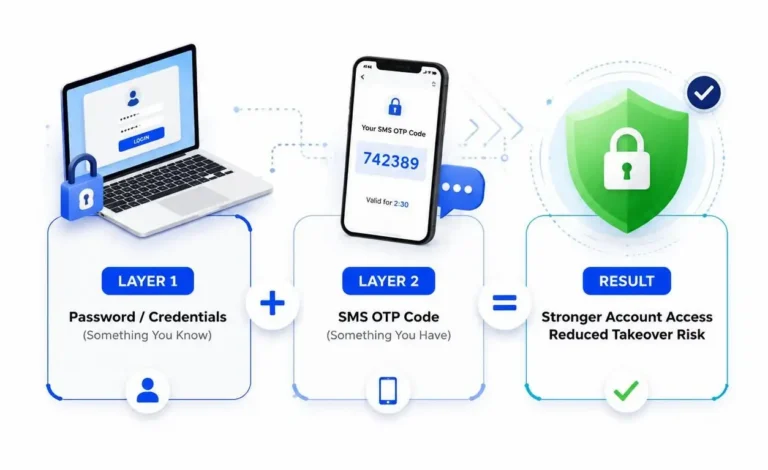
Mobile phone SMS authentication combines a Knowledge Factor (password) with a Possession Factor (possession of the mobile handset receiving an SMS code). During an authentication attempt, the underlying identity engine generates a time-limited, pseudo-random numeric code—known as a One-Time Password (OTP)—and dispatches it via a telecommunications SMS gateway to the user’s mobile number. Access is authorized only when the recipient enters the exact matching code within a strict expiration window.
It is crucial for technical decision-makers to distinguish between authentication and authorization:
Relying strictly on username-and-password combinations introduces severe operational and financial vulnerabilities for online businesses. Human behavior remains the primary weakness in single-factor credential systems.
Consider a growing online fashion merchant built on nopCommerce. The store processes 300 orders daily and stores customer shipping addresses, telephone numbers, and order histories. An attacker purchases a database of 500,000 compromised credentials leaked from an unrelated online portal. Using a credential-stuffing bot, the attacker tests these login pairs against the store’s customer login portal overnight.
Without multi-factor authentication, the bot successfully gains access to 450 customer accounts whose owners reused passwords. The attacker logs into these accounts, modifies shipping addresses, drains accrued store credit, attempts purchases using saved payment profiles, and harvests personal identity details. Beyond the immediate financial fraud, the store suffers severe reputational damage, customer churn, and payment gateway dispute fees—all stemming from single-factor login vulnerability.
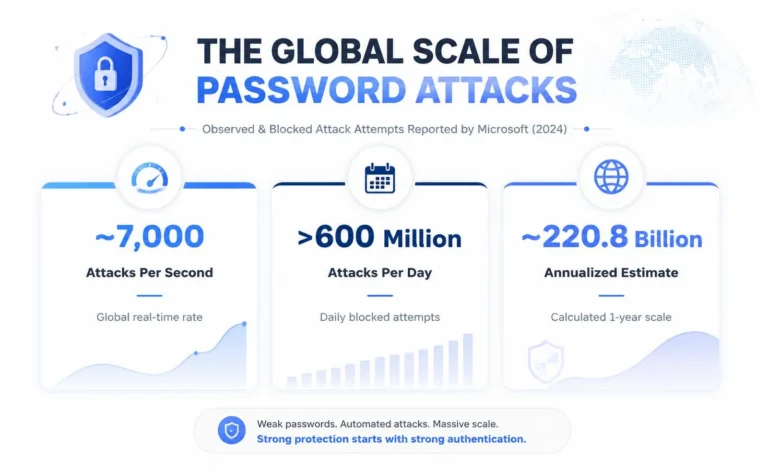
To appreciate the necessity of secondary authentication, enterprise leaders must examine the sheer volume of global credential targeting observed across the cybersecurity industry.


The 220.8 billion figure represents an annualized extrapolation of observed or blocked password attack attempts across global identity endpoints. It reflects automated brute-force and credential-stuffing traffic, rather than successful unauthorized breaches or individual compromise incidents.


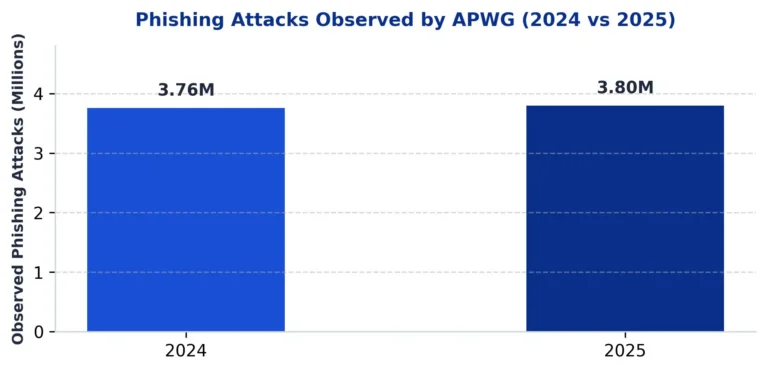
Simultaneously, social engineering and credential harvesting remain at record levels. The Anti-Phishing Working Group (APWG) observed approximately 3.8 million phishing attacks in 2025, representing a slight increase over the approximately 3.76 million observed attacks recorded in 2024 [2]. Phishing campaigns heavily target identity credentials, luring victims into inputting account names and passwords onto deceptive replica portals.
The operational impact of compromised credentials is documented in the Verizon 2025 Data Breach Investigations Report (DBIR). Verizon’s analysis revealed that compromised credentials were utilized as an initial access vector in approximately 22% of all confirmed security breaches studied [3].
Startup founders and small store owners often operate under the dangerous myth that cybercriminals only target large enterprise corporations. In reality, automated attack scripts continuously scan the public internet for vulnerable login endpoints regardless of company size. Small and medium-sized e-commerce sites are frequently targeted precisely because attackers assume smaller organizations possess weaker identity controls.
Two-factor authentication establishes an sequential verification process that prevents a compromised password from automatically granting account access.


When 2FA is active, the login architecture operates through the following structured sequence:
Even if an attacker obtains a customer’s valid password via a database leak or phishing campaign, they cannot complete Step 4 without physical control of the customer’s phone. This secondary barrier eliminates the vast majority of automated credential-stuffing attacks.
Integrating phone verification across multiple touchpoints strengthens store operations beyond standard login authorization:
To implement these security workflows natively within nopCommerce, Bangladesh Software Solution developed the Bangladesh Software Solution Phone SMS Authentication plugin. Designed specifically for nopCommerce architectures, the module extends store authentication and customer notification capabilities.
The plugin provides an extensive suite of configurable store administrator capabilities:
The Bangladesh Software Solution Phone SMS Authentication plugin provides flexible security controls, but security effectiveness depends on administrator setup. Store managers must actively configure rate limits, lockout rules, and short OTP expiry windows within nopCommerce settings.
Returning to our opening analogy, leaving a commercial building secured by a single lock is an unjustifiable risk when simple secondary locks are readily available. For nopCommerce merchants, startup founders, and growing online stores, password-only authentication leaves customer accounts exposed to automated credential stuffing, phishing harvesting, and account takeover attacks.
Establishing two-factor phone authentication early in your business journey creates a resilient identity architecture. The BSS Phone SMS Authentication plugin provides the native nopCommerce integration, multi-gateway controls, rate-limiting rules, and order communication features required to protect customer accounts while supporting business growth.
Learn more about the Bangladesh Software Solution Phone SMS Authentication plugin, or contact Bangladesh Software Solution to discuss installation, configuration, customisation, or nopCommerce security requirements.
A: SMS authentication is a security process that verifies a user’s identity by sending a short, time-limited One-Time Password (OTP) code via text message to their registered mobile phone during login or registration.
Yes. SMS OTP adds a mandatory second authentication factor (something you possess) to your password (something you know). This prevents attackers from accessing an account using stolen or leaked passwords alone.
Yes. The Bangladesh Software Solution Phone SMS Authentication plugin enables customers to register, sign in, and verify their identity using their mobile phone number alongside or in place of traditional email logins.
Yes. The plugin allows store owners to configure phone-based password recovery, requiring users to verify an SMS OTP before resetting their account password.
The plugin includes configurable rate-limiting controls, including mandatory resend cooldown timers, maximum hourly/daily request caps per IP or phone number, and failed-attempt lockouts.
Yes. The plugin supports international phone number formatting, country prefix validation rules, and multi-region telecommunications routing.
Yes. The plugin supports flexible custom API configurations, allowing store administrators to connect with virtually any SMS gateway provider using custom API endpoints, credentials, and Sender IDs.
While SMS OTP significantly improves security for general customer accounts, Bangladesh Software Solution recommends pairing high-privilege administrator logins with hardware-backed, phishing-resistant factors such as FIDO2 / WebAuthn passkeys or authenticator app TOTP.
Request a free, no-obligation quote and find the right talent for your project.