Informational

Is Software Outsourcing Risky? 10 Success Stories

July 23, 2026
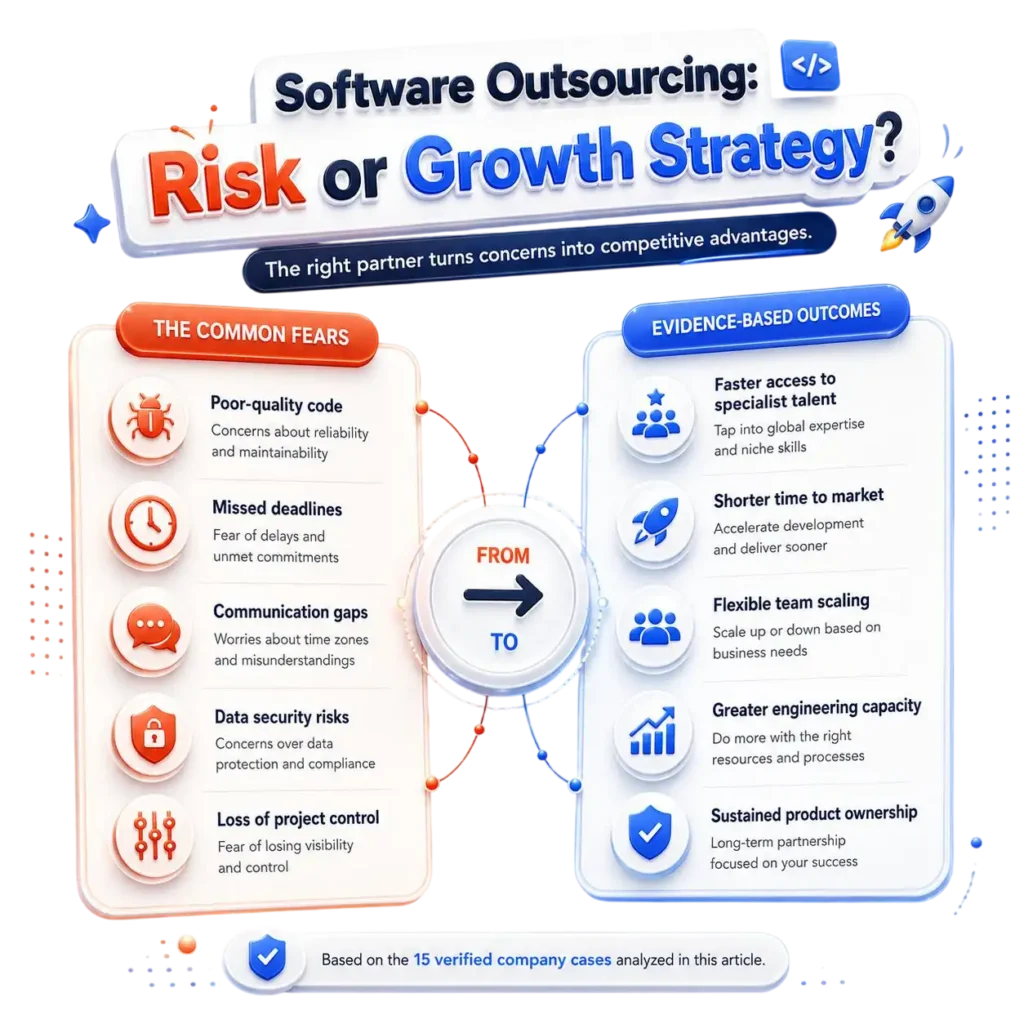
split infographic contrasting outsourcing fears with evidence-based outcomes.
Business development manager - Bangladesh Software Solution
Share:
Ten verified global examples show what separates outsourcing that works from outsourcing that fails — and how to tell the difference before you sign a contract.

Introduction

Every founder, CTO, or IT director who has considered offshore software development has asked the same question: what if it goes wrong? Poor-quality code, missed deadlines, communication breakdowns, security exposure, hidden costs, and dependency on a vendor you cannot fully see into are not imaginary fears — they are why real outsourcing engagements have failed.

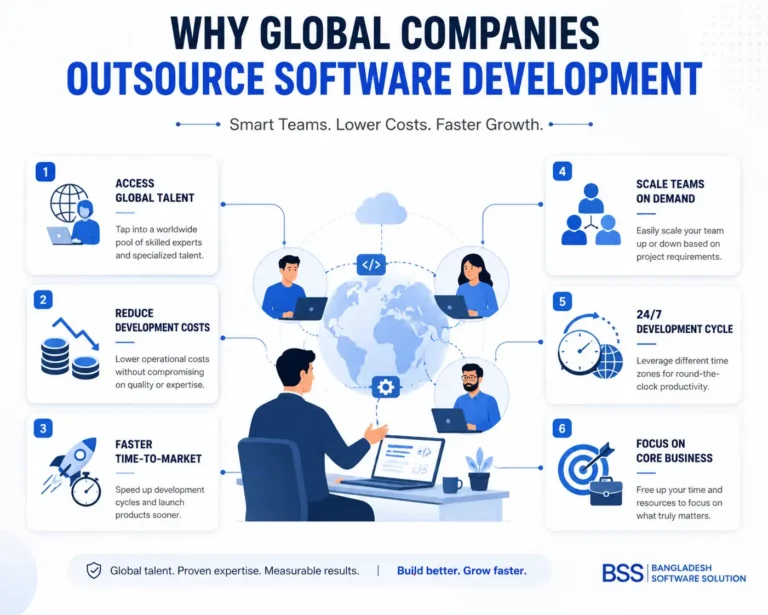
But the evidence tells a fuller story. Some of the world’s most recognizable technology, retail, and financial companies have built core parts of their engineering organizations offshore — through contractors, nearshore teams, acquisitions, or dedicated R&D centers — and turned that decision into a lasting advantage. What separates their outcomes from the cautionary tales is rarely the country a team is based in. It is how deliberately the engagement was structured and governed.

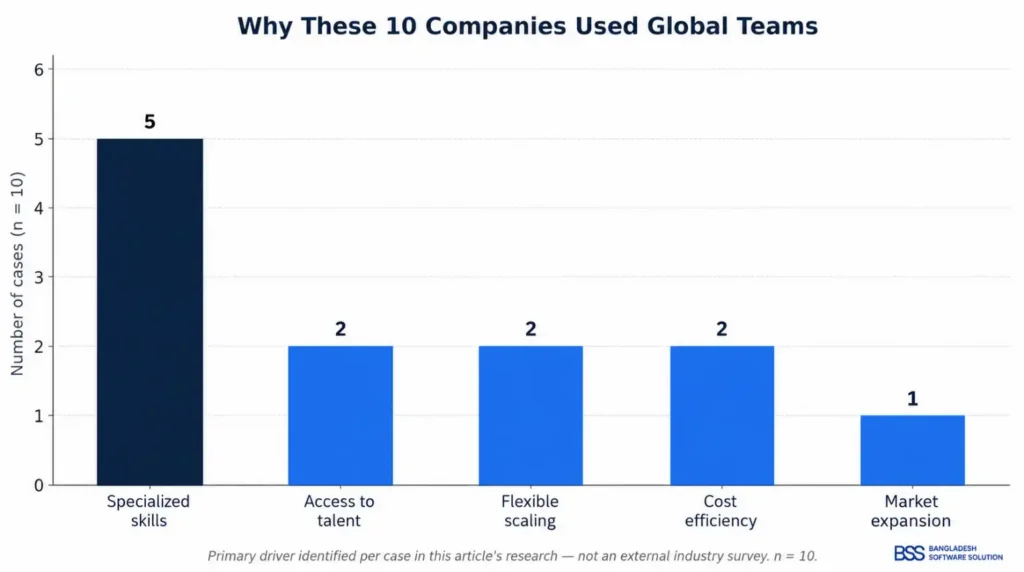
This article walks through 10 verified cases: what each company was trying to solve, what changed after it gained access to offshore or contracted talent, and what a purely in-house alternative would reasonably have required.

Why Software Outsourcing Feels Risky

The concerns business leaders raise are legitimate and deserve to be taken seriously, not waved away:

  • Poor-quality code and technical debt
  • Missed deadlines from unclear scope
  • Communication breakdowns across time zones
  • Data-security and compliance exposure
  • Unclear intellectual-property ownership
  • Hidden costs eroding the savings
  • Loss of control over the roadmap
  • High developer turnover
  • Dependency on a single vendor

None of these risks disappears simply by hiring offshore. What the 10 cases below show is that they can be managed — and left unmanaged, the same risks exist in local hiring too.

When Software Outsourcing Backfires

Failed engagements tend to share a small set of root causes: weak vetting of a partner’s track record, unclear ownership of code and decisions, security practices never formally agreed, communication left to ad hoc messages, and a partner chosen on price alone.

Unstructured, price-only, poorly managed outsourcing is risky. Software outsourcing itself is not — and the 10 companies below are the evidence.

What These 10 Companies Prove

Each case below is backed by reliable evidence — company newsrooms, well-sourced Wikipedia entries, Forbes, Bloomberg, Business Standard, and an award-recognized Cognizant release. Several are captive offshore R&D centers rather than third-party outsourcing; they carry a different risk profile but answer the same question — can real engineering work be trusted to a team outside a company’s home country? Each “in-house alternative” below is reasoned analysis, not a confirmed historical fact.

grouped diagram showing India, Estonia, Russia, and the US as talent regions with engagement models labeled.

1. WhatsApp: Scaling Messaging With a Tiny Team

  • The problem: In 2009, founders Jan Koum and Brian Acton had a messaging concept but no in-house iPhone developer.
  • The offshore move: They hired Igor Solomennikov, a contract iPhone developer in Russia found via the freelance marketplace RentACoder.com, to write the early iOS code.
  • The result: WhatsApp shipped in 2009 and grew into the world’s most used messaging app, acquired by Facebook for $19 billion in 2014 with a famously small engineering team.
  • The in-house alternative: hiring a full-time Silicon Valley iPhone engineer would likely have meant a slower, costlier search for a company running on a $250,000 seed round.
  • The lesson: One well-chosen contractor can close a critical skill gap faster than a lengthy local hire.
  • Sources: Forbes — “How Jan Koum Built WhatsApp” (2014)  ·  Wikipedia — WhatsApp

2. Skype: Built by a Contracted Estonian Team

  • The problem: In 2003, Niklas Zennström and Janus Friis had a peer-to-peer calling concept but no engineering team.
  • The offshore move: They contracted Estonian developers Ahti Heinla, Priit Kasesalu, Jaan Tallinn, and Toivo Annus — veterans of the Kazaa project — to build Skype’s backend from Tallinn.
  • The result: Skype launched in August 2003; Tallinn became the company’s largest office. eBay bought Skype for about $2.6 billion in 2005, and Microsoft for $8.5 billion in 2011.
  • The in-house alternative: rebuilding equivalent peer-to-peer networking expertise in Scandinavia would have meant starting from zero on a skill set that already existed, intact, in Tallinn.
  • The lesson: Nearshoring to a smaller market with concentrated expertise can beat hiring at home.
  • Sources: Wikipedia — Skype  ·  Estonian World

3. Bangladesh Software Solution: From Proof of Concept to Enterprise Solution

  • The challenge: Verifi3D required transforming an initial concept into a reliable, scalable technology solution capable of supporting enterprise-level requirements.
  • The outsourcing approach: The project partnered with Bangladesh Software Solution (BSS), leveraging BSS’s software engineering expertise to move beyond experimentation and build a production-ready solution.
  • The outcome: BSS successfully delivered Verifi3D by taking the project from a proof of concept (PoC) stage to an enterprise-grade solution. The project demonstrates how the right technology partner can help organizations convert innovative ideas into scalable products. 
  • What could have happened with only in-house hiring: Building a specialized development team internally could have required significant investment in recruitment, infrastructure, and technical leadership before achieving the same level of progress.
  • Key outsourcing lesson: A capable outsourcing partner does more than write code — it can provide the engineering experience, scalability, and product mindset needed to transform ideas into successful technology solutions.
  • Sources: Verifi3D – from proof of concept to enterprise solution – Bangladesh Software Solution.

4. GitHub — Global Distributed Engineering Model

  • The challenge: GitHub was created as a platform for developers worldwide, and from the beginning, the company operated in an environment where distributed collaboration was essential.
  • The outsourcing and distributed approach: GitHub embraced remote collaboration and distributed engineering practices, allowing talented developers from different locations to contribute rather than limiting recruitment to a single geographic area.
  • The outcome: The company became the world’s leading software development collaboration platform, eventually being acquired by Microsoft for $7.5 billion in 2018.
  • What could have happened with only in-house hiring: Restricting recruitment to one location would have limited access to specialized developers and slowed the platform’s ability to grow with the global developer community.
  • Key outsourcing lesson: Modern software companies can build world-class products by focusing on talent and capability rather than physical location.
  • Sources: Microsoft to acquire GitHub for $7.5 billion – Microsoft Malaysia News Center. (2018, June 5).

5. Basecamp — Global Distributed Software Development

  • The challenge: Basecamp built project management software for teams around the world. Maintaining a globally accessible product required a development model that supported flexibility and collaboration.
  • The outsourcing/distributed approach: The company adopted a remote-first working philosophy, demonstrating how software teams can operate successfully across locations.
  • The outcome: Basecamp became one of the most recognized project management platforms and helped popularize distributed software development practices.
  • What could have happened with only local hiring: A location-restricted hiring strategy would have reduced access to skilled developers and limited flexibility.
  • Key outsourcing lesson: A distributed development model can create sustainable engineering teams when communication processes are designed properly. Sources: https://basecamp.com/handbook

6. Oracle: Building Products From Bangalore Since 1994

  • The problem: Oracle needed added product-development capacity to keep pace with its growing software portfolio.
  • The offshore move: In 1994 it opened the Oracle India Development Center in Bangalore, adding a Hyderabad center in 1998.
  • The result: Both centers became major hubs, contributing to the Oracle e-Business Suite and other core product lines with thousands of engineers.
  • The in-house alternative: building that capacity solely in the US would likely have slowed product cycles as competition for enterprise-software engineers intensified.
  • The lesson: Sustained early investment in an offshore center compounds into a real engineering hub.
  • Sources: IBEF — Oracle in India (PDF)  ·  CIOL

7. SAP — International R&D Expansion

  • The challenge: SAP needed to scale enterprise software development beyond its headquarters in Germany to support growing global customer demands.
  • The outsourcing/global development approach: SAP expanded its international research and development operations, creating large engineering teams outside Germany.
  • The outcome: SAP’s global R&D network became a major contributor to its enterprise software, cloud, and digital transformation products.
  • What could have happened with only German-based hiring: Finding enough specialized software engineers in a competitive European technology market would have significantly slowed expansion.
  • Key outsourcing lesson: A global engineering footprint can help enterprises maintain innovation speed while accessing diverse talent pools.

8. Adobe: India Becomes Adobe's Largest Workforce

  • The problem: Adobe wanted to expand engineering capacity for its creative, document, and AI product lines beyond San Jose.
  • The offshore move: Adobe opened its first Indian R&D center in 1997 and has since built out Noida, Bengaluru, and Delhi offices.
  • The result: India is now Adobe’s largest workforce outside the US, with 8,000-plus employees said to contribute over a third of its global innovation.
  • The in-house alternative: sourcing that scale of AI engineering talent from the Bay Area alone would mean competing with every major AI employer there.
  • The lesson: A long-held offshore center can become central to a company’s roadmap, not just support.
  • Sources: Adobe Newsroom (2026)

9. Alibaba — International Technology Partnerships

  • The challenge: Alibaba needed to scale rapidly from a Chinese e-commerce startup into a global digital commerce ecosystem. This required extensive technology capabilities across payments, cloud infrastructure, logistics, and marketplace systems.
  • The outsourcing and partnership approach: Alibaba relied on international technology partnerships and global engineering collaboration to accelerate innovation across different business areas.
  • The outcome: Alibaba grew into one of the world’s largest e-commerce and technology companies, operating platforms used by millions of businesses and consumers.
  • What could have happened with only internal development: Developing every specialized technology capability internally would have slowed expansion and increased operational complexity.
  • Key outsourcing lesson: Strategic technology partnerships can help companies scale faster by combining internal vision with external expertise.
  • Sources: alibaba: The Inside Story 

10. AT&T: A Long-Term Cognizant Partnership

  • The problem: AT&T needed to modernize order management, customer care, and legacy IT beyond what internal teams could maintain alone.
  • The offshore move: Since 1997, AT&T has run a long-term outsourcing relationship with Cognizant covering application development, testing, and business-process work.
  • The result: The partnership won Outsourcing Center’s 2011 Outsourcing Excellence Award for Best Partnership, reflecting a stable, multi-year relationship.
  • The in-house alternative: keeping all legacy and customer-care systems fully in-house would have meant added software-maintenance overhead for AT&T’s core telecom teams indefinitely.
  • The lesson: A long, well-governed outsourcing relationship can beat a string of short vendor contracts.
  • Sources: Cognizant Newsroom

What the Winners Did Differently

A few patterns repeat across all 10 cases:

  • Long-term investment over one-off contracts, often lasting years or decades
  • Genuine ownership handed to the offshore team, not just execution
  • Gradual scaling — starting small before expanding
  • Executive sponsorship treating the team as core, not a cost line
  • A specific skill or capacity gap driving the decision, not cost alone

How to Reduce Software Outsourcing Risk

The businesses that avoid the outcomes they fear apply similar discipline, whether hiring one contractor or building a large offshore center:

  • Vet a partner’s verifiable portfolio and talk to real references
  • Start with a small, paid trial project before committing further
  • Define clear KPIs for velocity, quality, and delivery upfront
  • Put security and data-handling policies in writing
  • Build a documentation habit so knowledge is not siloed
  • Keep a direct line to the team, not a filtered summary
  • Track progress on shared sprint boards, not status emails

Outsourcing Risk and the Right Control

Visual 4 maps the risks founders and CTOs raise most often against why they happen and the practical control that prevents them.

Perceived risk Why it happens Practical control BSS approach
Poor-quality code
Weak vetting of developer skill before hiring
Paid trial project plus code-sample review
Pre-vetted developers, tested before joining a client project
Missed deadlines
Vague scope and no sprint structure
Defined KPIs and regular sprint check-ins
Sprint-based delivery with transparent reporting
Communication gaps
No direct line to the team, only filtered updates
Structured overlap hours and direct access to developers
Direct developer communication, not a relayed proxy
Data security risk
No written policy on code and credential access
Documented security and data-handling policy
Formal security practices agreed before work begins
IP ownership disputes
Unclear contract terms on code ownership
Written IP assignment in the engagement contract
Clear contractual ownership terms from day one
High turnover
Vendor spreads staff thin across many clients
Ask for dedicated, not shared, team members
Dedicated development teams working exclusively on one client

Table 1 – Outsourcing Risk and the Right Control.

When Outsourcing Beats an In-House Team

Across the 10 cases, offshore or outsourced teams tended to outperform a purely in-house approach on recruitment time, access to specialized skills, fixed employment overhead, ability to scale, and time to market. In-house teams often kept the edge on institutional knowledge continuity and functions needing constant in-person alignment. Communication, security, and management responsibility can go either way — they depend more on how the engagement is run than on where the team sits.

This is why some strategic or highly sensitive functions are often best kept internal, even at companies that outsource extensively elsewhere. Offshoring is a tool for specific problems, not a wholesale replacement for every internal team.

Build a Reliable Offshore Team With Bangladesh Software Solution

Outsourcing becomes safer when the right developers, processes, communication standards, and accountability are in place. That is the common thread across all 10 cases above — and the same standard BSS applies to every engagement it takes on.

BSS helps global businesses build dedicated offshore teams that work as an extension of their internal engineering organization — across frontend and backend development, mobile, QA, DevOps, and AI — backed by transparent sprint reporting, direct developer communication, and flexible scaling.

Bangladesh has emerged as a competitive global software development destination, pairing competitive rates with a fast-growing pool of English-speaking engineers, worth including when evaluating offshore software development.

Discuss Your Development Needs With Bangladesh Software Solution

Learn more about Bangladesh Software Solution offshore software development services, or explore BSS case studies and staff augmentation options, or contact BSS directly.