Informational

Frontend Ecommerce Development: How to Build Fast, Engaging and Conversion-Focused Online Stores

Frontend Ecommerce Development
Business development manager - Bangladesh Software Solution
Share:

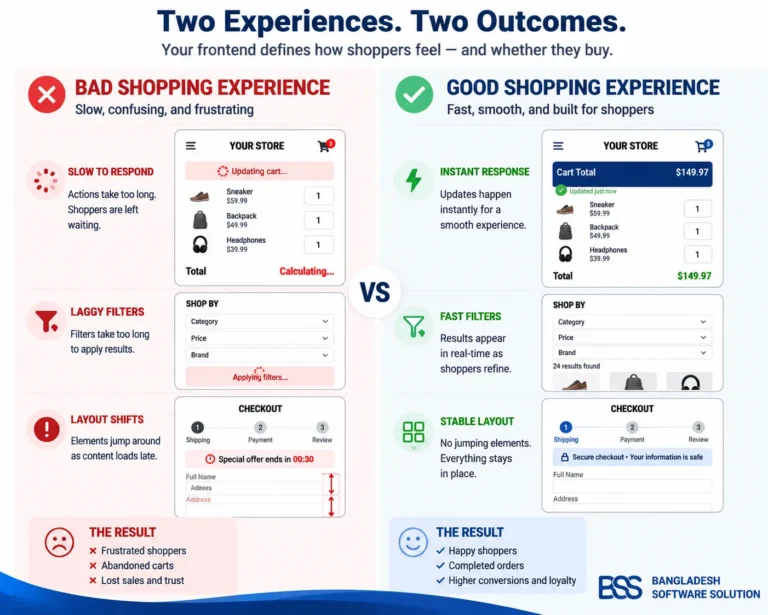
You add three items to your cart, and the page freezes for a moment before the total updates. You tap “Apply filter” on a mobile site and wait. You reach checkout, and the form fields jump as a banner loads late. None of this is a bad product or a bad price — it’s a frontend problem, and it’s exactly the kind of friction that sends shoppers to a competitor’s tab.

For ecommerce owners, decision-makers, and technical teams, frontend ecommerce development is no longer a design afterthought — it’s the layer shoppers touch, with a direct, measurable link to how many of them buy. This guide covers what it means, how it relates to the backend, what makes a storefront convert, and how to choose the right partner.

What Is Frontend Ecommerce Development?

Frontend ecommerce development is the practice of building everything a shopper sees and interacts with: the homepage, navigation, category pages, search and filters, product pages, cart, and checkout — the visual design, layout, and code (HTML, CSS, JavaScript, or a framework built on them) that renders in the browser or app.

Unlike backend development, which manages data and logic behind the scenes, the frontend is entirely about experience. A well-built one loads quickly, communicates trust, guides shoppers toward a decision, and works as well on a phone as on a desktop.

Ecommerce Frontend vs. Backend: How They Work Together

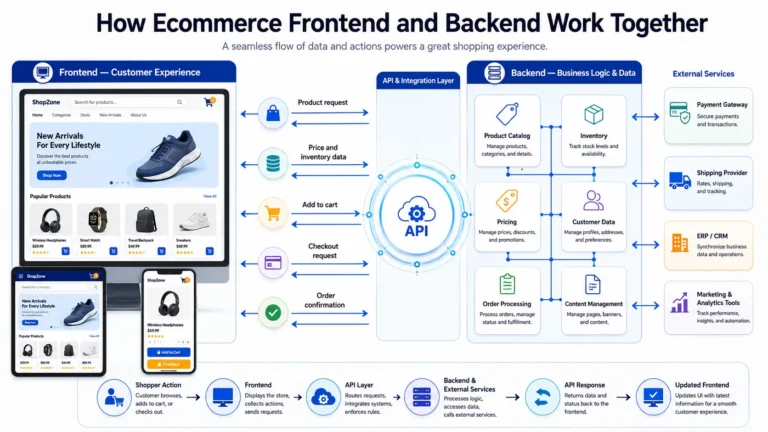
How the frontend layer connects through an API and integration layer to the backend, payment/shipping systems, ERP/CRM, and marketing tools.
Figure 1: How the frontend layer connects through an API and integration layer to the backend, payment/shipping systems, ERP/CRM, and marketing tools.

Every online store is really two systems working in tandem. The frontend is the storefront — the presentation layer shoppers browse and click through. The backend is the engine room: product catalogs, inventory, pricing, order processing, and customer data.

The two layers communicate through APIs: the frontend sends a request, the backend processes it against real data, and the frontend renders the result — ideally within a fraction of a second. A well-designed page is only as good as the data and speed behind it, and a powerful backend is wasted if the frontend can’t present it clearly.

Essential Elements of a High-Converting Ecommerce Frontend

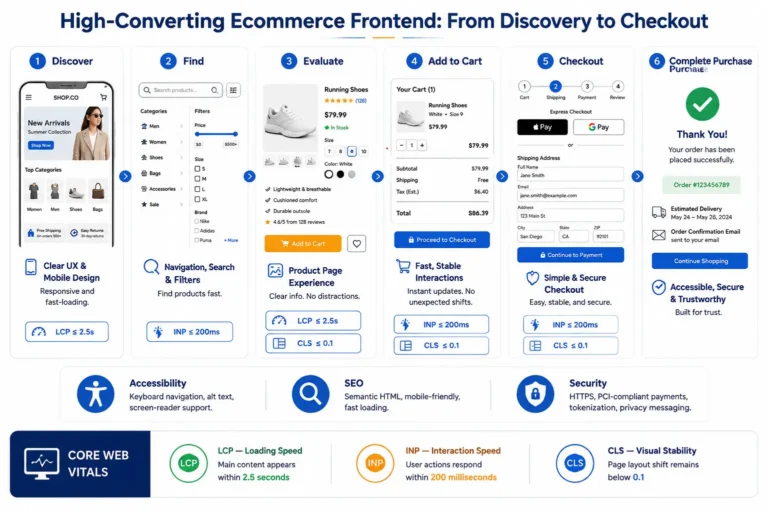
A conversion-focused storefront is the sum of many small, deliberate decisions across the shopping journey.

Figure 2: The shopper journey mapped to relevant frontend touchpoints and Core Web Vitals metrics at each stage.

User Experience (UX) and Mobile Responsiveness

Good UX means a shopper always knows where they are and what to do next. That starts with a responsive layout that adapts cleanly across screen sizes, since most ecommerce browsing now happens on mobile. A frontend that treats mobile as an afterthought — tiny tap targets, hidden menus, slow images — quietly loses sales a desktop-only review would never catch.

Navigation, Search, and Filters

Shoppers who can’t find what they want don’t wait — they leave. Clear category structures, predictive search, and fast, accurate filters (size, price, brand, availability) let shoppers narrow thousands of products to a handful in seconds. These interactions should feel instant; a laggy filter panel is one of the most common places INP (Interaction to Next Paint) problems show up.

For stores with large or complex product catalogues, Bangladesh Software Solution develops custom ecommerce search, navigation, and filtering solutions that make product discovery faster and easier.

Product Pages

The product page is where browsing turns into intent. High-quality images, clear pricing, honest availability, and easy-to-scan specs matter. So does restraint: pages loaded with auto-playing videos, pop-ups, and heavy scripts often hurt Largest Contentful Paint (LCP) more than they help conversion.

Checkout

Checkout is the highest-stakes screen on the site. Every unnecessary field, unclear error, or unexpected layout shift adds friction at the exact moment a shopper decides whether to finish. Guest checkout, visible progress indicators, and stable, predictable forms all reduce abandonment.

Bangladesh Software Solution develops custom ecommerce check-out solutions that make check-outs faster and easier.

Accessibility

An accessible frontend — color contrast, keyboard navigation, screen-reader-friendly markup, descriptive alt text — isn’t just a compliance checkbox. It widens the pool of customers who can complete a purchase, and tends to produce cleaner code as a side effect.

SEO and Core Web Vitals

Search visibility starts at the frontend. Semantic HTML, fast loads, and mobile-friendly layouts influence rankings. Google’s Core Web Vitals set a concrete target: LCP of 2.5 seconds or less, INP of 200 milliseconds or less, and CLS of 0.1 or less (web.dev). Research from Google and Deloitte links small load-time gains to measurable conversion gains (Think with Google), making frontend development and technical SEO inseparable.

Security

The frontend is also where shoppers judge trust: a visible padlock, a clean checkout free of intrusive scripts, and clear privacy messaging matter. It should never handle sensitive payment data directly — that’s the job of PCI-compliant gateways and tokenization, with the frontend simply presenting a secure interface.

Traditional vs. Headless Ecommerce Frontend

In a traditional setup, frontend and backend are bundled in one platform, rendered through its theming system. In a headless ecommerce frontend, the presentation layer is fully decoupled from the commerce engine and communicates with it through APIs, giving teams freedom to build the storefront in any modern framework while the backend still handles catalog, orders, and payments.

Comparison Area Traditional Ecommerce Frontend Headless Ecommerce Frontend

Architecture

Frontend and backend are connected in one platform using a built-in theme system.

Frontend is separated from the backend and connects through APIs.

Design Freedom

Customization depends on available themes, templates, and platform limitations.

Developers can create unique storefronts using any modern frontend framework.

Performance

Speed depends on the platform, theme quality, plugins, and hosting setup.

Faster experiences are possible through optimized code, caching, and modern frontend tools.

Channels

Mainly designed for a single website storefront.

Supports multiple experiences such as websites, mobile apps, marketplaces, and smart devices

Launch Speed

Faster to launch because most features are already built into the platform.

Requires more planning and development before launch due to custom integrations.

Maintenance

Easier to manage because frontend and backend updates happen in one system.

Requires managing separate frontend and backend systems but allows independent updates.

Scalability

Works well for simple stores but can become limiting as brands need more customization and sales channels.

Helps growing brands scale faster by adding new experiences and channels without rebuilding the entire system.

Cost

Lower initial cost with fewer development requirements.

Higher initial investment but can provide more flexibility and long-term growth potential.

Best Fit

Best for businesses that need a reliable storefront, quick setup, and standard ecommerce features.

Best for brands that need custom experiences, multiple channels, and the ability to evolve quickly.

Table 1: Traditional versus headless ecommerce frontend, compared across architecture, design freedom, performance, channels, speed, and best fit.

Neither approach is universally “better.” A traditional, theme-based frontend can be the faster, cheaper route for a store that needs one clean storefront and a quick launch. Headless earns its added complexity when a brand sells across multiple channels or needs to scale content and commerce independently.

Common Frontend Development Mistakes to Avoid

  • Treating mobile as a smaller desktop instead of designing for it directly
  • Overloading pages with heavy scripts and auto-playing media that damage load speed
  • Skipping accessibility until late, forcing a retrofit instead of building it in
  • Adding checkout fields or steps that aren’t strictly necessary
  • Ignoring layout stability, so images and banners shift content as pages load
  • Choosing a framework or theme by trend rather than catalog size, traffic, and team capability

How to Choose an Ecommerce Development Partner

How to Choose an Ecommerce Development Partner
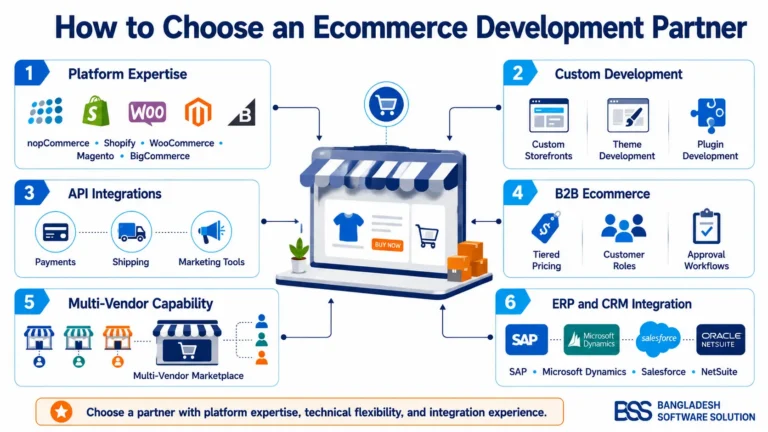
Figure 3: Choose a good Ecommerce development partner

Because the frontend touches design, performance, SEO, and revenue at once, the team that builds it needs range: platform expertise across nopCommerce, Shopify, WooCommerce, Magento, or BigCommerce, plus the ability to build custom themes, develop plugins, and connect the storefront to payment, shipping, and marketing tools via API integrations.

If you sell to other businesses, run multiple sellers, or use enterprise systems, look further still: B2B features like tiered pricing and approvals, multi-vendor marketplace capability, and clean ERP/CRM integration with systems such as SAP, Microsoft Dynamics, Salesforce, or NetSuite.

This is the kind of work Bangladesh Software Solution (BSS) focuses on as an ecommerce development partner — building custom storefronts and themes, developing plugins and API integrations, and supporting B2B, multi-vendor, and ERP/CRM-connected stores across nopCommerce, Shopify, WooCommerce, Magento, and BigCommerce.

Our experience includes helping businesses move from fragmented selling channels to scalable ecommerce platforms. For example, we transformed a Facebook-first skincare business into a complete nopCommerce-based ecommerce operation with centralized order management, improved checkout experience, payment workflows, and business process automation. Read the full case study: Transforming a Facebook-first skincare business into a scalable ecommerce operation built on nopCommerce.

Conclusion: Build a Frontend That Earns the Sale

Every freeze, delay, and confusing screen on your storefront is a small opening for a shopper to leave. Strong frontend ecommerce development closes those openings — fast, stable pages, intuitive navigation, accessible design, and a checkout that gets out of the way. Combined with solid technical SEO and Core Web Vitals, it becomes one of the most direct levers a business has over its conversion rate.

Planning a new storefront, a redesign, or a move to headless? Bangladesh Software Solution can help you build a frontend that performs as well as it looks. Explore Bangladesh Software Solution’s ecommerce development services to get started.


Frequently Asked Questions

What is the difference between ecommerce frontend and backend development?

The frontend is everything a shopper sees and interacts with — pages, navigation, checkout — while the backend manages data and logic behind the scenes, such as inventory, orders, and payments. They connect through APIs.

A combination of optimized images, minimal unnecessary scripts, mobile-responsive design, stable layouts, and fast, predictable interactions across search, filters, product pages, and checkout.

It’s an architecture where the frontend is built and deployed independently of the backend commerce engine, connected only through APIs, giving teams more flexibility to build custom, multi-channel experiences.

Google and Deloitte research has linked faster load times to measurable improvements in retail conversion rates, and Core Web Vitals are also a confirmed Google ranking signal (web.dev), so performance affects both visibility and sales.

BSS works across nopCommerce, Shopify, WooCommerce, Magento, and BigCommerce, building custom themes, plugins, and API integrations, including for B2B, multi-vendor, and ERP/CRM-connected stores.