Informational

Offshore Ecommerce Development Teams: How Businesses Scale Faster in 2026

Fast delivery in Bangladesh.
Business development manager - Bangladesh Software Solution
Share:

Why Ecommerce Businesses Need Offshore Development Teams

A successful ecommerce store is not built once and forgotten. Every growing business eventually faces the same challenge: finding enough technical expertise to improve checkout, integrate new systems, optimize performance, and launch new features without slowing growth. That work never stops.

Ecommerce stores are never really “finished.” They need new integrations, faster page speeds, security updates, and new features to stay competitive. That work never stops.

Finding skilled ecommerce developers locally can be slow and expensive, especially for platforms like nopCommerce or WooCommerce, or for specialized work like ERP integrations and AI-powered features.

Offshore development teams give ecommerce businesses access to experienced technical talent without the cost and delay of building a large in-house team from scratch. For growing online retailers, that difference often decides whether a competitor ships a feature first.

What Is an Offshore Ecommerce Development Team?

An offshore ecommerce development team is a group of remote developers who build, customize, and maintain your ecommerce platform, working alongside your existing business and marketing teams.

They don’t replace your team. They extend it. An offshore ecommerce development team helps businesses access skilled developers without the challenges of expanding an internal hiring process, while you stay in control of priorities and decisions. Most engagements start with a specific need, such as a platform migration or a checkout redesign, and grow from there.

When Should You Hire an Offshore Ecommerce Team?

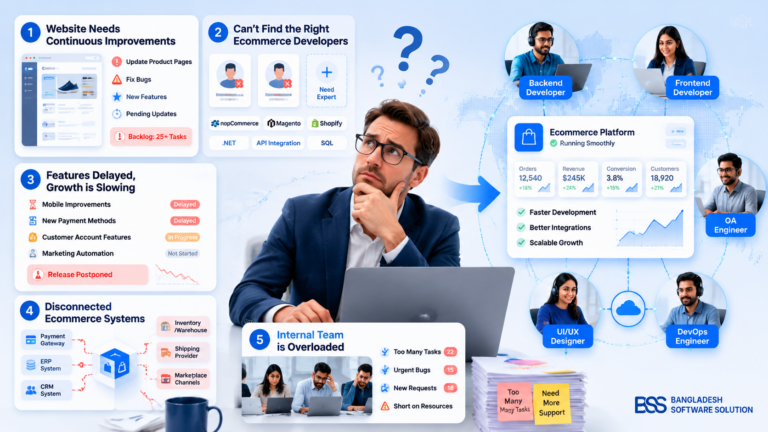
An offshore team is usually a good fit when:

Your ecommerce platform needs continuous improvements
You cannot hire specialized developers locally
You need faster feature delivery
You need ecommerce integrations
Your internal team needs additional support

When to choose an offshore development team
Figure 1: When to choose an offshore development team.

Why Ecommerce Companies Choose Offshore Development Teams

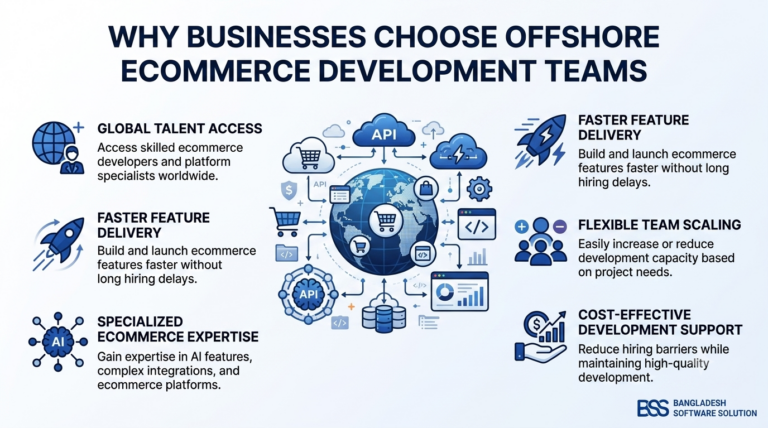
Businesses turn to offshore ecommerce developers for several reasons:

  • Access to skilled ecommerce developers, including specialists in specific platforms and integrations.
  • Faster feature development, since you’re not waiting months to fill an open role.
  • Flexible team scaling, adding or reducing developers as project needs change.
  • Access to specialized expertise, such as AI features or complex API integrations.
  • Cost-effective development support, compared to building a large local team.
  • Long-term ecommerce improvement and maintenance, not just one-off projects.
Why businesses choose offshore ecommerce development teams.
Figure 2: Why businesses choose offshore ecommerce development teams.

Roles and Services Provided by Offshore Ecommerce Development Teams

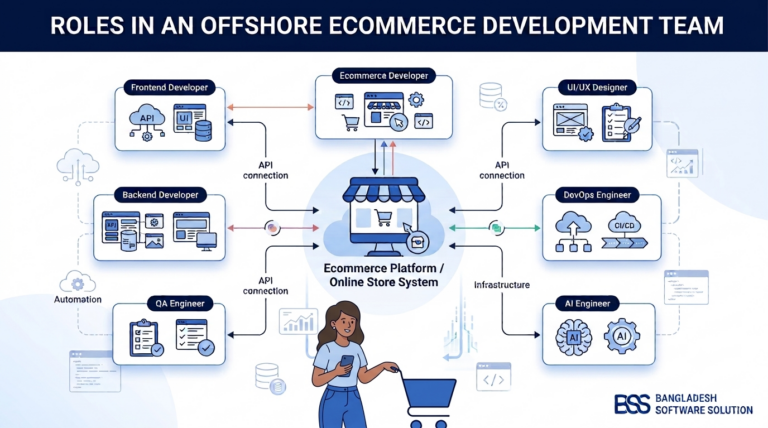
A dedicated ecommerce development team can include:

  • Ecommerce developers, for platform-specific build-out.
  • Frontend developers, for storefront design and user experience.
  • Backend developers, for catalog, checkout, and order logic.
  • QA engineers, for testing across devices and browsers.
  • UI/UX designers, for conversion-focused design.
  • DevOps engineers, for deployment and uptime.
  • AI engineers, for recommendations and automation.
Figure 3: Common roles available through an offshore ecommerce development team.
Service Examples

Ecommerce Platform Development

nopCommerce, WooCommerce, Shopify customization

Custom Ecommerce Development

Features, plugins, extensions

API Integration

ERP, CRM, payment, shipping integrations

Performance Optimization

Speed, scalability, user experience improvements

AI Ecommerce Solutions

Recommendations, automation, AI assistants

Maintenance & Support

Updates, improvements, troubleshooting

Table 1: Core services offered by offshore ecommerce development teams.

Offshore Ecommerce Development Team vs In-House Team

Factor In-House Team Offshore Team

Hiring speed

Slow, competitive local market

Faster access to available talent

Talent availability

Limited to local market

Global talent pool

Cost structure

Full salary, benefits, overhead

Flexible, engagement-based cost

Scalability

Harder to scale quickly

Scale up or down as needed

Access to expertise

Limited to team’s existing skills

Broader specialist access

Table 2: Offshore ecommerce development team vs. in-house team.

How to Build and Manage an Offshore Ecommerce Development Team

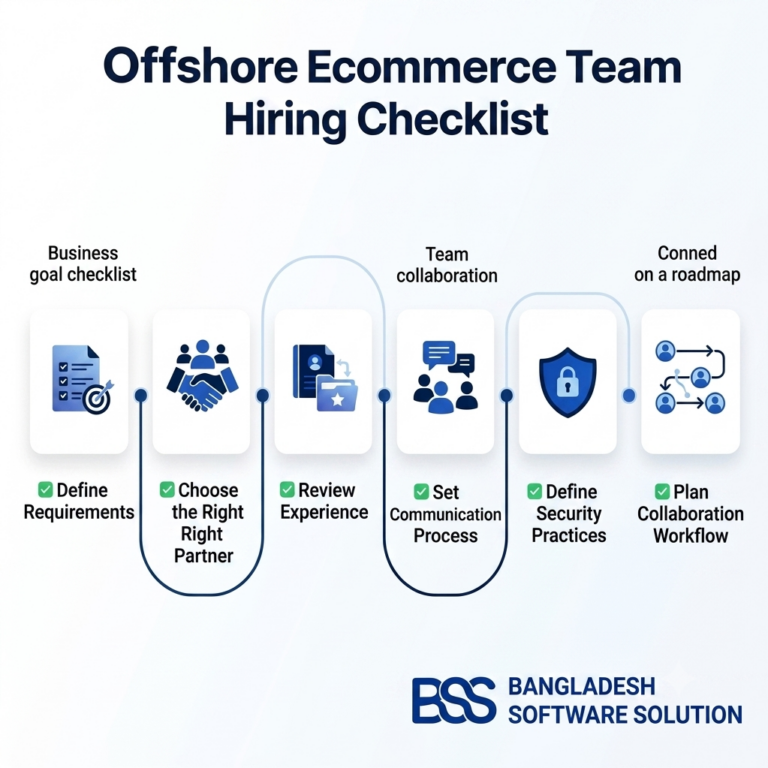
A successful offshore ecommerce engagement does not happen by simply hiring developers and starting work. It begins with a clear understanding of your business goals, technical requirements, and the outcomes you want to achieve. Defining the project scope early helps ensure that everyone is aligned from the beginning.

The next step is choosing the right development partner — one that understands your ecommerce platform, industry requirements, and long-term growth plans. Reviewing their technical expertise, previous ecommerce projects, and experience with similar challenges helps you make a more confident decision.

Once the partnership begins, establishing a clear communication process is essential. Defined communication channels, regular updates, project management tools, and transparent reporting help keep the team aligned and prevent misunderstandings.

Security should also be addressed before development starts. Clear expectations around data protection, access control, source code ownership, and confidentiality create a safer working environment for both sides.

Finally, the collaboration workflow should be designed to work smoothly with your existing team. A well-integrated offshore team should feel like an extension of your organization — working together through shared processes, tools, and goals to deliver continuous ecommerce improvements.

Figure 4: Offshore ecommerce team hiring checklist.

Common Risks of Offshore Ecommerce Development and How to Avoid Them

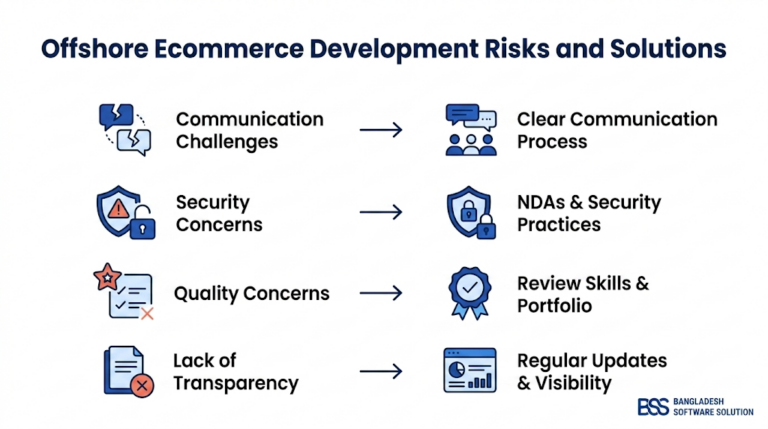
Communication Challenges

Solution: A clear communication process and shared collaboration tools from day one.

Security Concerns

Solution: Signed NDAs, controlled access, clear code ownership, and defined security practices.

Quality Concerns

Solution: Review technical skills, past portfolio, and development process before starting.

Lack of Transparency

Solution: Regular updates, progress tracking, and shared project visibility.

Common offshore ecommerce development risks and how to avoid them.
Figure 5: Common offshore ecommerce development risks and how to avoid them.

Checklist when Choosing the Right Offshore Ecommerce Development Partner

Choosing an offshore ecommerce partner is not only about finding developers at a lower cost.

The right partner should understand your business goals, ecommerce platform requirements, security expectations, and long-term growth plans.

Before signing an agreement, evaluate these key areas:

Ecommerce Platform Experience

Choose a partner with proven experience in your ecommerce platform, whether it is nopCommerce, Shopify, Magento, WooCommerce, or a custom solution. Platform expertise reduces development risks and speeds up delivery.

Previous Ecommerce Projects

Review completed ecommerce projects to understand their experience with real-world challenges such as checkout optimization, integrations, B2B features, and scalability.

Technical Expertise

Evaluate the team’s skills across frontend, backend, APIs, databases, cloud infrastructure, integrations, and emerging technologies such as AI automation.

Security Practices

Confirm that the partner follows proper security standards, including NDA agreements, controlled access, secure coding practices, data protection, and clear ownership of source code.

Communication Process

A successful offshore engagement requires transparent communication. Check their collaboration tools, reporting process, meeting schedules, and how they handle project updates.

Post-Launch Support

Look for a partner who can support your ecommerce platform after launch through maintenance, bug fixes, performance improvements, security updates, and future enhancements.

The right offshore ecommerce partner should act as an extension of your team, not just an external service provider.

Why Choose Bangladesh Software Solution for Offshore Ecommerce Development

Bangladesh Software Solution helps businesses build and scale ecommerce platforms through dedicated offshore development teams.

Our experience includes nopCommerce and WooCommerce development, custom ecommerce features, AI-powered ecommerce solutions, and ERP and API integrations. We work as an extension of your existing team, supporting both new platform builds and long-term improvement of stores already in production.

Whether you need a single specialist or a full ecommerce development team, we structure the engagement around your goals and stay involved for the long term, not just a single launch. Our developers work directly with your product and marketing teams, so ecommerce priorities stay aligned with the rest of the business.

BSS Ecommerce Experience: Real-World Success Stories

Bangladesh Software Solution has helped businesses across different industries build scalable ecommerce platforms that solve real operational challenges and support long-term growth.

Common offshore ecommerce development risks and how to avoid them.

For Ola Sportswear, Bangladesh Software Solution developed a B2B-ready, multi-currency ecommerce platform designed for European market expansion. The solution included core ecommerce development, B2B ordering capabilities, multi-currency support, and improvements aligned with European market requirements. The result was a scalable ecommerce foundation that enabled Ola Sportswear to manage international growth more efficiently.

For Ladily, a Facebook-first skincare business, BSS transformed its social commerce operation into a scalable ecommerce ecosystem built on nopCommerce. The solution included a custom ecommerce experience, one-page checkout, Facebook order integration, advanced payment rules, pre-order management, and centralized inventory and reporting. The new platform helped Ladily streamline operations, manage growing customer demand, and expand beyond manual Facebook selling, while successfully handling over 2 million requests within 30 days to support business growth.

These projects demonstrate how BSS combines ecommerce expertise, platform knowledge, and custom development capabilities to help businesses overcome growth challenges and build technology solutions that support their future expansion.

Read the full case studies to see how BSS helped Ola Sportswear and Ladily achieve ecommerce growth through scalable solutions. 

Need experienced ecommerce developers without expanding your internal hiring process? Talk to Bangladesh Software Solution about building a dedicated offshore ecommerce development team. https://bssoln.com/contact-us/

Frequently Asked Questions

What is offshore ecommerce development?

Offshore ecommerce development is the practice of hiring a remote team to build, customize, or maintain your ecommerce platform, instead of hiring locally.

To access skilled talent faster, reduce hiring costs, and scale development capacity up or down as project needs change.

Offshore developers integrate into your existing workflows and tools, working alongside your internal team while you retain control of priorities and decisions.

Common services include platform development, custom features, API integrations, performance optimization, AI ecommerce solutions, and ongoing maintenance.

Yes, when the partner uses signed NDAs, controlled access, clear code ownership, and defined security practices.

Look for proven platform experience, a strong project portfolio, clear communication practices, and long-term support options.