





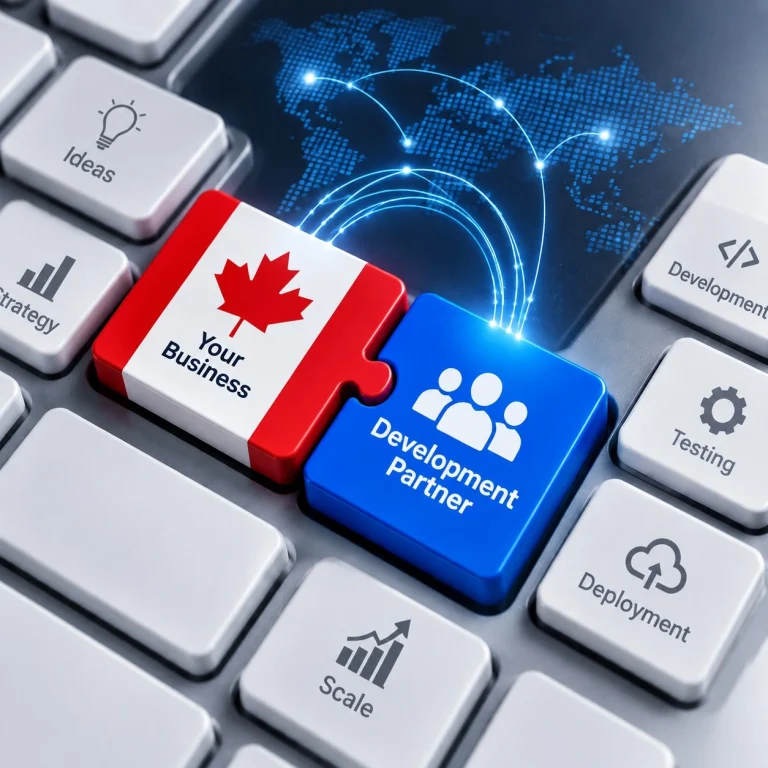
Canadian businesses are under growing pressure to modernize faster than their internal teams can keep up with. Whether you are a startup validating a new product idea or an established company replacing a legacy system, custom software development Canada searches reflect a real shift: companies want technology built around their exact processes, not off-the-shelf tools that force a compromise. The challenge is rarely the idea itself — it is finding the right technical partner to execute it reliably, securely, and on a timeline that makes business sense.
Local hiring alone often cannot solve this. Specialized developers are expensive and hard to recruit quickly in a competitive Canadian labour market, and many growing companies do not need a full in-house engineering department — they need dependable custom software development capacity they can scale up or down. That is why more Canadian businesses are pairing internal product leadership with an external technology partner: a structure that keeps decision-making local while extending engineering capacity through a trusted, transparent collaboration model
Why Canadian Businesses Need Flexible Software Development Support
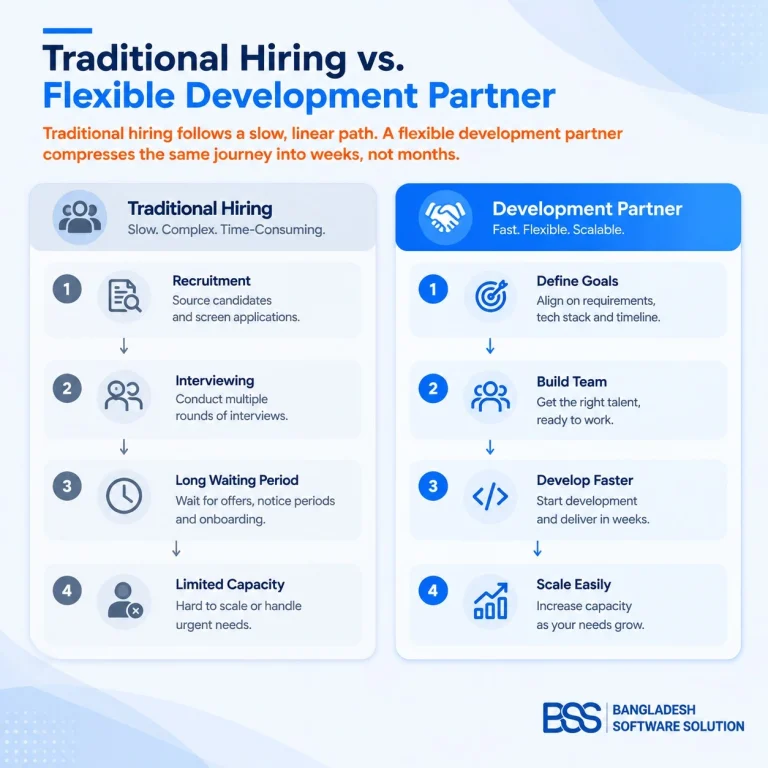
Building an internal engineering team from scratch is slower than most founders expect. Recruitment cycles for senior developers can stretch past three months, interviews consume leadership time, and even a successful hire needs weeks to reach full productivity.
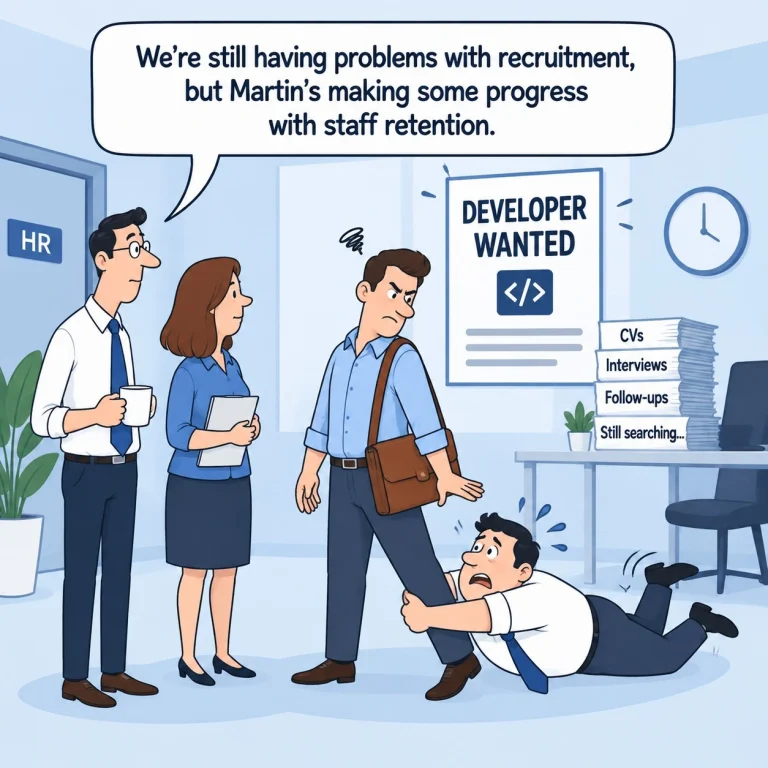
Meanwhile, product roadmaps do not pause. A flexible dedicated development team changes this equation: instead of waiting through a full hiring cycle, a Canadian business can define its goals, onboard a development team, and begin building within weeks. This model does not replace strategic leadership — it removes the bottleneck between a validated idea and a working product, while leaving product direction firmly with the Canadian business.
What Canadian Companies Should Look For in a Software Development Partner
Not every software development partner operates the same way, and the differences matter once a project is underway. Look for consistent, structured communication — regular updates, shared project boards, and a single point of contact rather than a rotating cast of developers. Technical expertise should be demonstrable through past work, not just claimed. A serious partner will also have a defined quality assurance process, covering code review, testing, and security checks before release. Transparency around timelines, costs, and progress reduces surprises later. Finally, ownership terms should be unambiguous from day one, covering both the code produced and any underlying intellectual property.
Before selecting an offshore or remote development partner, businesses should verify important factors such as technical capability, communication process, security practices, ownership terms, and delivery experience. Our blog on offshore development partner verification checklist can help companies evaluate potential partners before starting a collaboration.
A useful Question to ask
“Who owns the source code and intellectual property after development?”
This is one of the most overlooked questions in a software engagement, and one of the most important. A written agreement should state clearly that the client owns the finished code, documentation, and any related intellectual property once payment terms are met. Without this in writing, a business can find itself dependent on its development partner indefinitely, unable to switch providers or bring work in-house later. Canadian businesses evaluating a potential partner should ask this question directly, before signing any contract, not after.
Privacy and Compliance Considerations for Canadian Software Projects
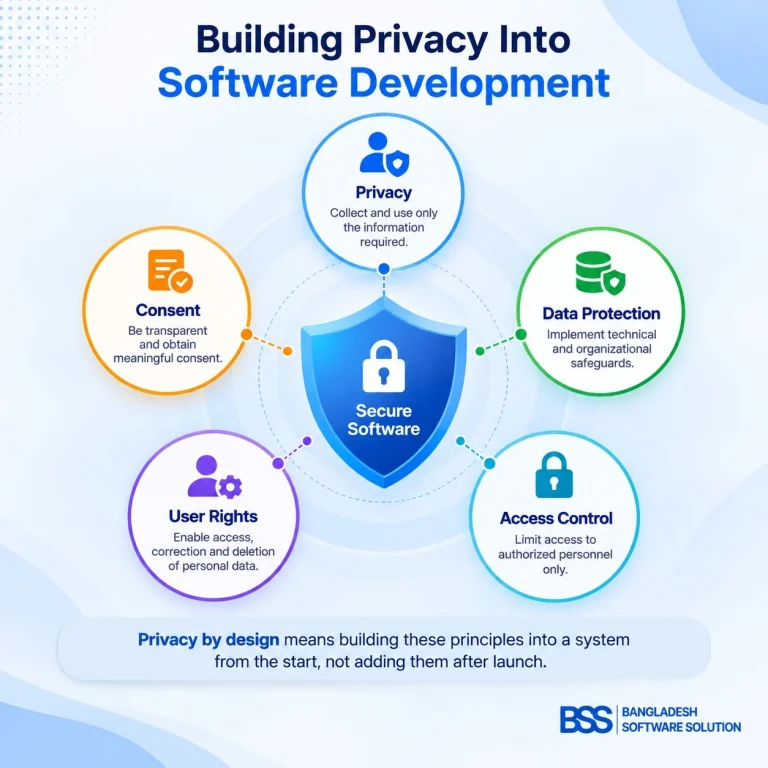
Privacy is not an afterthought in Canadian software projects — it is a design requirement. Any application that collects customer information, whether a CRM, an e-commerce platform, or an internal tool, needs to be built with data protection considered from the first architecture decision, not patched in before launch. This is often called privacy by design: limiting what data is collected, controlling who can access it, and building in safeguards rather than relying on policy documents alone. For Canadian businesses, this approach is shaped directly by federal law.
The Personal Information Protection and Electronic Documents Act, known as PIPEDA, is the federal law governing how private-sector organizations across Canada collect, use, and disclose personal information during commercial activity. According to the Office of the Privacy Commissioner of Canada, PIPEDA sets out ten fair information principles covering accountability, consent, limiting collection, safeguards, and individual access to personal data, and it applies to organizations engaged in commercial activity across provincial and international borders. For a custom software project, this has practical implications. A development team needs to think through what customer data a system actually needs to collect, how long it will be retained, who inside the organization can access it, and what safeguards — encryption, access controls, audit logs — protect it in storage and in transit. Provinces such as British Columbia, Alberta, and Quebec have their own substantially similar privacy laws, so a Canadian business operating nationally should confirm which framework applies to its specific operations before development begins.
How Canadian Businesses Can Work Successfully With Offshore Development Teams
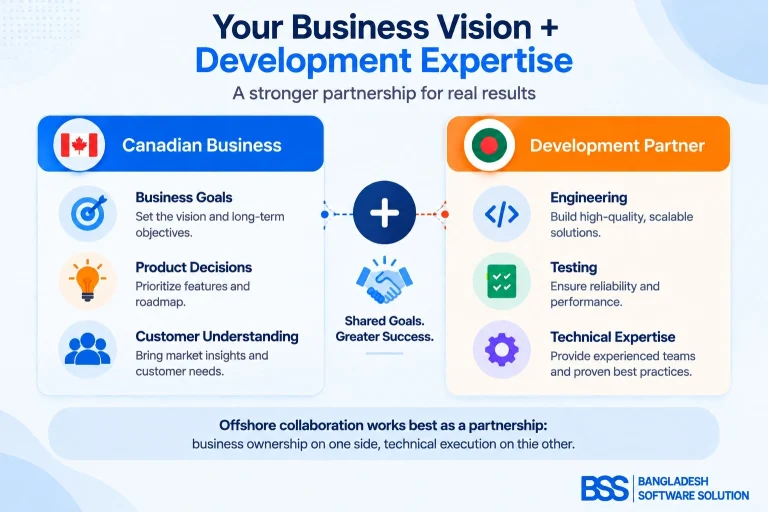
Choosing offshore software development does not mean giving up control of a project. The most successful engagements follow a clear division of responsibility: the Canadian business owns product vision, business goals, and customer understanding, while the development partner contributes engineering, testing, and technical execution. This works when communication is structured — daily or weekly check-ins, shared documentation, and a project management tool both sides use consistently. Time zone differences, often cited as a concern, are manageable with overlapping working hours and asynchronous updates. Written documentation, in particular, keeps decisions traceable even as a project scales or team members change.
The decision between building an internal team and working with an offshore partner often depends on factors such as cost, speed, scalability, and access to talent.
Table 1: Local Hiring vs Offshore Development Partner: Key Differences for Canadian Businesses
| Factor | Local Hiring | Offshore Partner |
|---|---|---|
Cost | Higher | Flexible |
Hiring speed | Slow | Faster |
Scalability | Limited | Easy |
Talent pool | Regional | Global |
Good to remember
While cost and speed are important factors, successful offshore collaboration depends on more than pricing. Clear communication, technical ownership, security practices, and shared workflows determine whether a partnership delivers long-term value.
Readers who want to explore the complete software development lifecycle from idea to launch can read our detailed software development process guide.
Choosing the Right Development Partner: A Practical Checklist
Clear communication process
Strong technical capability
Security practices
Quality assurance process
Code ownership
Ability to scale
Good to Know
A successful software partnership is not only about writing code. It is about combining business knowledge, technical expertise, communication, and long-term support.
Key Facts About Canada's Technology Landscape
ICT Sector GDP Contribution
Canada’s ICT sector contributed $131.6 billion to national GDP in 2024, accounting for 5.8% of national GDP.
Advanced Technology Adoption
60.6% of Canadian enterprises had adopted at least one of fifteen advanced technologies tracked in the 2022 Survey of Advanced Technology.
Source: soStatistics Canada
PIPEDA Coverage
PIPEDA applies to private-sector organizations engaged in commercial activity across Canada, under ten fair information principles set out in Schedule 1 of the Act.
Case Study: Helping a Sportswear Business Prepare for European Market Expansion
A strong example of how a development partnership can support business growth comes from OLA Sportswear, where Bangladesh Software Solution helped build a B2B-ready, multi-currency ecommerce platform designed to support expansion into the European market.
As the business looked beyond its existing operations, it needed a digital platform that could handle more complex requirements than a traditional online store. The solution needed to support international customers, multiple currencies, and B2B purchasing workflows while providing a scalable foundation for future growth.
Bangladesh Software Solution developed a flexible ecommerce platform tailored to these business goals. The platform helped improve operational efficiency, create a smoother buying experience for customers, and provide the technical foundation required for expanding into new markets.
The project demonstrates how businesses can combine their internal market knowledge with external engineering expertise. Instead of building a large in-house technical team from scratch, companies can work with an experienced development partner to access specialized skills, accelerate delivery, and create software solutions that evolve with their growth.
Ready to Talk About Your Project?
If your business is exploring custom software development in Canada and wants a technology partner that values transparent collaboration, get in touch with our team to talk through your project and engineering capacity needs.
Frequently Asked Questions
How much does custom software development cost in Canada?
Costs vary widely depending on project scope, complexity, and team structure. A simple internal tool costs far less than a multi-platform product with integrations and ongoing support. Working with a development partner that offers transparent, itemized pricing — rather than a single lump estimate — makes it easier to understand what drives the cost and where a Canadian business can adjust scope to fit its budget.
Should Canadian companies hire local developers or offshore teams?
It depends on the project. Local teams offer easy in-person collaboration but can be costly and hard to scale quickly. Offshore teams extend engineering capacity and specialized skills at a more flexible pace. Many Canadian businesses use a hybrid model: local product leadership paired with an offshore or remote development team handling execution, keeping decision-making close while extending technical capacity where needed.
How can Canadian businesses protect their software ownership?
Ownership should be defined in writing before development starts, not negotiated afterward. The agreement should state that the client owns the source code, documentation, and related intellectual property once agreed payment milestones are met. Businesses should also confirm they will receive full access to repositories and technical documentation, not just a finished product, so they are never locked into one provider.
What privacy requirements should software developers consider in Canada?
Any system handling personal information should be designed with PIPEDA’s fair information principles in mind: clear consent, limited collection, defined retention periods, and appropriate safeguards such as encryption and access controls. Businesses operating in British Columbia, Alberta, or Quebec should also confirm whether their province’s own privacy legislation applies alongside or instead of PIPEDA.
How do offshore development teams communicate with Canadian companies?
Effective offshore collaboration relies on structured communication: scheduled check-ins during overlapping working hours, shared project management tools, written documentation of decisions, and a single point of contact on the development side. This structure keeps Canadian stakeholders informed and in control of priorities, even when day-to-day execution happens in a different time zone.
How long does custom software development take?
Timelines depend on scope. A focused minimum viable product can often be built in a few months, while a full platform with multiple integrations takes longer. A development partner should be able to break the project into phases with clear milestones, so a Canadian business can see working progress early rather than waiting until the very end of the project.