1. Verify That the Company Actually Exists
Start with the basics. Look up legal company registration details, how long the business has operated, and whether its official website matches what you see elsewhere. Check LinkedIn for a company page with real activity, not just a logo. A small team or a developing-country location is not a red flag on its own — a lack of verifiable, consistent information is.
2. Look at the Actual Team, Not Just the Website
A polished homepage doesn’t prove technical capability. Search LinkedIn for the people who actually work there: developers, technical leads, QA staff. Does the leadership team have a real technical background? A genuinely staffed company looks different online than one built mostly around marketing.
3. Check Independent Reviews
Testimonials on a company’s own site are curated by definition. Look instead at independent platforms, such as Clutch, where clients leave reviews the company can’t edit. Check whether reviewers describe real project details and consistent feedback over time, not just a handful of generic five-star comments.
4. Examine Case Studies for Real Problems and Results
A strong case study follows a simple pattern: challenge, solution, technology, result. A vague line like “we successfully completed the project” tells you nothing. Compare that to Bangladesh Software Solution’s caravan manufacturing case study, where a manufacturer relying on manual clipboard checks needed a way to verify component accuracy and frame alignment on its assembly line. Bangladesh Software Solution built a browser-based Progressive Web App using computer vision, WebAssembly, and ArUco marker tracking to catch misalignment and color mismatches in real time, without requiring expensive industrial hardware. The documented results are specific: a 75% reduction in inspection time, zero structural rework tied to the roof-fitment issue that had been causing costly disassembly, and 100% component accuracy on the color-verification process. That level of detail — a defined problem, a described technical approach, and measurable outcomes — is what a real case study looks like, and it’s exactly what you should be looking for from any partner you’re evaluating, not just Bangladesh Software Solution.
5. Check Whether Their Technical Expertise Matches Your Project
Years in business doesn’t guarantee fit. A team experienced in simple mobile apps isn’t automatically the right choice for computer vision, enterprise ERP, or complex cloud infrastructure. Ask for examples involving similar technologies, similar industries, and similar technical challenges — not just similar company sizes.
6. Find Out Exactly Who Will Work on Your Project
Before signing anything, ask who the actual developers are, their experience level, whether they’re dedicated to your project, and who manages them day to day. Vague answers here are worth taking seriously.
7. Ask About the Developer Screening Process
How does the company evaluate developers before hiring them? Technical interviews, coding assessments, and communication checks suggest a structured process. Be cautious of anyone who can’t describe how they select talent beyond “we only hire the best.”
8. Verify Security and Intellectual Property Protection
Ask directly about NDAs, source code ownership, access controls, and how confidential data is handled. A partner that treats these questions as routine is a good sign. One that gets defensive is not — regardless of what certifications they claim.
9. Evaluate Communication Before Signing the Contract
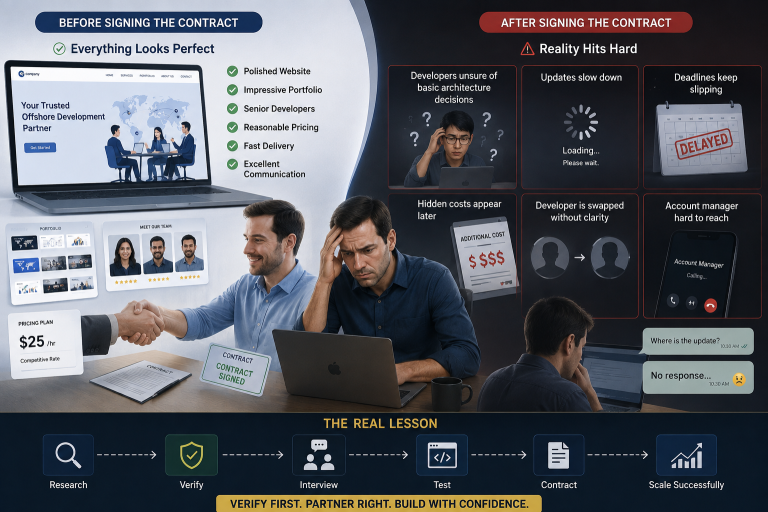
How a company communicates during sales often predicts how they’ll communicate afterward. If replies are already slow or inconsistent before you’re a paying client, don’t expect that to improve. Pay attention to response times, clarity, meeting availability, and how often they report progress.
10. Look for Transparent Pricing
Understand exactly what you’re paying for before you commit.
Table: Questions to Ask About Offshore Development Pricing
Before choosing an offshore development partner, it helps to have a realistic baseline for your own project budget. Use our MVP Cost Calculator to estimate the potential cost of building your MVP based on your requirements, features, and project scope. This gives you a useful benchmark when comparing offshore development quotes.
11. Clarify Who Owns the Source Code
Your agreement should state plainly, in writing, that you own the source code, documentation, designs, and any other project assets once delivered or paid for. This shouldn’t require a legal battle to confirm later.
12. Ask What Happens if a Developer Leaves
Turnover happens everywhere. Ask how quickly a replacement is provided, how knowledge gets transferred, and whether onboarding a new developer adds extra cost to you.
13. Understand Their Quality Assurance Process
Good software involves more than writing code. Ask about code reviews, automated and manual testing, dedicated QA staff, and how changes are verified before deployment.
14. Start With a Small Pilot Project
Where possible, begin with a paid pilot, a proof of concept, or a single MVP module before committing further. It’s a low-risk way to evaluate technical ability, communication, and reliability before scaling up.
15. Speak With a Real Client or Ask for References
A reference call can surface things a portfolio never will. Ask past clients about reliability, communication, deadline management, and what it was like to work with the team long-term.