Bangladesh Software Solution is a global technology company delivering innovative software solutions and driving digital transformation across industries.
Bangladesh Software Solution is a global technology company delivering innovative software solutions and driving digital transformation across industries.
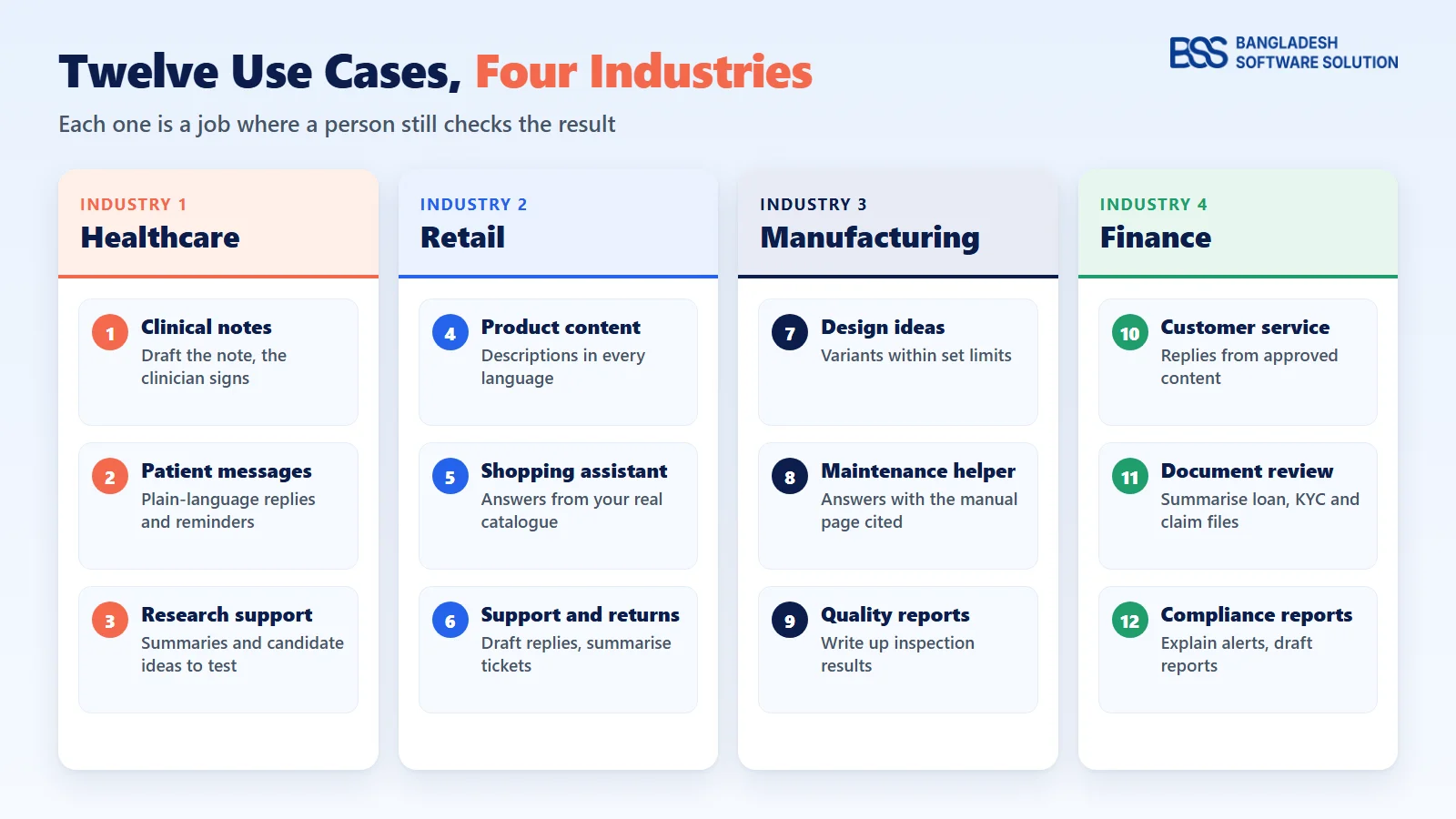
Figure 1: Twelve generative AI use cases, three each for healthcare, retail, manufacturing and finance.
Generative AI use cases by industry range from drafting clinical notes in healthcare to writing product pages in retail, answering technician questions in manufacturing and reading loan documents in finance. This guide explains twelve practical examples, three in each industry, and shows what each one needs, where it can go wrong and how to start.
It is written for business owners, product leaders and IT managers who hear a lot about AI but need to know where it actually helps. Bangladesh Software Solution (BSS) is a software company headquartered in Dhaka, Bangladesh, with an office in Nieuwegein, the Netherlands. We build AI and machine learning solutions, so we also say plainly where generative AI is a poor fit.
The short answer: generative AI works best where people spend hours writing, reading or searching, and where a person can check the result before it matters. It works worst where one wrong answer is costly and nobody reviews it.
Reading about generative AI use cases by industry is only useful if you can match each one to your own data. Use the sections below as a checklist, and skip the ones that do not fit how your team works.
What Are Generative AI Use Cases?
Generative AI use cases are specific jobs where a model creates new content, such as text, images, code, summaries or design options, from a prompt and your own data, so people finish the work faster or with less effort.
Older AI mostly sorted or predicted things: is this email spam, how many units will sell next month. Generative AI writes, drafts and explains. That makes it useful for the many jobs that are really about language and documents.
Key Fact
A good use case has four parts: a user, an input, an output and a person who checks the output. If one part is missing, the use case is not ready.
Industry matters because the data, the rules and the cost of a mistake are different. A draft product description is low risk. A draft clinical note is not. The same model can do both, but the process around it must be different. That is why generative AI use cases by industry need different controls.
How most business use cases work
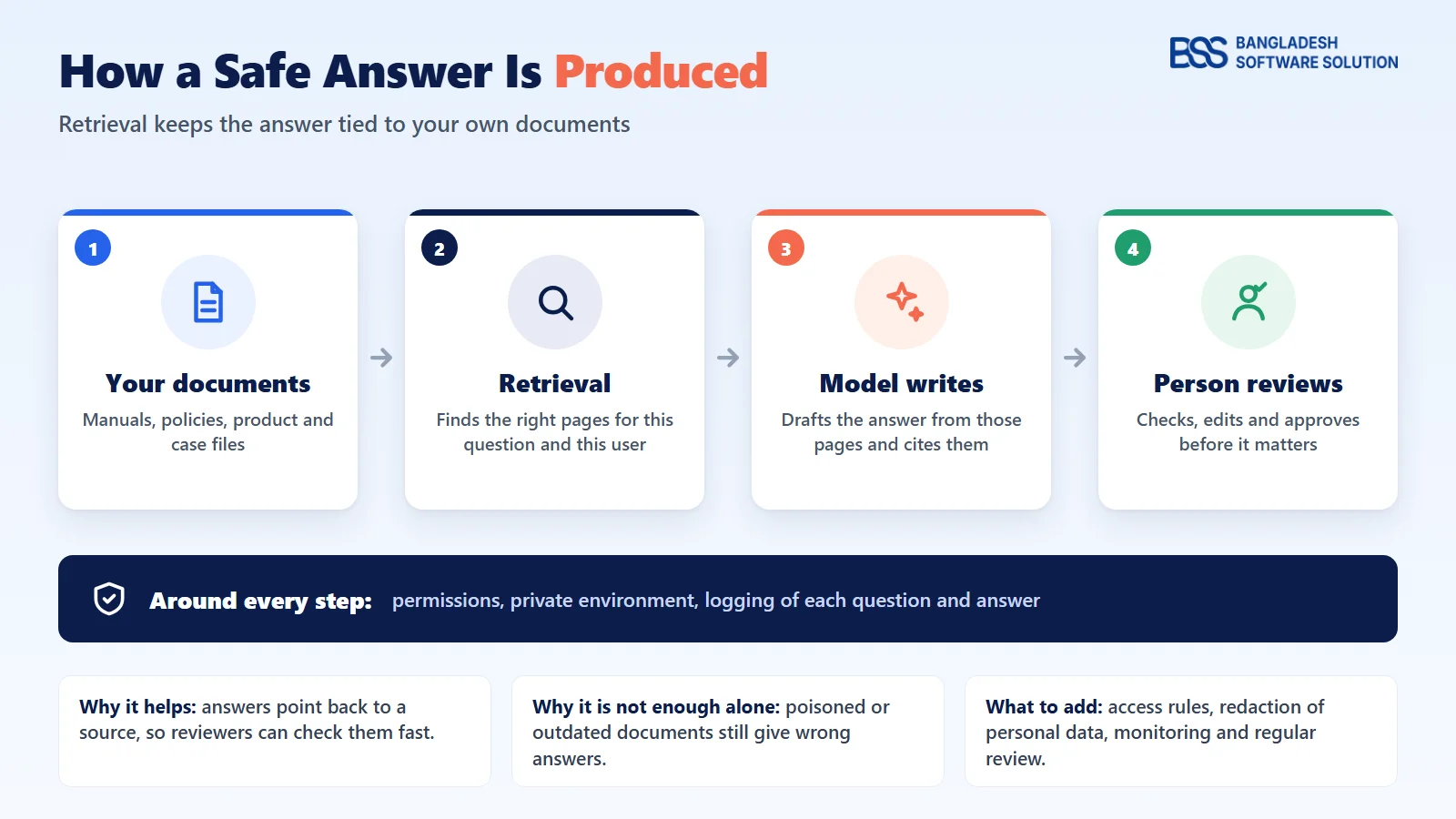
Most business use cases follow the same pattern. The model gets a question, a retrieval step finds the right documents from your own systems, the model writes an answer from those documents, and a person reviews it when the stakes are high.
This pattern is called retrieval-augmented generation (RAG). It keeps your data in your own environment and lets the answer point back to its source. Our article on how RAG secures business data explains it in more detail.
Generative AI in Healthcare
Generative AI in healthcare mostly reduces paperwork and helps people understand information. It does not replace clinical judgment, and every output that affects a patient needs a qualified person to review it.
1. Drafting clinical notes and summaries
Clinicians spend a large part of their day on documentation. A model can turn a recorded or typed conversation into a draft note, and summarise a long patient history into one page.
The clinician reads, corrects and signs the note. The saving comes from not typing everything from scratch. The risk is a wrong detail that looks right, so review is not optional.
2. Patient messages, reminders and triage support
Models can draft plain-language replies, appointment instructions and follow-up reminders, and translate them into the patient's language. They can also help staff sort incoming messages by topic and urgency.
This is support for staff, not diagnosis. A message that sounds urgent should always reach a person quickly.
3. Research and drug discovery support
In research, generative models summarise large sets of papers, draft trial documents and suggest candidate molecules for scientists to test.
The output is a starting point. Laboratory work and clinical trials still decide what is true, so these tools shorten the search, not the testing.
Healthcare data is among the most sensitive data there is. Privacy rules such as HIPAA in the United States and GDPR in Europe apply, so keep patient data in a secured environment, keep logs of who asked what, and make sure a clinician stays responsible for the final result. Compared with other generative AI use cases by industry, healthcare has the strictest review rule: nothing reaches a patient without a clinician's approval.
Important Question
Who signs off the output, and where is the patient data stored? If you cannot answer both, the project is not ready to start.
Generative AI in Retail
Generative AI in retail gives quick wins because stores have a huge amount of content to write and mistakes are cheap to fix. It is often the best place to start.
1. Product descriptions, images and catalogue content
A retailer with thousands of products needs titles, descriptions, size guides and translations for each. A model can write a first version from the product attributes, in the brand's tone, and repeat the work for every language.
Image models can also create background and lifestyle variations for product photos. A person should still check facts such as size, material and price before anything is published.
2. Shopping assistants and personalised recommendations
A shopping assistant answers questions such as "which of these fits a small kitchen?" using your catalogue and policies. Personalised emails and on-site suggestions can use the same approach.
The assistant must answer from your real catalogue and stock. If it guesses, it will promise products you do not have. That is why it needs a connection to live product and order data.
3. Customer support and returns
Support teams use models to draft replies, summarise long tickets and look up order status. Agents review the draft and send it, which cuts typing time and keeps replies consistent.
For returns, the model can explain the policy and collect the details, then pass the case to a person for approval.
Retail results depend on clean product data and connected systems. If your store, inventory and accounting do not share data, the AI will repeat the gaps. See our guide on e-commerce and ERP integration for how to connect them, and our e-commerce development page for what we build. Of all the generative AI use cases by industry in this guide, retail is usually the cheapest to test, because a wrong product description is easy to fix.
Generative AI in Manufacturing
Generative AI in manufacturing helps with design options, knowledge and documents. The machines themselves should still run on proven control systems, not on a language model. Of the generative AI use cases by industry covered here, manufacturing depends most on good documents.
1. Design ideas and CAD assistance
Engineers use generative tools to propose design variations from a set of limits, such as weight, cost or material. Models can also write scripts that automate repetitive CAD steps.
The engineer decides what is safe and buildable. If you already automate CAD and CAM work, our CAM and CAD automation page shows the kind of work we do in that area.
2. Maintenance and shop-floor knowledge assistants
Factories have thousands of pages of manuals, maintenance logs and procedures. A knowledge assistant lets a technician ask "how do I reset this fault on line 3?" and get the answer with the manual page it came from.
Because the answer cites its source, the technician can check it. This saves search time, and it helps new staff learn faster.
3. Quality reports and documentation
Inspection results, non-conformance reports and work instructions take time to write. A model can summarise inspection data, draft a report and produce work instructions in more than one language for the quality team to approve.
It does not decide whether a part passes. It writes up what the inspection and measurement tools already found.
Two cautions apply to generative AI in manufacturing. Your designs are valuable intellectual property, so keep them in a private environment. And do not connect a language model directly to machine controls: give it read-only access to data, and keep a human in charge of any change on the floor. Generative AI in manufacturing pays off most when the manuals, logs and drawings already exist in digital form.
Generative AI in Finance
Generative AI in finance reads, summarises and drafts. Decisions about money stay with people and with approved rules, because the cost of a wrong answer is high and the sector is closely regulated. Finance has the most rules of all the generative AI use cases by industry in this guide.
1. Customer service and advice drafts
Banks and insurers use assistants to answer product questions from approved documents, and to give staff a draft reply during a call or chat.
The assistant must stay inside approved content. It should not give personal financial advice that no one has reviewed, and it should hand over to a person when a question goes beyond its limits.
2. Document processing for loans, KYC and claims
Loan files, identity checks and insurance claims arrive as long documents. A model can extract the key facts, summarise a file, and flag what is missing.
A credit or claims officer still makes the decision. The model shortens the reading time and makes the file easier to review.
3. Compliance, fraud and risk reporting
Fraud and risk alerts are usually raised by classic machine learning models. Generative AI helps by writing the explanation: a clear summary of why an alert fired, a draft of a suspicious activity report, or a short digest of a new regulation.
Compliance staff review and file the result. The model saves writing time, not accountability.
Finance needs strong controls. Keep an audit trail of every prompt and answer, test the system for unfair bias, follow data residency rules, and make sure each automated step has an owner. Generative AI in finance succeeds when the controls come first and the model second.
Generative AI Use Cases by Industry: Side-by-Side
The table compares generative AI use cases by industry, using the first use case we usually suggest for each one. It shows what data you need, what can go wrong and who checks the output.
Industry
Good first use case
Main data needed
Main risk
Who checks
Healthcare
Good first use case
Draft clinical notes
Main data needed
Visit transcripts, note templates
Main risk
A wrong clinical detail
Who checks
The clinician
Retail
Good first use case
Product descriptions
Main data needed
Product attributes, brand guide
Main risk
Wrong size, price or claim
Who checks
Merchandiser
Manufacturing
Good first use case
Maintenance knowledge assistant
Main data needed
Manuals, maintenance logs
Main risk
An outdated or wrong procedure
Who checks
Maintenance lead
Finance
Good first use case
Loan and KYC document summaries
Main data needed
Applications, statements, policies
Main risk
A missed or misread fact
Who checks
Credit or compliance officer
The pattern is simple: start where the work is mostly reading and writing, where the data is already digital, and where one person can check each result in a few minutes.
Figure 2: How a safe generative AI answer is produced: your data, retrieval, the model, then a human review.
What Risks Should You Plan For?
Five risks come up in almost every one of the generative AI use cases by industry above: wrong answers, data privacy, bias, security and over-trust. Plan for each one before you launch.
✓
Wrong answers (hallucination): a model can state something false with full confidence. Ground answers in your documents and show the source.
✓
Data privacy: do not send sensitive data to a tool you do not control. Use a private environment and limit who can see what.
✓
Bias: a model learns from past data, which can contain unfair patterns. Test with real cases from different groups.
✓
Security: prompts and documents can be attacked. Our RAG article notes that vector databases can be targeted and that "RAG poisoning" must be handled with encryption, redaction of personal data, input checks and monitoring.
✓
Over-trust: people stop checking when the tool is usually right. Keep review steps in the process and measure errors.
Good to Remember
RAG is not a silver bullet. It lowers the chance of wrong answers and keeps data in your control, but it still needs permissions, monitoring and regular review.
When the assistant also needs to use tools such as your database or order system, a standard connection method helps. It matters most for generative AI use cases by industry that act on live data, such as order lookups. We explain this in our overview of how MCP supports domain-specific AI agents.
How to Choose and Start Your First Use Case
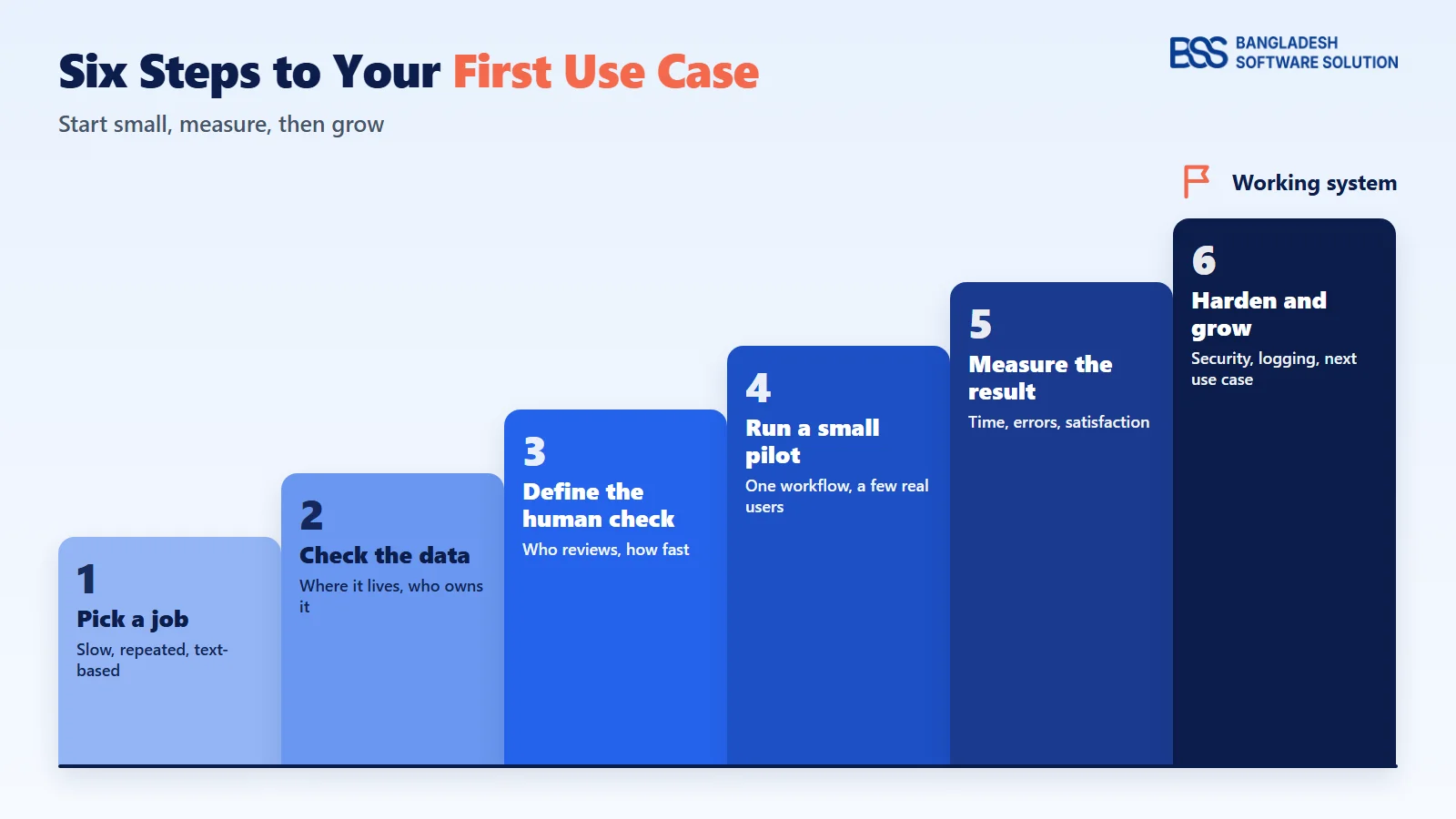
You do not need a large programme to start with generative AI use cases by industry. Pick one job, test it on a small group, and measure the result before you grow. Follow these six steps.
1
Pick a job, not a technology. Choose a task that is slow, repeated and based on text or documents, such as writing notes, descriptions or reports.
2
Check your data. Find where the documents live, who owns them and whether they are accurate and allowed to be used.
3
Define the human check. Decide who reviews the output, how fast, and what happens when the model is wrong.
4
Run a small pilot. Use one workflow and a small group of real users. A pilot with a clear scope is easier to judge and to stop.
5
Measure the result. Compare time, errors and user satisfaction with the old way of working.
6
Harden and grow. Add security, logging and support, then extend to the next use case.
Figure 3: Six steps from choosing a job to growing a pilot into a working system.
Common mistakes to avoid
Most failed pilots share the same few mistakes. Avoid them and you are ahead of many teams.
✓
Starting with the hardest use case. Begin with a low-risk job so the team learns before the stakes rise.
✓
Skipping the human check. Without a reviewer, small errors spread unnoticed.
✓
Using poor data. Out-of-date manuals or messy product data give poor answers whatever the model.
✓
Choosing the tool first. Pick the job and the data first, then the model.
✓
Measuring nothing. If you do not track time or errors, you cannot tell whether the pilot worked.
Good teams also write down what the system must never do, such as give medical advice, approve a loan or change a machine setting, and they test those limits before launch.
How to measure the results
Choose one number per use case and track it from day one. These are examples of useful measures for generative AI use cases by industry:
✓
Healthcare: minutes spent on documentation per visit.
✓
Retail: time to publish a new product, and the share of returns caused by wrong product information.
✓
Manufacturing: time to find the right procedure, and time to write an inspection report.
✓
Finance: time to review a loan or claim file, and the number of files sent back for missing information.
If the number does not improve after a fair test, change the use case or stop. A stopped pilot that taught you something is better than a large rollout that no one uses.
How BSS Works With Generative AI
BSS offers AI and ML development as one of its core services. Our technology list includes OpenAI, PyTorch, TensorFlow, LangChain and Ollama, so we can build with hosted models or with models that run in your own environment.
We usually help in three ways: choosing a use case that fits your data and your risk level, building a small pilot, and connecting it to your existing systems. A pilot can be built as an MVP first, so you see results before you commit to a larger project.
You can work with us through a dedicated development team when the product will keep growing, or through a fixed-scope project when the scope is clear. If you are not sure which fits, we will tell you honestly.
If you are comparing generative AI use cases by industry for your own company, start with one job from the table above and talk to us about a pilot.
FAQs
01
What are the most common generative AI use cases by industry?
+
In healthcare, drafting clinical notes. In retail, writing product content and supporting customers. In manufacturing, knowledge assistants for maintenance and design help. In finance, summarising loan, identity and compliance documents. Each one saves time on reading and writing work.
02
Which industry benefits most from generative AI?
+
It depends on your data and your risk level. Among generative AI use cases by industry, retail often sees fast results because content mistakes are cheap to fix. Healthcare and finance can gain a lot, but they need more controls, so they take longer to launch safely.
03
Is generative AI safe to use in healthcare and finance?
+
It can be, when it is used with controls. Keep sensitive data in a private environment, ground answers in approved documents, keep a full audit trail and require a qualified person to approve anything that affects a patient or a financial decision.
04
Will generative AI replace workers?
+
In these use cases it supports people rather than replacing them. It drafts and summarises, and people review and decide. The jobs that change most are the ones with a lot of repeated writing or searching.
05
How do I start with generative AI in my business?
+
Pick one of the generative AI use cases by industry that is a slow, text-based task, check that the data is ready, decide who reviews the output, and run a small pilot. Measure time and errors, then decide whether to grow it.
06
What data do I need for generative AI?
+
You need the documents the task depends on, such as manuals, product data, policies or case files. They must be accurate, current and allowed to be used. Poor data gives poor answers, whatever the model.
07
What is the difference between generative AI and traditional AI?
+
Traditional AI usually classifies or predicts, such as flagging fraud or forecasting demand. Generative AI creates new content, such as text, images or code. Many real systems use both: the older model finds the case and the generative model explains it.
Ready to find the right generative AI use case?
Our team can review your data and suggest a small pilot.