Informational

Offshore Development vs Local Hiring: Why Startups Choose Offshore Teams

Offshore Development vs Local Hiring Why Startups Choose Offshore Teams
Business development manager - Bangladesh Software Solution
Share:

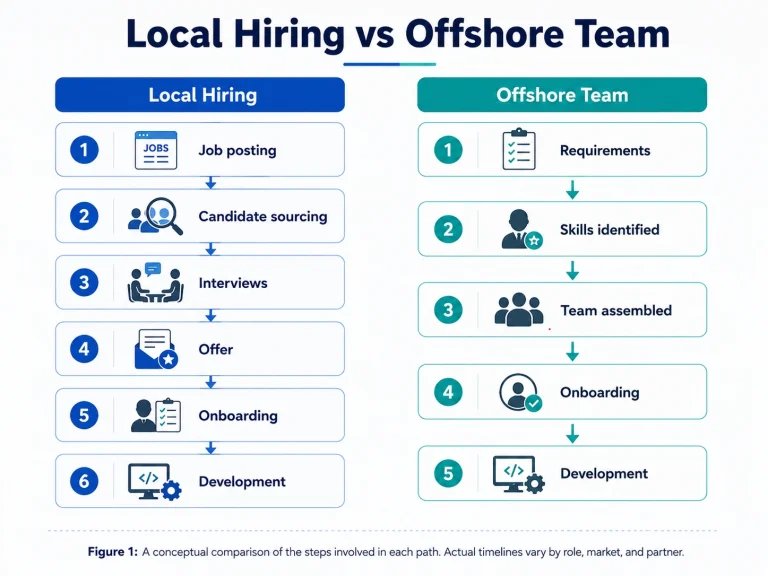
A startup founder closes a funding round, finalizes the product roadmap, and now faces a harder question: who actually builds the product. Posting job listings, screening candidates, and negotiating offers for developers, QA engineers, and DevOps specialists can take months the runway doesn’t have. This is the moment many founders start weighing offshore development for startups against building a team from scratch at home. Neither path is automatically right. The decision depends on speed, budget, the skills required, and how the company works.

Offshore Development vs Local Hiring: A Quick Comparison

An offshore development team is a group of developers, testers, and technical specialists based in another country who work as an extension of a startup’s engineering function, either through a staffing partner or a dedicated team model. Compared with local hiring, the two approaches differ across several practical factors.

The table below summarizes how offshore development vs local hiring typically compares. These are general patterns, not guarantees — actual results depend on the specific partner, market, and engagement model.


Table 1: Offshore development vs local hiring — a general comparison, not a fixed rule.

Factor Local Hiring Offshore Development Team

Hiring speed

Recruitment can take time

Existing talent can often be assembled faster

Talent pool

Primarily local

Global

Cost structure

Salary + recruitment + benefits + equipment + overhead

Usually engagement-based

Scaling

New recruitment required

Capacity can be easier to adjust

Specialist skills

Availability depends on local market

Broader access

Communication

Easier physical collaboration

Requires effective remote communication

Long-term commitment

Usually higher

More flexible depending on model

Six Reasons Startups Choose Offshore Development Teams

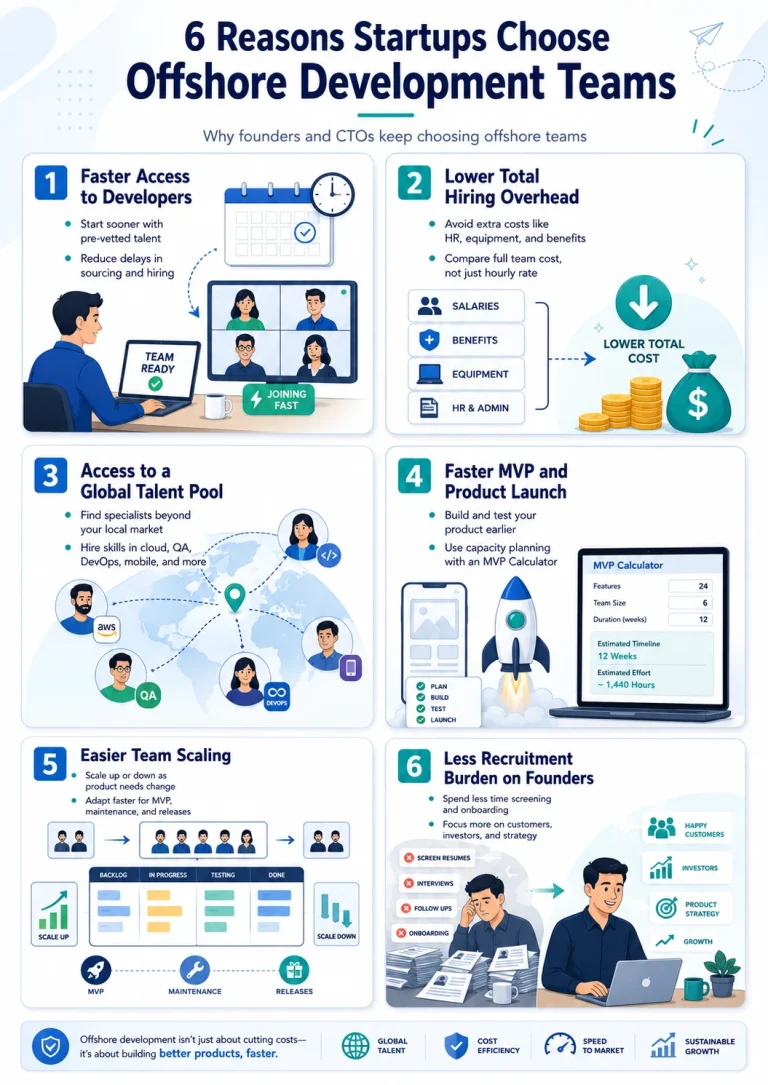
Startups don’t choose offshore development because it sounds efficient. They choose it because it solves specific, recurring problems that slow young companies down. Here are six reasons this model keeps coming up in founder and CTO conversations.

6 reasons startups choose offshore development teams

1. Faster Access to Developers

Local recruitment for a single senior developer can take weeks of sourcing, interviewing, and negotiating — longer for specialized roles. An offshore development team, especially one already assembled around relevant skills, can often begin work sooner because the sourcing and vetting has already happened. For an early-stage company, this time difference can shift a launch date by a meaningful margin, directly affecting time-to-market.

2. Lower Total Hiring Overhead

It’s tempting to compare a local developer’s salary to an offshore hourly rate and call it a day, but that comparison misses most of the real cost. A local hire brings recruitment fees, salary, benefits, payroll taxes, equipment, software licenses, onboarding time, and ongoing HR management. If that person leaves, the company absorbs replacement costs and lost momentum too. Founders evaluating offshore development for startups should compare the total cost of building and running a team, not just a headline rate.

3. Access to a Global Talent Pool

Local talent pools are limited by geography. A startup based in one city may have easy access to generalist web developers but struggle to find someone experienced in cloud infrastructure, QA automation, or a specific framework. Offshore development teams typically draw from a wider pool, which can include specialists in .NET, Java, Python, React, DevOps, mobile development, or data and AI work — without the company needing to relocate anyone or wait for a rare local match.

4. Faster MVP and Product Launch

For most early-stage companies, getting a working product in front of real users matters more than shaving a few dollars off an hourly rate. A startup that can assemble the engineering capacity it needs sooner is a startup that can start testing assumptions, gathering feedback, and adjusting its roadmap sooner. Bangladesh Software Solution MVP Calculator can help founders estimate what that capacity might look like for their specific product.

5. Easier Team Scaling

Development needs rarely stay flat. A startup might need a larger team to push through MVP development, then a smaller maintenance team afterward, then a spike in capacity again ahead of a major release. Hiring and laying off local staff to match this rhythm is slow and can hurt morale. An offshore engagement is often easier to scale up or down as priorities shift, without the same overhead each time.

6. Less Recruitment Burden on Founders

Every hour a founder spends screening resumes or managing a new hire’s onboarding is an hour not spent with customers, investors, or product strategy. Shifting the recruitment and management burden to an offshore partner doesn’t remove founder involvement entirely, but it can free up meaningful time for the work that most directly affects growth.

Building Engineering Capacity: Two Paths

The Hidden Cost of Local Software Hiring

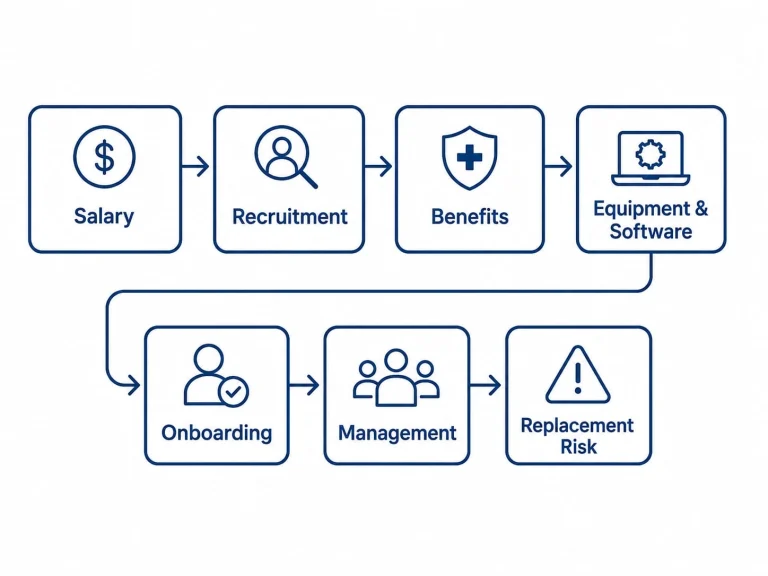
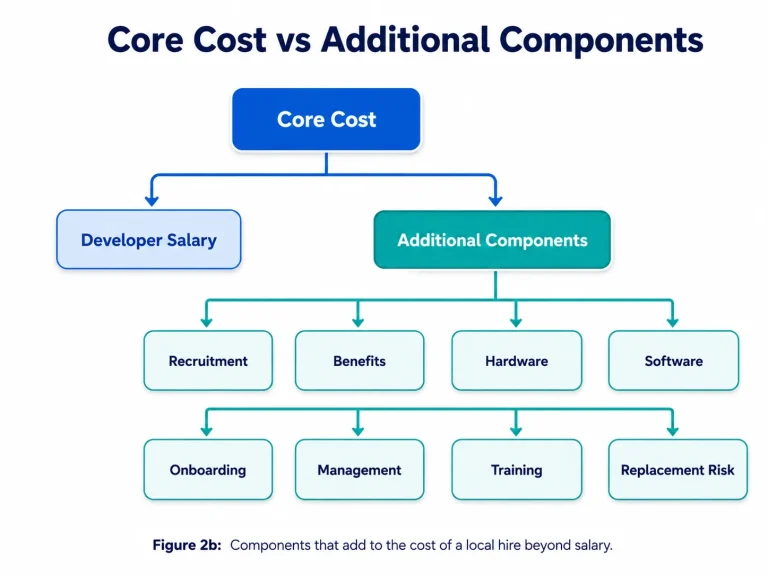
The advertised salary for a local developer is rarely the full story. Recruitment fees, benefits, equipment, software licenses, onboarding time, ongoing management, and the risk of replacing someone who leaves all add to what a hire actually costs a company.

Figure 2a: Salary is only one component of the total cost of building an internal development team.
Components that add to the cost of a local hire beyond salary.

None of this makes local hiring a bad choice. It means a fair comparison between offshore developers vs local developers has to look at total cost of building and maintaining engineering capacity, not the salary line alone.

When Offshore Development May Not Be the Right Choice

Offshore development is not the right fit for every situation. Local hiring, or a hybrid model, may work better when the role requires continual physical presence, such as hardware work or in-person client demonstrations. Regulatory or data-residency requirements can also restrict where certain development work is legally allowed to happen.

Some teams rely heavily on face-to-face collaboration and haven’t yet built the habits — documentation, async updates, clear handoffs — that remote work requires. And for roles considered strategically core to the company’s long-term IP or culture, many founders still prefer to build that capability in-house, even if it takes longer.

How to Choose the Right Offshore Development Partner

Not every offshore development team is a good fit, so it’s worth evaluating a potential partner carefully before committing. A practical checklist includes:

  • Relevant technical experience in your stack and industry
  • Proven case studies or a portfolio of comparable work
  • The ability to interview proposed developers before they join your project
  • A clear, documented communication process
  • Enough working-hour overlap for real-time collaboration
  • Transparent, itemized pricing with no hidden fees
  • Clear terms on code and intellectual-property ownership
  • Documented security practices
  • A defined QA process, not an afterthought
  • A stated policy for replacing underperforming resources
  • Client references you can actually contact
  • Regular project visibility and reporting

Our blog How to Verify an Offshore Development Partner Before Hiring covers this evaluation process in more depth.

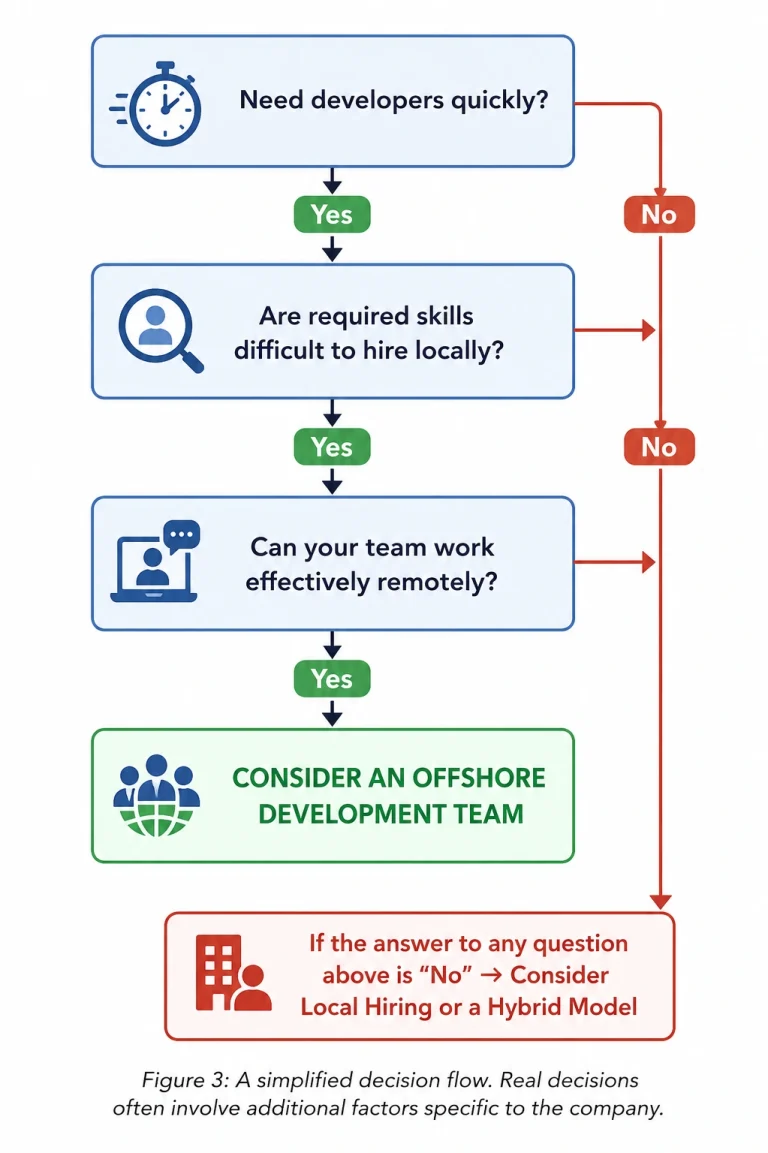
Offshore or Local? A Simple Startup Decision

Offshore development is worth serious consideration when developers are needed quickly, when local recruiting is dragging on, when the required skills are hard to source nearby, when engineering capacity needs to flex up or down, or when protecting startup runway is a priority — provided the team can collaborate effectively at a distance.

Local hiring can still be the better choice for roles that are strategically core to the company and benefit from continuous, in-person collaboration. Many startups end up running a hybrid of both.

Conclusion

Offshore development is not simply a cheaper alternative to local hiring. Its strongest value for startups can be faster access to talent, scalability, and the ability to build products without spending months assembling every technical capability internally.

Bangladesh Software Solution works with startups to access software development expertise and figure out which engagement model actually fits their product and stage — offshore, local, or a mix of both.

Need additional engineering capacity without spending months recruiting? Talk to the Bangladesh Software Solution team about building an offshore development team around your product requirements.

Frequently Asked Questions

Is offshore development cheaper than local hiring?

Often, but the bigger difference is total cost. Offshore teams can reduce expenses related to recruitment, benefits, equipment, onboarding, and long-term hiring overhead.

Startups often choose offshore teams for faster access to developers, broader talent pools, easier scaling, lower hiring overhead, and faster product launches.

Local hiring may be better when a role requires physical presence, strict data-residency compliance, frequent face-to-face collaboration, or is strategically core to the company.

Yes. Offshore teams can often be scaled up or down more easily as product requirements change, without repeating the full recruitment process each time.

Yes. Offshore teams can often be scaled up or down more easily as product requirements change, without repeating the full recruitment process each time.