Informational

Offshore Development Team Structure: Essential Roles, Team Size, and Best Practices

offshore development team structure
Business development manager - Bangladesh Software Solution
Share:

Offshore development problems often start with structure, not technical talent. Companies may hire strong engineers but overlook the roles, ownership, reporting lines, and workflows needed to turn individual contributors into a coordinated team. The result can be missed deadlines, unclear responsibilities, and unnecessary rework.

A strong offshore development team structure defines who owns decisions, how work moves between roles, and how teams communicate across time zones. This guide covers essential offshore development team roles, team size by project type, delivery workflows, communication structure, and practical ways to scale.

Essential Roles in an Offshore Development Team Structure

A well-structured offshore software development team needs a mix of builders, quality gatekeepers, and coordinators. Combine roles on smaller projects; separate them as complexity grows.

Table 1: Main responsibilities and when you need them in different role.

Role Main Responsibility Offshore Development Team

Frontend Developer

Builds the user-facing interface and interactions

Any product with a UI

Backend Developer

Builds server logic, APIs, and the data layer

Any product with business logic or data

Full-Stack Developer

Covers both frontend and backend work

Small teams, MVPs, tight budgets

QA Engineer

Tests functionality and catches regressions before release

As soon as real users are involved

DevOps Engineer

Manages infrastructure, deployments, and CI/CD

Once releases become frequent

Technical Lead

Sets technical direction, reviews code, unblocks the team

Growing teams or projects with several developers

Software Architect

Designs system structure for scale and integrations

Enterprise or highly technical builds

Project Manager / Scrum Master

Runs sprints, tracks progress, removes blockers

Teams requiring regular coordination across roles or time zones

Product Owner

Owns the backlog and prioritizes features

When business priorities shift often

Business Analyst

Translates business needs into technical requirements

Complex domains, multiple stakeholders

UI/UX Designer

Designs user flows and interface layouts

Any product where usability matters

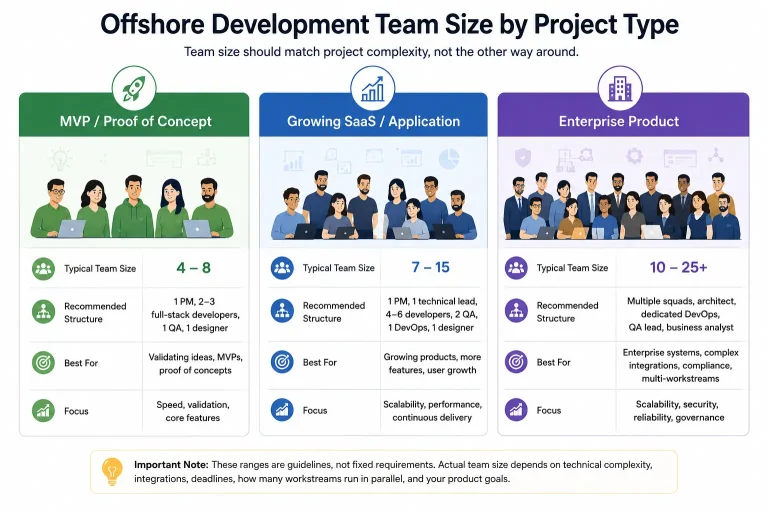
Offshore Development Team Size by Project Type

Offshore team size should match project complexity, not the other way around. Use these as starting points, then adjust.

Figure 1. Offshore development team size

Processes That Make Offshore Teams Work

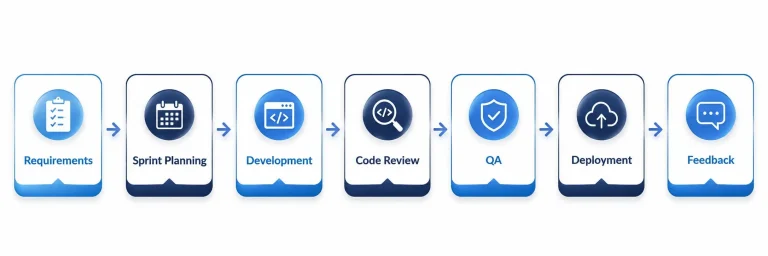
Structure without process falls apart fast. A clear delivery workflow gives an offshore team defined handoffs, ownership, and feedback points from requirements through release.

The offshore development workflow, from requirements to feedback.
Figure 2: The offshore development workflow, from requirements to feedback.

Table-2: Workflow Stages—What Happens and Best Practices

Workflow Stage What Happen Best Practice

Requirements

Business needs are translated into clear tasks and acceptance criteria.

Keep specifications, decisions, and dependencies documented in one shared location.

Sprint Planning

The team agrees on priorities, scope, owners, and delivery goals.

Plan work in short cycles and assign one clear owner to each task.

Development

Developers build features according to agreed requirements and standards.

Use regular check-ins and enough time-zone overlap to resolve blockers quickly.

Code Review

Changes are reviewed before being merged into the main codebase.

Require peer review to maintain code quality and consistency.

QA

Features are tested for functionality, regressions, and edge cases.

Combine manual testing with automated tests where appropriate.

Deployment

Approved changes move into staging or production.

Use CI/CD pipelines to make releases more consistent and reduce manual errors.

Feedback

Results, issues, and user feedback are fed into the next development cycle.

Review sprint outcomes and turn lessons learned into new priorities.

Offshore Development Best Practices That Support the Entire Workflow

A few processes should run across every stage:

  • Progress visibility: track sprint goals, blockers, and delivery status in a shared project tool.
  • Clear escalation: define who handles urgent technical, delivery, or business decisions.
  • Communication rhythm: combine asynchronous updates with scheduled live discussions when decisions require collaboration.
  • Documentation: keep requirements, architecture decisions, APIs, and key project knowledge accessible to the whole team.

The goal is not to add more meetings or processes. It is to create a predictable workflow where handoffs are clear, issues surface early, and every team member understands their responsibility.

Offshore Team Management and Communication Structure

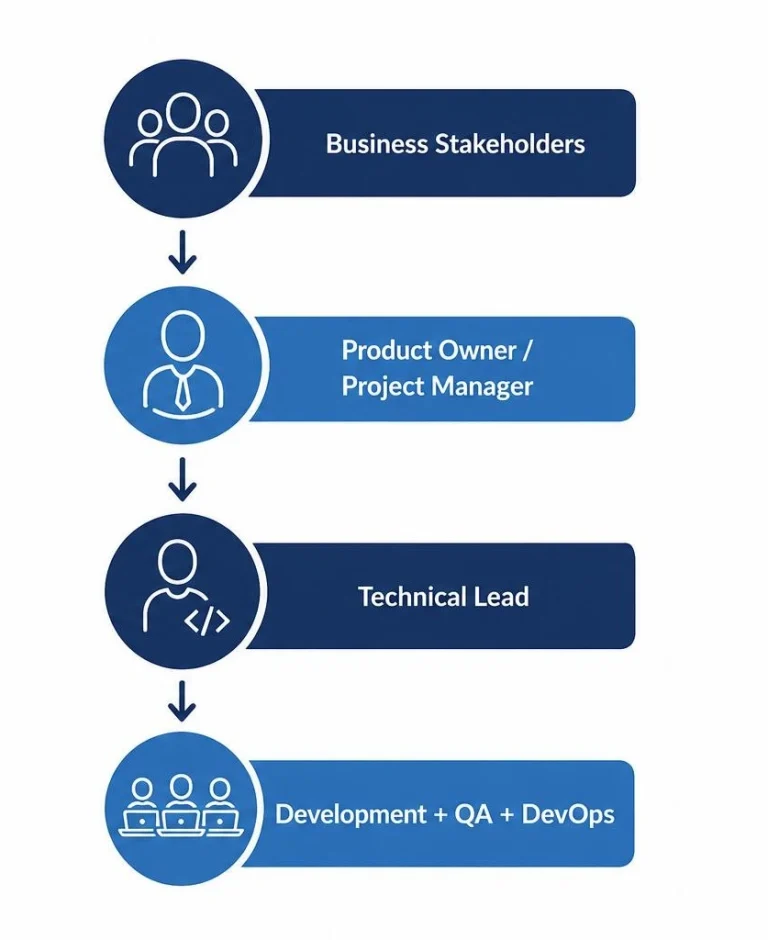
Communication works best when it flows through defined channels rather than letting every stakeholder assign work directly to developers. A clear reporting line keeps priorities consistent and protects the team from conflicting instructions.

A typical offshore development team communication and reporting structure.
Figure 3: A typical offshore development team communication and reporting structure.

How to Scale an Offshore Development Team

Growth should follow evidence, not guesswork. A practical scaling sequence:

  1. Start with a core team covering the essential roles.
  2. Measure delivery performance over two to three sprints.
  3. Identify skill bottlenecks slowing the team down.
  4. Add specialists as complexity increases.
  5. Split into sub-teams only when coordination becomes difficult.

Building the right structure starts with choosing the right partner. Check out our blog on how to verify an offshore development partner.

Conclusion

A strong offshore development team structure isn’t about hiring more people — it’s about assigning the right roles, setting clear ownership, and building communication and review processes that hold up across time zones. Get the structure right and team size becomes a scaling lever rather than a risk.

If you’re evaluating providers or building your own distributed development team structure, start with the roles and processes above, then adjust as your product and team grow.

Frequently Asked Questions

What roles are essential in an offshore development team?

A typical offshore team includes developers, QA coverage, and someone responsible for project coordination. As complexity grows, technical leads, DevOps engineers, product owners, and specialists can be added.

Team size depends on scope and complexity. MVPs usually start with a small cross-functional team, while larger SaaS and enterprise projects may require additional specialists or multiple squads.

A dedicated project manager becomes increasingly valuable as the team grows or coordination becomes more complex. Smaller teams may combine project management responsibilities with a product owner or technical lead.

Use defined channels: stakeholders work through a product owner or PM, who routes technical decisions through a technical lead to the development team, rather than assigning tasks directly to developers.

A dedicated offshore team works exclusively on your product with consistent roles and processes. Freelancers are typically project-based, less integrated, and harder to scale or hold accountable long-term.