Bangladesh Software Solution is a global technology company delivering innovative software solutions and driving digital transformation across industries.
Bangladesh Software Solution is a global technology company delivering innovative software solutions and driving digital transformation across industries.
Business intelligence vs data analytics is a question most growing companies ask when their reports stop answering the questions managers actually have. The short answer: business intelligence (BI) shows what is happening in the business, and data analytics explains why it happened and what is likely to happen next.
This guide is for business owners, finance and operations leaders and IT managers who are weighing the two. Bangladesh Software Solution is a software company headquartered in Dhaka, Bangladesh, with an office in Nieuwegein, the Netherlands. We build custom software, AI and machine learning solutions and data systems, so we explain here where each approach fits and where it does not.
You do not have to pick a winner. Most companies need both, in the right order. The sections below compare business intelligence vs data analytics: what each one does, how they differ, how they work together and how to decide where to start.
At a glance
Business intelligence
BI describes past and current performance.
Data analytics
Analytics finds patterns, causes and likely futures.
AI and ML
AI and machine learning make that analysis more predictive.
Decisions
Data only has value when it ends in a decision someone acts on.
Why Do Businesses Struggle to Turn Data Into Decisions?
Most businesses do not lack data. They lack a connected, trusted view of it, and a habit of acting on what it shows.
Sales data sits in one system, customer records in another, stock and production figures in a third, and finance in spreadsheets that only one person understands. Every month the pile grows, yet meetings still open with the same question: what is actually happening in the business?
Three problems appear again and again:
01
Scattered data
Systems do not talk to each other, so every report starts with copying and pasting numbers.
02
Reports that only look back
A monthly report tells you what already happened, often too late to change it.
03
No clear next step
Teams read the numbers, nod and carry on, because nobody turned the numbers into a recommendation.
A folder full of figures cannot tell a manager which region is slipping, why a loyal customer stopped ordering or which product will sell out next month. That needs two different capabilities, and the debate about business intelligence vs data analytics is really about which one solves which problem.
Good to remember
More data does not automatically create better decisions. Businesses need systems that turn information into insight, and insight into action.
What Is Business Intelligence?
Business intelligence is the practice of collecting business data, cleaning it and showing it in reports and dashboards, so everyone works from the same trusted numbers. It answers the question: what happened, and what is happening now?
BI usually covers reporting, dashboards, KPIs, performance monitoring and data visualization. A good setup pulls data from your sales, finance and operations systems into one place, defines each metric once and keeps the figures up to date without manual work.
Two examples show how it works in practice:
Example: retail
A retail chain tracks daily sales, compares revenue by region and sees its best-selling products on one dashboard.
Example: manufacturing
A manufacturer follows production output, downtime and defect rates on a daily operations report.
What business intelligence solutions include
Business intelligence solutions are the tools and systems that make this possible. Typical parts are a data store that brings sources together, reports and dashboards for different roles, scheduled alerts when a KPI moves out of range, and access rules so each person sees only what they should.
The value is shared truth. When finance, sales and operations quote the same number, meetings move from arguing about the data to deciding what to do.
What BI cannot do on its own
BI is strong at describing. It is weaker at explaining and predicting. A dashboard can show that sales in one region fell, but it will not tell you whether the cause was pricing, a stock shortage or a competitor. That gap is where analytics starts, and it is the first real difference in the business intelligence vs data analytics comparison.
?
Ask yourself
Can our current reports explain clearly what happened in our business, and does everyone trust the same numbers?
What Is Data Analytics?
Data analytics is the process of examining data to find patterns, explain causes, predict outcomes and recommend actions. Where BI reports the result, analytics asks what lies behind it.
It goes beyond reporting to answer three further questions:
WHY
Why did it happen?
WHAT NEXT
What will happen next?
WHAT TO DO
What action should we take?
Analysts work with the same business data but go deeper. They test ideas, compare groups of customers, look for unusual behavior and build models that estimate what comes next.
The four kinds of data analytics
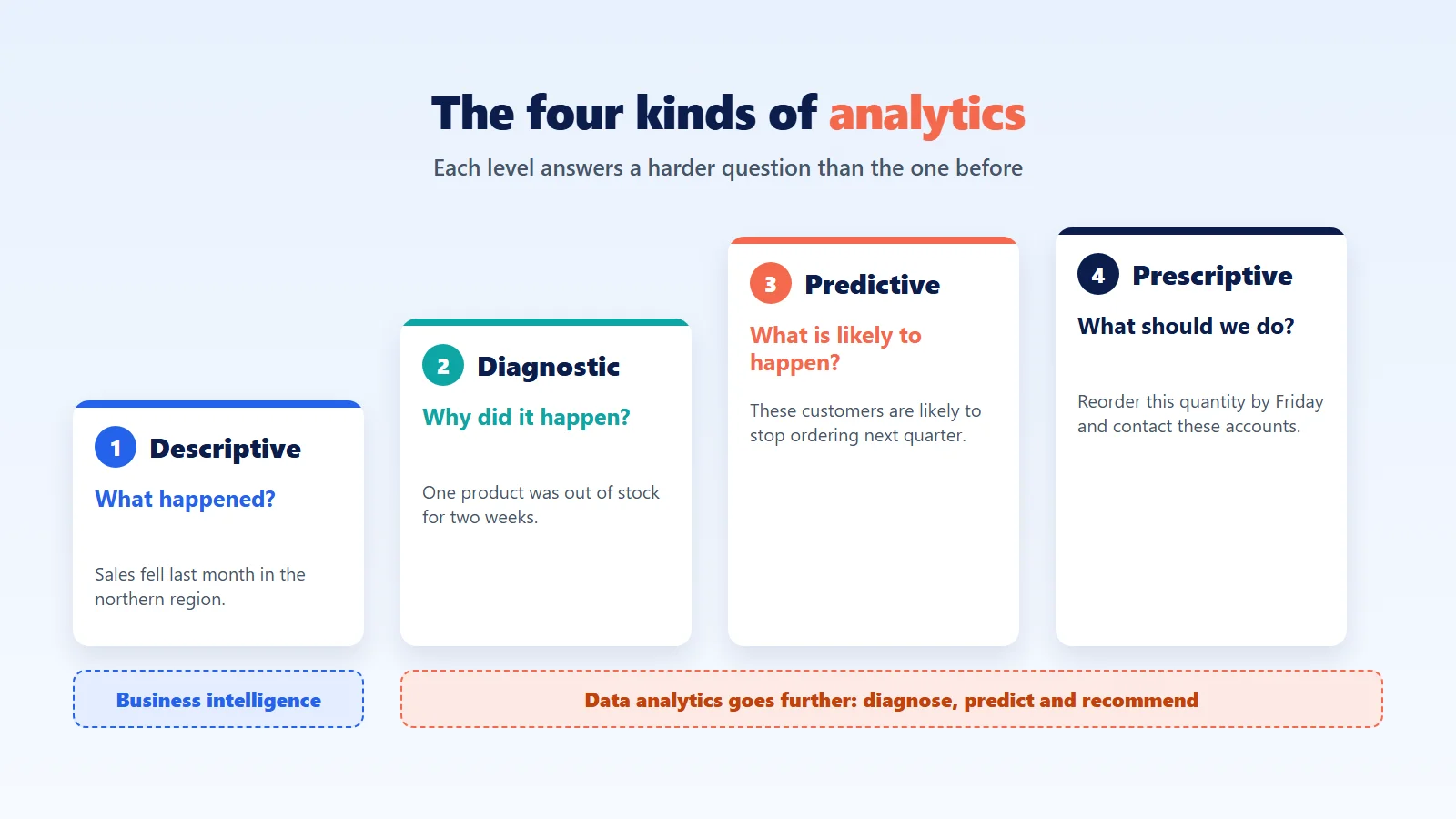
Analytics is often grouped into four levels. Each one answers a harder question than the one before.
Level 1
Descriptive
What happened? This is where BI lives.
Level 2
Diagnostic
Why did it happen? For example, sales fell because one product was out of stock for two weeks.
Level 3
Predictive
What is likely to happen? For example, which customers are likely to stop ordering.
Level 4
Prescriptive
What should we do? For example, reorder this quantity of this product by Friday.
Figure 1: The four kinds of analytics, from describing the past to recommending an action.
How predictive analytics works
Predictive analytics uses historical data to estimate what is likely to happen. A model learns from past orders, payments, visits or machine readings and then scores new situations, such as the chance that a customer will leave or that a machine will fail.
The result is a probability, not a promise. A good predictive model improves with new data, and a person still decides how to act on the score. That is why predictive analytics works best when it feeds a clear business decision rather than sitting in a report.
What data analytics services include
Data analytics services usually include customer analysis, operational insights, business trend analysis and predictive models, built on data that has first been cleaned and connected. The output is not only a chart. It is a finding, such as "these three product groups drive most of the returns", with a recommended action.
?
Ask yourself
Are we only looking at past performance, or are we preparing for future decisions?
Business Intelligence vs Data Analytics: Key Differences
In the business intelligence vs data analytics comparison, the two overlap but serve different purposes. BI is built for monitoring and shared reporting. Analytics is built for discovery, explanation and prediction.
Monitors
Business intelligence
Purpose
Understand performance
Main question
What happened?
Data used
Mostly historical and current data
Output
Reports and dashboards
Typical users
Managers and executives
Typical rhythm
Always on, refreshed on a schedule
Explains and predicts
Data analytics
Purpose
Discover insights and predictions
Main question
Why did it happen? What happens next?
Data used
Historical, current and predictive data
Output
Insights and recommendations
Typical users
Analysts and decision-makers
Typical rhythm
Project-based or ongoing investigation
The simplest way to remember business intelligence vs data analytics: BI is the instrument panel, and analytics is the mechanic who explains why a warning light came on and what will break next.
Many articles frame business intelligence vs data analytics as a contest. In real companies they are steps on one path. You cannot analyse data you cannot trust, so BI usually comes first, and analytics builds on it.
Good to remember
The best question is not which one is better. It is which business problem you are trying to solve.
How Do BI and Data Analytics Work Together?
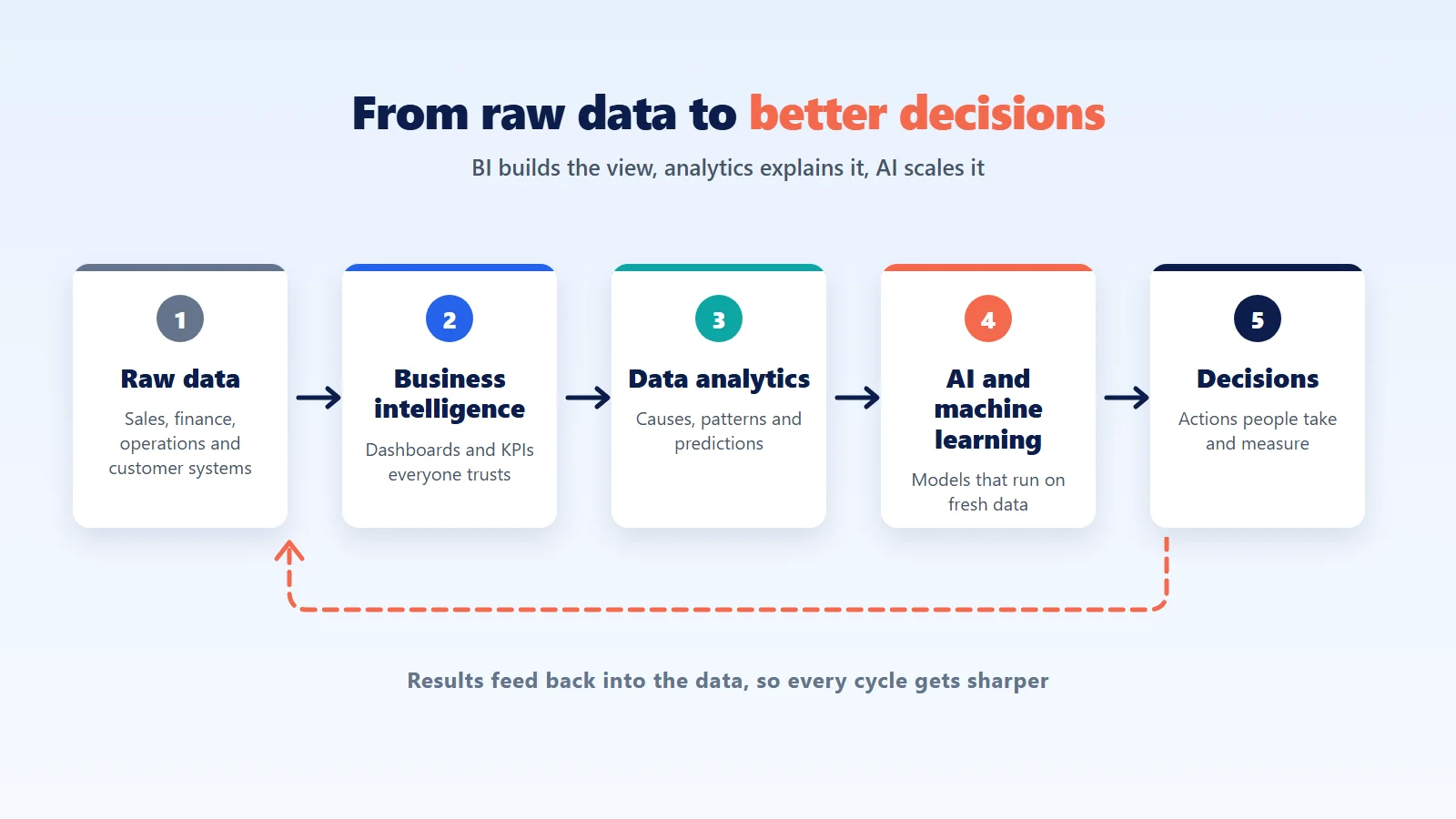
Business intelligence vs data analytics is not a choice between rivals, because they work as a chain. BI builds a reliable view of the business, analytics explains and forecasts, and AI and machine learning scale those predictions so they run automatically.
Here is how the chain looks in a typical company:
1
Collect and connect
Data from sales, finance, operations and customer systems is gathered and cleaned in one place.
2
Report and monitor
BI turns that data into dashboards and KPIs that everyone trusts.
3
Investigate and predict
Analysts look for causes and patterns and build predictive models.
4
Automate and scale
Machine learning runs those models on fresh data and sends the results to the people or systems that act on them.
5
Decide and learn
The team acts, measures the result and feeds it back into step 1.
Figure 2: How raw data moves through BI, analytics and AI or machine learning to better business decisions.
The loop matters more than any single step in business intelligence vs data analytics. A forecast that nobody sees is wasted, and a dashboard that nobody questions never improves. Our article on an autonomous ML pipeline with Apache Airflow shows how data steps like these can be automated so they run without manual work.
How Do AI and Machine Learning Change Analytics?
AI and machine learning move analytics from explaining what happened to estimating what is likely to happen, and they do it on far more data than a person could review by hand.
Machine learning models learn from historical data and help businesses to:
01
Predict customer behavior
02
Forecast demand
03
Detect unusual patterns, such as a suspicious transaction
04
Automate routine decisions, such as reordering stock
What AI-powered analytics means in practice
AI-powered analytics, often called machine learning analytics, adds models to the normal analytics process. Instead of an analyst checking each case, the model scores every case and highlights the ones that matter.
For example, a model can score every open order for the risk of late delivery, or every customer for the chance of leaving. The team then works on the highest-risk cases first.
Combined with predictive analytics and intelligent automation, these models support AI-driven decisions. People still validate the important ones. A model that reorders low-value stock can run on its own. A model that flags a suspicious payment should send the case to a person.
What AI needs before it works well
AI does not fix messy data. It repeats whatever it learns, including mistakes. Before you build models, check three things:
Check 1
The data is accurate, complete and recent enough for the question.
Check 2
The business rules are clear, so the model has a definition of success.
Check 3
Someone owns the result and will act on it.
Newer generative AI tools are a different kind of tool from predictive models, and many real systems use both.
Good to remember
Modern analytics is moving from explaining the past to predicting future possibilities, but a person should still own the important decisions.
What Do BI and Data Analytics Look Like in Real Businesses?
In business intelligence vs data analytics examples across industries, BI shows the current state, and analytics goes further to predict or optimize. These examples are illustrations of common uses, not client case studies.
Ecommerce
BUSINESS INTELLIGENCE
Sales dashboard
DATA ANALYTICS
Customer prediction and demand forecasting
An online store uses BI to see daily orders, conversion and revenue by channel. Analytics then helps it forecast demand for each product and predict which customers are likely to buy again. Connecting the store to your ERP makes both easier, because stock and order data stay in sync. See our guide to ecommerce ERP integration for how that works.
Manufacturing
BUSINESS INTELLIGENCE
Production monitoring
DATA ANALYTICS
Predictive maintenance
A factory uses BI to follow output, downtime and defects. Analytics looks at machine readings to estimate when a part is likely to fail, so maintenance is planned before a breakdown stops the line.
Finance
BUSINESS INTELLIGENCE
Financial reporting
DATA ANALYTICS
Fraud detection and risk analysis
A finance team uses BI for monthly and quarterly reporting. Analytics adds fraud detection and risk analysis, which need models that learn what normal behavior looks like and flag the exceptions.
Logistics
BUSINESS INTELLIGENCE
Delivery performance
DATA ANALYTICS
Route optimization
A logistics company uses BI to measure on-time delivery. Analytics suggests better routes and predicts delays before they happen.
How Do Businesses Choose Between BI and Data Analytics?
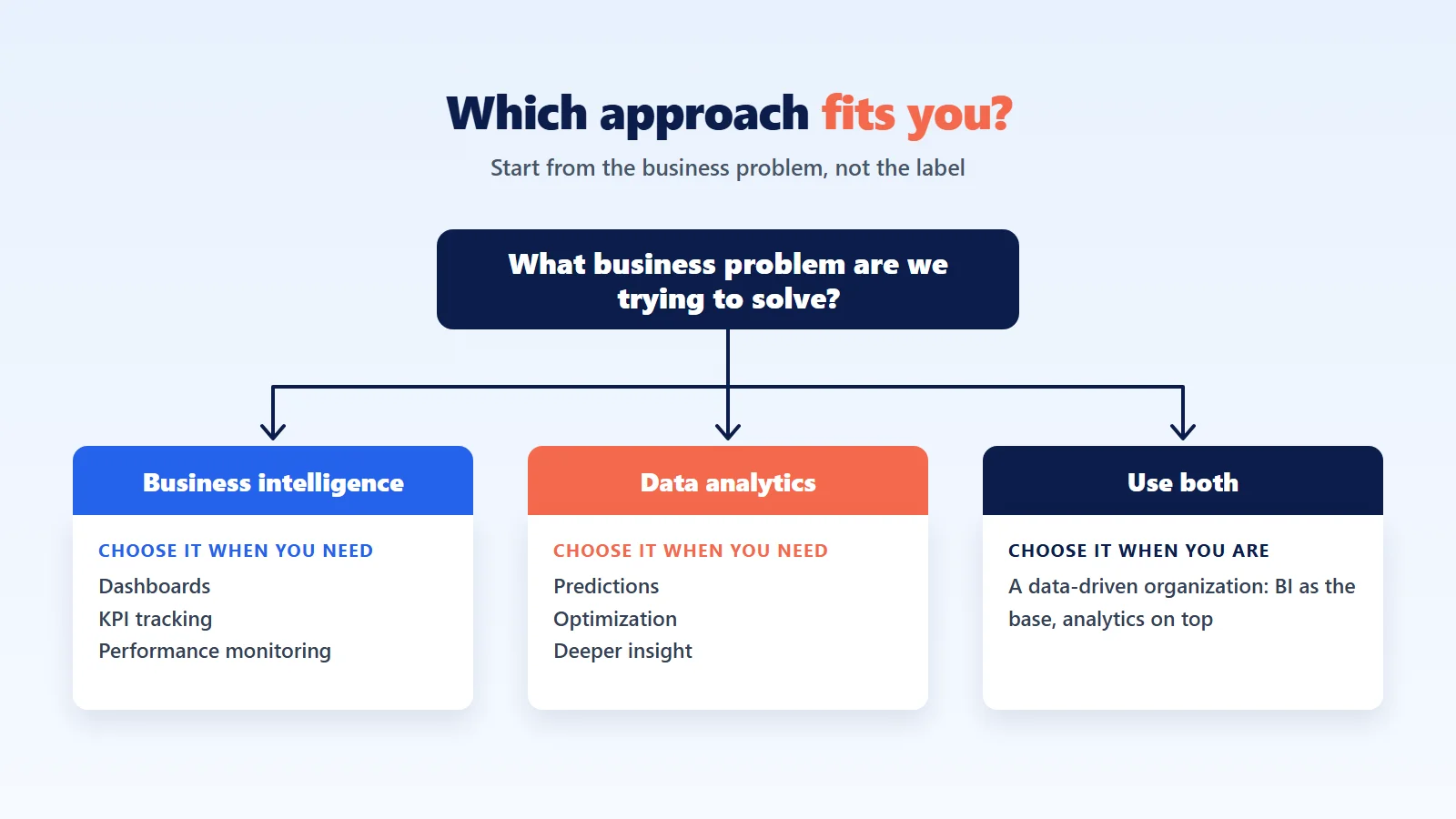
In the business intelligence vs data analytics decision, choose by the problem you need to solve, not by the label. If you need to see and monitor performance, start with BI. If you need to explain, predict or optimize, add analytics.
Choose
Business intelligence
when you need
✓ You need dashboards your teams trust
✓ You need KPI tracking across departments
✓ You need to monitor performance regularly
Choose
Data analytics
when you need
✓ You need predictions, such as demand or churn
✓ You need optimization, such as routes, pricing or stock
✓ You need deeper insight into why something changed
Use
Both
when you are
Building a data-driven organization, which is where most growing companies end up.
Figure 3: A simple way to choose the right approach, starting from the business problem.
Rule of thumb
A practical rule for business intelligence vs data analytics helps most teams: if you cannot answer "what happened last month?" in one minute with numbers everyone agrees on, fix BI first. If you can, and the next question is "why" or "what next", invest in analytics.
How Does Data-Driven Decision Making Help a Business?
Data-driven decision making means choosing actions based on evidence from your own data instead of habit or the loudest opinion. When BI and analytics work together, the business gets faster, calmer and more accurate decisions.
The benefits are practical:
01
Faster decisions
Because the numbers are already in one place.
02
Better customer understanding
Because you can see who buys, who leaves and why.
03
Improved efficiency
Because you find the slow or wasteful steps.
04
More accurate forecasting
Because models learn from your real history.
05
Reduced operational risk
Because you spot problems early.
06
Better resource planning
Because you know what demand is likely to be.
None of this happens automatically. Data-driven decision making is a habit as much as a technology. Teams need to look at the numbers on a regular schedule, agree on who acts on them and check afterwards whether the decision worked.
?
Ask yourself
Which three decisions in our business are made every week, and what data would make each one better?
How to Start: Six Practical Steps
Whichever side of business intelligence vs data analytics you start with, begin with one decision that matters, and grow from there. A focused first project proves the value and teaches your team what good data looks like.
1
Pick one business question
For example, "which customers are at risk of leaving?" or "why are returns rising?".
2
List the data you need
Note where it lives and who owns it.
3
Connect and clean it
Fix duplicates, missing fields and conflicting definitions first.
4
Build the BI view
Create one dashboard with a small set of KPIs and agree on how each is calculated.
5
Add analytics where the dashboard raises a question
Start with diagnosis, then try a simple prediction.
6
Measure and repeat
Track whether decisions improved, then move to the next question.
Common mistakes to avoid are building dozens of dashboards nobody uses, starting machine learning before the data is clean and measuring only the model, not the business result.
How Bangladesh Software Solution Helps Businesses Build Data-Driven Solutions
Bangladesh Software Solution helps businesses turn data into actionable intelligence, from first reports to predictive models. We combine business intelligence services, advanced analytics, AI and ML development and custom software development, so one team can build the whole path from data to decision, whichever side of business intelligence vs data analytics you need first.
Service 01
Business intelligence services and solutions
Our business intelligence services cover dashboards and reporting systems that give your teams a shared view of performance. Our data visualization services turn complex figures into charts and views that managers can read at a glance.
Service 02
Data analytics services
Our data analytics services cover customer analysis, operational insights, business trend analysis and predictive business insights. The goal is to explain what the numbers mean, not just display them.
Service 03
AI-powered analytics
For companies ready for the next step, we build predictive models, machine learning solutions and intelligent automation as artificial intelligence solutions trained on your own data.
Service 04
Integration with your systems
Data engineering pipelines bring scattered sources together. Our solutions connect with ERP, CRM, ecommerce platforms, databases and cloud systems, and custom software fills the gaps between them. After launch, we monitor results and improve the models and dashboards as your data grows.
If you are comparing business intelligence vs data analytics for your own company, start with the one decision you most want to improve and talk to us about the shortest path from your data to that decision.
FAQs
01
What is the difference between business intelligence and data analytics?
+
In the business intelligence vs data analytics question, business intelligence reports and visualizes what happened and what is happening now. Data analytics explains why it happened and predicts what may happen next. BI is built for monitoring, and analytics is built for discovery and prediction.
02
Is business intelligence part of data analytics?
+
They overlap. BI is often the reporting foundation, and analytics adds deeper analysis, prediction and recommendations. In many companies BI is the first step and analytics is the second.
03
Which is better for businesses: BI or data analytics?
+
Neither wins the business intelligence vs data analytics debate. Choose by the problem. Use BI to monitor performance, analytics for insight and prediction, and both when you are building a data-driven organization.
04
How does AI improve data analytics?
+
Machine learning finds patterns in large datasets, predicts outcomes and automates routine decisions faster than manual analysis. People should still review the important decisions.
05
Why do businesses need business intelligence solutions?
+
Business intelligence solutions bring scattered data into shared dashboards and reports, so teams track the same KPIs and act on the same trusted numbers instead of arguing about whose spreadsheet is right.
06
Do I need BI before I invest in predictive analytics?
+
Usually yes. Predictive models need clean, connected and trusted data, and a BI foundation gives you that. If your data is already reliable, you can start with a focused predictive project.
07
How can Bangladesh Software Solution help with data analytics projects?
+
Bangladesh Software Solution builds dashboards, analytics solutions and machine learning models, integrates them with your existing systems and improves them through monitoring. You can start with one focused question and grow from there.
Ready to turn your data into decisions?
Talk to the Bangladesh Software Solution team about business intelligence, data analytics and AI/ML development.