Bangladesh Software Solution is a global technology company delivering innovative software solutions and driving digital transformation across industries.
Bangladesh Software Solution is a global technology company delivering innovative software solutions and driving digital transformation across industries.
Dedicated Development Team vs Project-Based Development: How to Choose
Dedicated development team vs project-based development: compare cost, control, flexibility and risk, then use five questions to pick the one that fits your project.
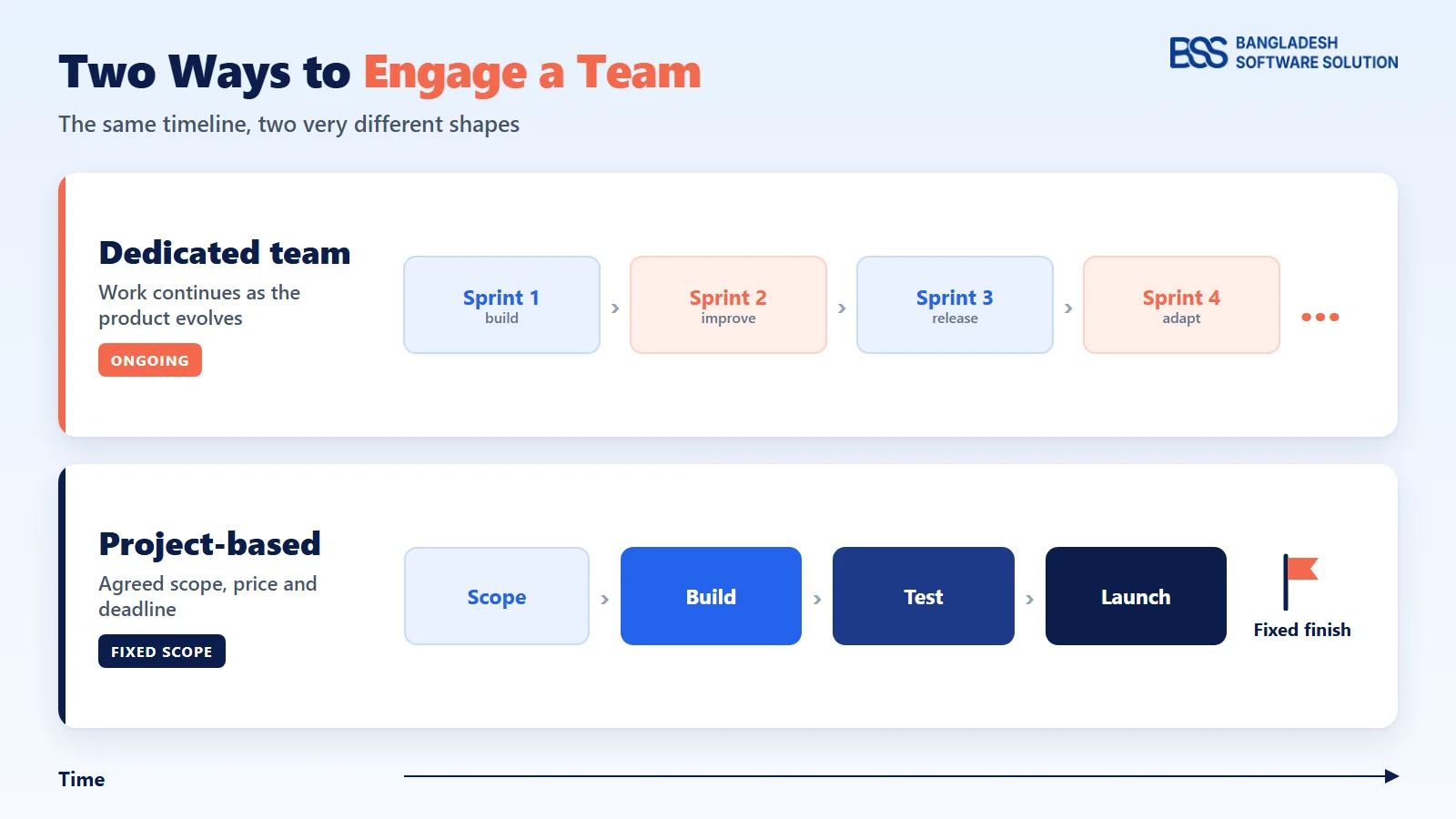
Figure 1: Two ways to engage a development team: ongoing and evolving, or defined and fixed.
Dedicated development team vs project-based development comes down to one question: do you know exactly what you are building? If the scope is fixed and the deadline is clear, project-based development usually fits. If the product will keep changing, a dedicated team usually does.
This guide compares the two models on cost, control, flexibility and risk, shows how each one fails and how to avoid it, and ends with five questions to help you decide. It is written for founders, product owners and IT managers who plan to outsource software development. Bangladesh Software Solution (BSS) is a software company headquartered in Dhaka, Bangladesh, with an office in Nieuwegein, the Netherlands. We offer both models, so we describe where each one works and where it does not.
What Is a Dedicated Development Team?
A dedicated development team is a group of developers, usually with QA engineers and other specialists, who work only on your product for an ongoing period and are typically paid on a recurring basis rather than per deliverable. This arrangement is often called the dedicated team model.
You set the priorities and the team does the work. The vendor handles hiring, equipment and day-to-day team administration, so you get the capacity of an in-house team without building one yourself. Because the same people stay on the product, they build up knowledge of your code and your users over time.
At BSS, the dedicated development team model comes in full-time, part-time and project-based options. The team works to your office schedule, and you can scale it up or down as the work changes.
How the dedicated team model works in practice
The dedicated team model usually starts with a short discovery call. You describe the product, the skills you need and your working hours. The vendor proposes a team, you meet the developers, and the first sprint is planned around your top priorities.
From then on, you run the roadmap. The team joins your planning and daily check-ins, uses your tools and reports progress the way an in-house team would. If priorities change, you re-order the work and you do not need a new contract for each change.
The model works best when you have a product owner who can answer questions quickly and a roadmap that is longer than a few months.
What Is Project-Based Development?
Project-based software development means a vendor agrees to deliver a defined scope for an agreed price and timeline, and takes responsibility for delivering it.
The work is planned before it starts: requirements are analysed, scope, cost, milestones and technology are fixed, and then the vendor designs, builds, tests and deploys. The BSS fixed-price project model follows this path in six steps: requirement analysis, scope and cost finalisation, UI/UX design, development, quality assurance, and deployment and delivery.
People often use “project-based” and “fixed-price” to mean the same thing, and this guide does too. Strictly, some project work is billed on time and materials, so confirm the billing method in any contract.
How project-based software development runs
A typical project follows clear phases: scope, design, build, test and launch. Each phase ends with something you can review, such as a signed-off specification, a design, a working build or a test report.
Because the scope is written down first, the quality of that document decides how smooth the project is. Spend time on requirements, acceptance criteria and what is out of scope. A clear brief is the cheapest way to avoid delays.
After launch, the contract normally ends. Bug fixes, hosting and new features are handled in a support agreement or a new project, so ask what happens after delivery before you sign.
Dedicated Team vs Project-Based: Side-by-Side
Dedicated development team vs project-based development: the short answer
Choose a dedicated team for work that will change and grow. Choose a project for work you can define fully today. If you are unsure, a small fixed-scope project first and a dedicated team afterwards is a common and safe path.
Cost, control and risk are the three things that separate the models most. Cost is steady for a team and fixed for a project. Control sits with you in a team and with the vendor in a project. Risk is shared differently, so read the contract with all three in mind.
In the dedicated development team vs project-based development comparison, the main differences are scope flexibility, who directs the work, and who carries the delivery risk. The table shows the typical pattern for each model. Contract terms vary by vendor.
Factor
Dedicated team
Project-based
Best for
Dedicated team
Evolving products and long roadmaps
Project-based
Defined scope, one-off builds, MVPs with a locked feature list
Scope
Dedicated team
Can change from sprint to sprint
Project-based
Agreed before work starts
Cost structure
Dedicated team
Recurring cost for the team
Project-based
Agreed price for the scope
Budget predictability
Dedicated team
Predictable per month; the total depends on how long you run the team
Project-based
Predictable in total, as long as the scope holds
Your control
Dedicated team
High: you direct the priorities
Project-based
Lower: the vendor manages delivery against the specification
Flexibility
Dedicated team
High: change direction and resize the team
Project-based
Lower: changes are usually re-scoped
Who carries delivery risk
Dedicated team
Shared; you steer the work
Project-based
Mostly the vendor, for the agreed scope
Effort from you
Dedicated team
Higher: someone must own priorities
Project-based
Lower: mainly reviews and sign-offs
Product knowledge
Dedicated team
Builds up inside the team over time
Project-based
Tends to end at handover
After launch
Dedicated team
The team continues
Project-based
Needs a separate support agreement
Key Fact
The biggest difference is who holds the risk. In a project, the vendor commits to an outcome for the agreed scope. With a dedicated team, you direct the work and decide when it is done.
How Does Cost Differ Between the Two Models?
Dedicated team vs fixed price comes down to the shape of the cost: project-based development gives you a known price for a known scope. A dedicated team gives you a known recurring cost for an open-ended scope. Neither is cheaper by default.
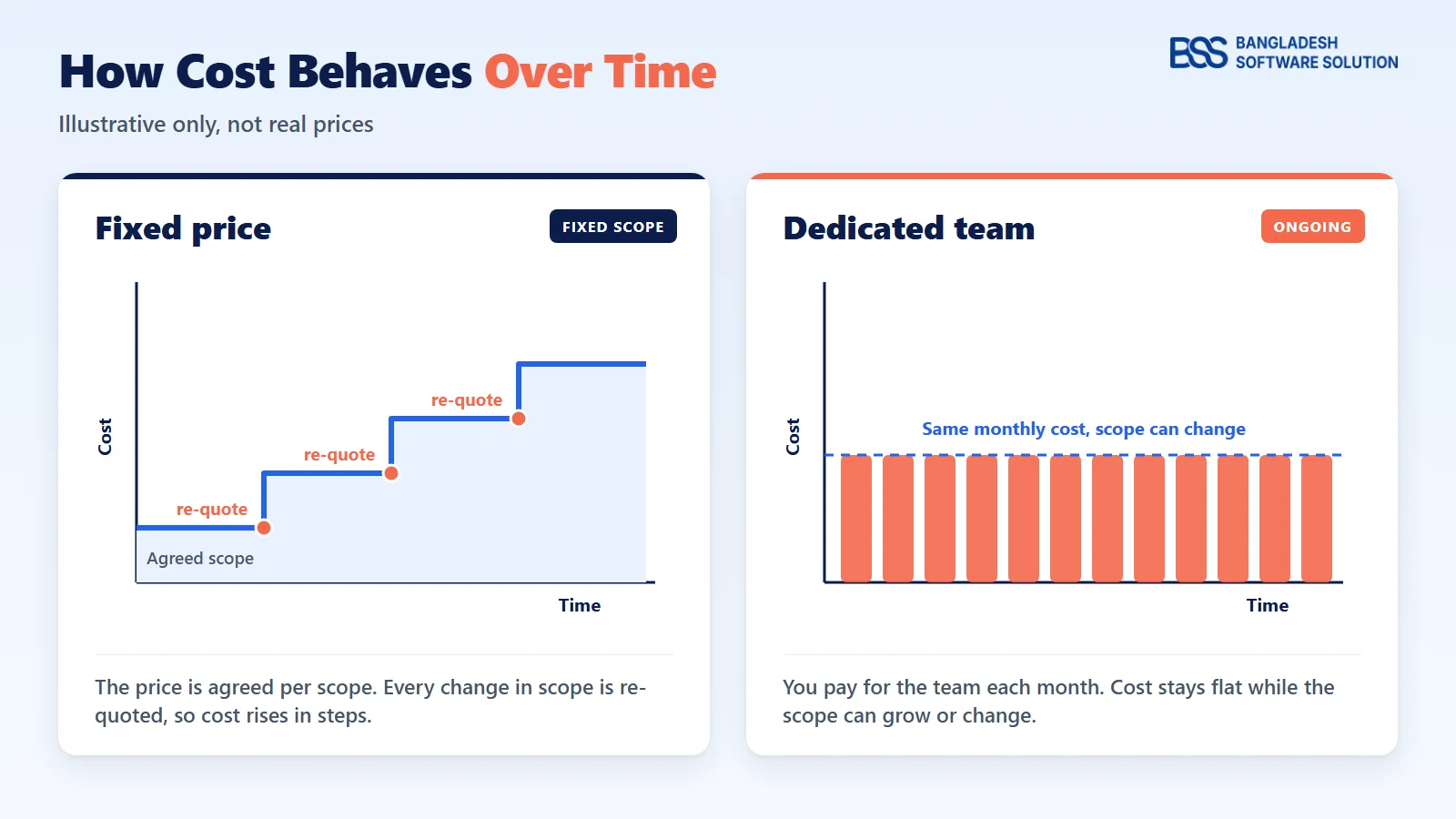
With a fixed price, the vendor builds some allowance for estimation risk into the quote. If you then change the scope, the change is typically re-quoted, so frequent changes make this model expensive and slow. With a dedicated team, you pay for capacity whether the backlog is full or thin. That is efficient while the team works on valuable features and wasteful when it waits for decisions.
As a rule of thumb in dedicated development team vs project-based development, short work with a clear specification costs less as a project. Long work that will change tends to cost less with a dedicated team, because you do not pay for a new estimate each time you change direction. This is the same idea behind the Agile Manifesto’s preference for responding to change over following a plan.
Dedicated team vs fixed price: what you actually pay for
With a fixed price you pay for a finished scope. The price is agreed up front, often in stages tied to milestones, and extra work is quoted separately. With a dedicated team you pay for capacity: a monthly cost for the people on your product, whatever they build that month.
That is why the two models feel different on the invoice. A fixed price is easier to budget for a single release. A monthly team cost is easier to compare with hiring in-house, and it stays flat while the scope grows. When you compare dedicated development team vs project-based development, add up the whole year, not only the first quote.
Figure 2: How cost behaves over time (illustrative, not real prices): a fixed price rises in steps when the scope changes, while a dedicated team stays steady each month.
Good to Remember
Compare what each price includes, not only the number. Check whether QA, project management, design, deployment and post-launch support are inside the price or extra.
When Is a Dedicated Team the Better Choice?
Choose a dedicated team when the product will keep evolving after launch, when user feedback will shape the next features, or when you need steady capacity that you cannot hire locally. This is the clearest case in the dedicated development team vs project-based development choice.
✓
The roadmap runs past launch: there is always a next release to build.
✓
Requirements will change: you expect to learn from users and adjust.
✓
You have a product owner: someone can decide priorities quickly.
✓
You want deep product knowledge: the same developers stay on your codebase.
✓
Your workload moves up and down: you need to resize the team without a new contract each time.
✓
Your in-house team is at capacity: hiring locally is slow or expensive.
When Is Project-Based Development the Better Choice?
Choose project-based development when you can describe the finished product in detail, the work is short to mid-term, and you want a fixed price and date without managing developers day to day. This is the other clear case in the dedicated development team vs project-based development choice.
✓
Requirements are well defined: you can write down what is in and what is out.
✓
The scope is stable: you do not expect major changes while it is being built.
✓
The budget is fixed: you need to know the total cost before you start.
✓
It is a one-off build: for example a website, an integration or an MVP with a locked feature list.
✓
You cannot manage developers daily: you prefer to review milestones and sign off.
Good to Remember
A clear scope is the condition for a fixed price, not a bonus. If you cannot say what “done” means, a fixed price tends to turn into arguments about change requests.
How Each Model Fails and How to Avoid It
In dedicated development team vs project-based development, each model has a typical way of going wrong, and each has a practical fix. Most failures come from a mismatch between the model and the project, not from the model itself.
Where a dedicated team goes wrong
✓
Paying for idle capacity: keep a prioritised backlog and review team utilisation every month.
✓
No one owns priorities: name one decision-maker on your side before the team starts.
✓
Knowledge leaves with people: require documentation and code reviews, and keep the repository in your own account.
✓
A poor fit with one person: ask to interview key members and agree on a replacement process in the contract.
Where a project goes wrong
✓
A vague specification: write acceptance criteria for every milestone.
✓
Change friction: agree on how change requests are estimated and approved before you sign.
✓
Surprises at the end: ask for demos at each milestone and access to the code throughout.
✓
A handover gap: require documentation, source code ownership and a support plan for after launch.
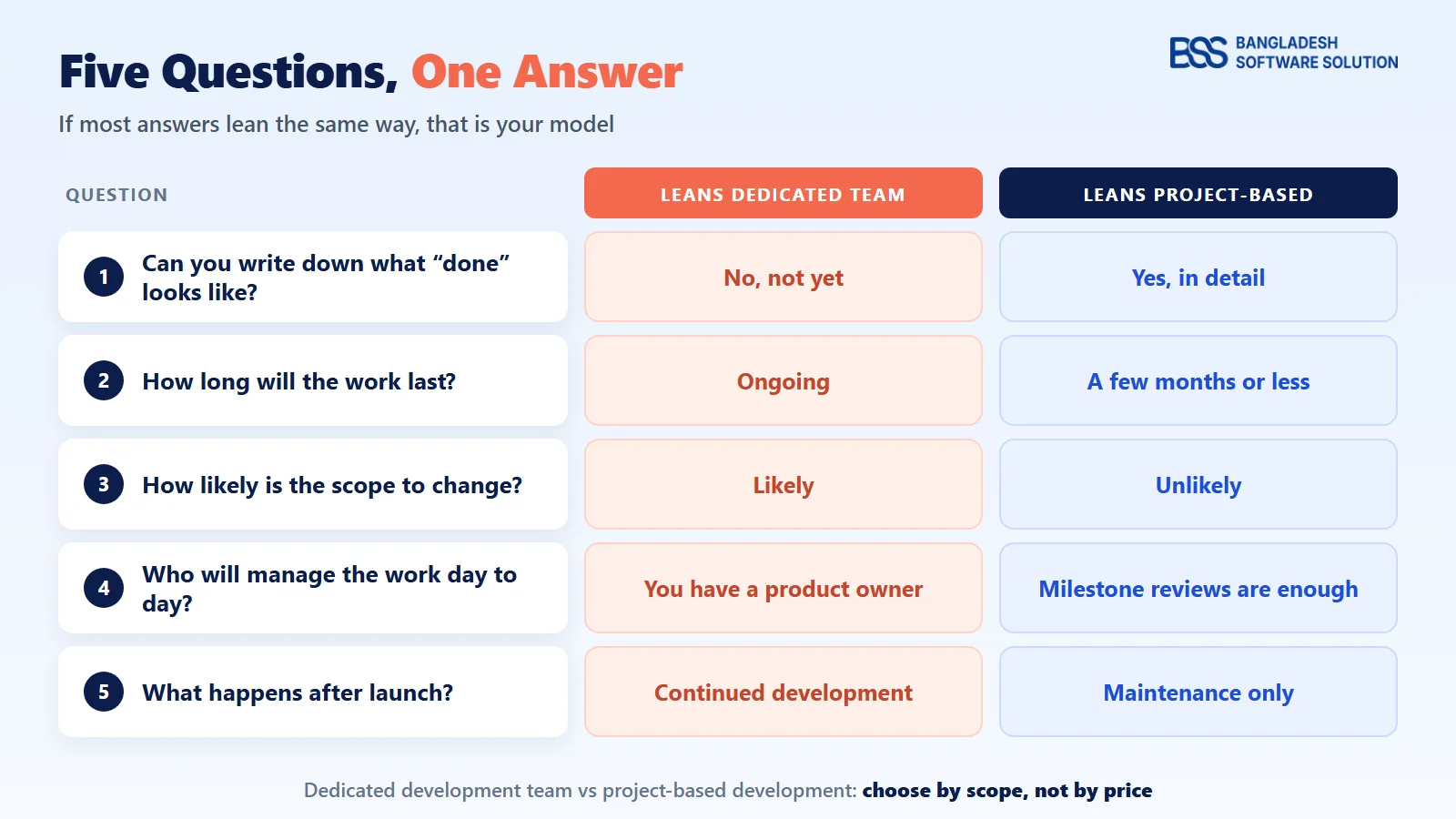
Answer these five questions in order to settle dedicated development team vs project-based development for your project. If most answers point the same way, that is your model.
1
Can you write down what “done” looks like? If yes, project-based fits. If no, lean towards a dedicated team.
2
How long will the work last? A few months or less leans towards a project. Ongoing work leans towards a dedicated team.
3
How likely is the scope to change? Unlikely favours a project. Likely favours a dedicated team.
4
Who will manage the work day to day? If you have a product owner with time, a dedicated team works. If not, a project with milestone reviews is easier.
5
What happens after launch? If you need continued development, plan for a dedicated team. If you only need maintenance, a project plus a support agreement can be enough.
Figure 3: The five questions as a scorecard: each answer leans towards a dedicated team or towards a project.
Important Question
If your requirements changed by a third halfway through the build, would you rather pay for a re-quote or simply reprioritise? Your answer usually points to the right model.
Can You Combine Both Models?
Yes. A common path is to build the first version as a fixed-scope project and then move to a dedicated team for the roadmap that follows. In practice, many teams treat dedicated development team vs project-based development as a sequence, not a one-time choice.
This works well when you need a first release with a known budget but expect to keep improving the product afterwards. It also lets you test the vendor on a defined piece of work before committing to a longer engagement. BSS offers MVP development for the first stage.
Plan the switch early. Ask the vendor to document the code, keep the repository in your own account and agree how the team will be formed when the project ends. A planned handover keeps the same knowledge in the room.
Discovery and scope
↓
Project-based build (fixed-scope first version)
↓
Launch and user feedback
↓
Dedicated team (ongoing roadmap)
Figure 4: A common hybrid path: a fixed-scope project first, then a dedicated team.
Whether you want to hire dedicated development team members or start a fixed-price project, BSS offers both, and we will tell you honestly which one fits your scope. That advice covers the dedicated development team vs project-based development question before you sign anything.
✓
Dedicated team: full-time, part-time or project-based teams that work to your office schedule and can be scaled up or down. Roles include frontend, backend, full-stack, DevOps and QA engineers.
✓
Fixed-price project: scope, cost, timeline and deliverables are agreed before development starts, and the price stays the same through the project.
✓
Where we work from: Dhaka, Bangladesh, with an office in Nieuwegein, the Netherlands.
What to check before you hire dedicated development team members
Before you hire dedicated development team members, check five things: who owns the code and the work, how the vendor replaces a developer who leaves, how you can scale the team up and down, how time zones and meetings will work, and what the monthly price includes. Ask for the answers in writing.
A good vendor answers these directly. If an answer is vague, treat it as a warning sign. In the dedicated development team vs project-based development decision, clear terms matter as much as the model itself.
What is the difference between a dedicated development team and project-based development?
+
A dedicated development team works only on your product for an ongoing period and follows your priorities. In project-based development a vendor delivers a defined scope for an agreed price and timeline. The first suits evolving products; the second suits work you can fully specify upfront. That is the core of dedicated development team vs project-based development.
02
Which is cheaper, a dedicated team or a fixed-price project?
+
Neither is cheaper by default. A fixed-price project is usually cheaper for a short, well-defined scope, which is why scope should come first in dedicated development team vs project-based development. A dedicated team usually costs less per feature on long, evolving products, because the team learns the product and you are not re-quoting every change. Compare what each price includes, such as QA, project management and support.
03
Is project-based development the same as fixed price?
+
In most conversations, yes. Project-based development usually means a fixed scope for a fixed price. Strictly, some project work is billed on time and materials, so confirm the billing method in the contract.
04
Can I switch from project-based to a dedicated team later?
+
Yes. A common path is to build the first version as a project and then move to a dedicated team for the roadmap that follows. To make the switch easy, keep the source code in your own repository and ask for documentation at handover.
05
How is a dedicated team different from staff augmentation?
+
Staff augmentation adds individual developers to your own team, and you manage them. A dedicated team is a group provided by the vendor and focused on your product, often with its own coordination. Which one fits depends on how much management you want to take on.
06
Do I need a project manager for a dedicated team?
+
You need someone on your side who sets priorities, usually a product owner. Whether the vendor also provides a project manager depends on the agreement, so ask about it before you sign.
Not sure whether a dedicated team or a fixed-price project fits?
Tell us about your scope, timeline and how much the plan may change, and the BSS team will suggest a model.